

Article
When Someone Else's AI Notetaker Joins Your Call
For marketing, events, communications and business development staff at large defense and space primes: four moments on a partner call when someone else's AI notetaker appears, and which public rules from a national laboratory, a state government, DoD and the ITAR text speak to each one.
Policy Ai Meetings Notetakers Cui Export Control Partners Defense Space
Who this is for: events, marketing, communications and business development staff at a large defense or space prime who host partner kickoffs. Your company allows AI only on a company account IT issues, or not at all, and company material stays out of public chatbots. If you work at a small contractor or startup, your labeled box sits after the common mistakes.
General information only: not legal advice, and not a security or export-control ruling. Whether an outside AI tool may stay on a call, and what happens to its files, is a decision for IT, your security office and your trade compliance team.
Teaching example: Invented Pellucan Avionics and everything that happens to it here are made up. No real prime, agency, launch partner, program or trade show is named.
The Tuesday kickoff
Invented Pellucan Avionics, an airborne sensor company, opens a 2 p.m. kickoff with the launch agency for next spring’s show. Eleven names are on the invite, two from the agency’s overseas office. A twelfth tile is already in the waiting room: the agency’s AI notetaker, with a banner that a summary will be emailed to all attendees. Fifteen minutes in, an engineer describes what the new sensor can see at range for the booth video. Nobody at Pellucan asked for the bot or knows where its recording lives. By 3 p.m. a summary of the call, accurate or not, sits in eleven inboxes, including two outside the United States.
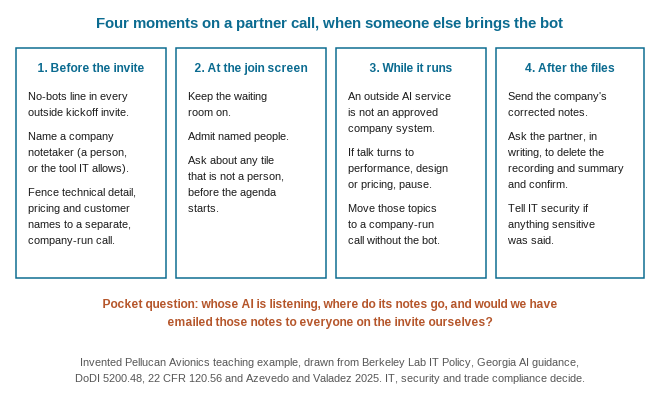
The harder case is not a request from your own staff for a company notetaker; at a prime, the company either bans AI meeting tools or allows only the one IT runs. It arrives when a launch agency, booth builder, trade-show partner or vendor brings its own AI notetaker into the waiting room. The question to keep in your pocket: whose AI is listening, where do its notes go, and would we have emailed those notes to everyone on the invite ourselves?
Two of the sources quoted below are public rules a national laboratory and a state government wrote for their own staff; they appear only as examples of what a written meeting-bot rule can look like, and they bind no one outside those two employers. Personal AI accounts and government systems covers why a personal or outside AI account is a different question from a company tool.
Few written policies mention a meeting bot
In their 2025 Impacting Education article, Paula Cristina R. Azevedo and Christine B. Valadez report that “Of the 122 with AI policies, eight member institutions discussed AI meeting assistants or had specific policies,” after searching, in March 2024, the websites of all 135 member institutions of one education-doctorate consortium (CPED), of which 122 had AI policies or guidelines publicly available. That figure is about those university web pages in that month, not about companies, primes or government. The article is licensed CC BY 4.0; the quotations here are unchanged excerpts.
Our reading: if your company policy says “AI tools” but never mentions a bot that joins a call, check whether it covers this case.
Moment 1: before the invite
The same study describes how these tools work. “The user does not have to attend the meeting for the AI meeting assistant to attend.” When the tool is linked to a calendar, “it recognizes video conference meetings and automatically joins and records the meeting.” Two of the eight universities point out that “registering for the tool gives meeting assistants the right to access meetings just because the bot-owner is invited, even when the human does not attend the meeting and without the knowledge or consent of participants.”
Our reading: the partner’s bot is coming because the partner’s calendar has your invite.
Company-policy framing: put a line in every outside-partner kickoff invite: “Please do not bring AI notetakers or recording bots. We will share notes.” The host names a company notetaker, a person or the approved tool if IT allows one. Technical detail, pricing and customer names go on a separate agenda, for a company-run call.
Moment 2: at the join screen
As an example only, and only as a rule that binds the lab’s own staff, Lawrence Berkeley National Laboratory’s IT Policy guidance (a DOE national laboratory page, accessed November 16, 2026) says its employees “are not permitted to use third-party AI bots” in the lab’s video meetings. It lists why: “AI bots appear as additional meeting participants, making it difficult for hosts to obtain explicit consent from all attendees regarding the AI services being utilized.”; “Multiple AI bots can join a single meeting, leading to disruptions and complicating the host’s ability to control the meeting environment effectively.”; and “The presence of third-party bots can pose risks to confidential discussions, as data handling policies may vary between AI service providers.”
As a second example, Georgia’s guidance for state organizations (accessed November 16, 2026), which binds only Georgia state entities and their employees, says “Meeting hosts must be diligent when admitting participants to virtual meetings to ensure no AI bot note-takers join.” The same page, still only for those state entities and employees, says “Prior authorization from GTA is required for any generative AI tools intended for regular organizational usage, including but not limited to AI-driven transcription, summarization, note-taking, or decision-making assistance.”
Our reading: a host at a prime can do what both ask of their own hosts: keep the waiting room on, admit named people, and ask about any tile that is not a person. This article does not tell you which button to press.
Moment 3: while it runs
DoD Instruction 5200.48, “Controlled Unclassified Information (CUI),” effective March 6, 2020 and cleared for public release, says “DoD personnel will not use unofficial or personal (e.g., .net; .com) e-mail accounts, messaging systems, or other non-DoD information systems, except approved or authorized government contractor systems, to conduct official business involving CUI.” In a paragraph that opens “This paragraph highlights requirements for DoD contractors,” it says “Whenever the DoD provides CUI to, or CUI is generated by, non-DoD entities, protective measures and dissemination controls, including those directed by relevant law, regulation, or government-wide policy, will be articulated in the contract, grant, or other legal agreement, as appropriate.” It also notes that unauthorized disclosure of certain CUI, “such as export controlled-technical data, may also result in potential civil and criminal sanctions against responsible persons.” The instruction governs DoD and reaches contractors through their contracts. This article cites it as effective March 6, 2020 and does not call it current.
Under 22 CFR 120.56, technical data is released through, among other ways, “Oral or written exchanges with foreign persons of technical data in the United States or abroad,” and the eCFR copy is displayed as up to date as of 11/12/2026, so whether anything on a given call is technical data is trade compliance’s call. Treat the AI question as a release question is the place to start that conversation.
Our reading: an outside party’s AI service is not a system your company approved, and its summary may go to everyone on the invite. If the call drifts toward performance, design or pricing, pause and move it to a company-run call without the bot. Do not treat this article as a finding that any call “was an export” or “was a CUI violation.” Ask trade compliance, and ask the security office.
Moment 4: after the files exist
Berkeley Lab’s guidance, binding only its own staff, warns that AI summaries can “omit details and introduce inaccuracies” and “can be automatically saved and emailed to participants,” and says those summaries “should be reviewed before being shared.” It also says its staff must not use AI transcription or meeting summary features “when handling sensitive, proprietary, or personally identifiable information (PII) unless explicitly approved by IT Policy.” Georgia’s guidance, which binds only its own state bodies, says “Once created, meeting recordings and transcriptions become public records and are subject to retention rules,” and that “Meeting hosts are responsible for determining the need for recordings and automated transcriptions and keeping any records created.” On the eight university sites that addressed meeting assistants, “Privacy, confidentiality, and data security concerns are mentioned in all eight of the sites referencing AI meeting assistants,” and “security itself is mentioned in five of them.”
Our reading: when a partner’s bot did record, three things happen the same day: the company’s notetaker sends the corrected notes, someone asks the partner in writing to delete the recording and summary and to confirm, and IT security hears about it if anything sensitive was said. A partner’s summary of your call is still about your company. For the copies your company keeps, see Put meeting recordings, transcripts and AI notes on your retention schedule.
Ask trade compliance, once, whether an outside party’s transcript of a call where technical data came up raises a release question, and write the answer down so the next host does not have to guess.
What about accessibility?
The Berkeley Lab page, again only for its own staff, notes that “some staff may rely on transcription tools due to accessibility needs” and routes them to a supported path. Our reading: the answer to “no outside bots” is a company-run captioning or transcription option, not “no captions.” Ask HR and IT what that option is before the first partner call, and put it on the same card as the no-bots invite line.
Common mistakes
- Admitting the tile and asking later. Ask whose it is before the agenda starts.
- Treating “AI tools” in the company policy as enough. Check whether a bot that joins a call is actually covered.
- Letting the call drift into performance or pricing. Move those topics to a company-run call without the bot.
- Leaving the emailed summary in eleven inboxes. Correct the notes, ask for deletion in writing, and tell IT security if anything sensitive was said.
Small contractors and startups. No IT department? One person owns the meeting rule. Put the no-bots line in every outside invite, keep the waiting room on, name a human notetaker, and keep technical detail and pricing off any call an outside tool is recording. If your contracts carry CUI or export-control terms, those terms decide; read them first.
Related
Related reading: personal AI accounts and government systems, treat the AI question as a release question, record what an AI tool keeps before capture work goes in, and find out what is under an AI marketing tool before you buy.
Limits
These sources are two institutional guidance pages written for their own staff, one DoD issuance, one regulation definition and one study of university web pages. None measures how often outside notetakers record defense marketing calls or how often their summaries go wrong, so this article makes no such claim. IT, the security office and trade compliance decide what happens to the tool and its files.
Sources
- Lawrence Berkeley National Laboratory, IT Policy, "Guidance on Using Generative AI tools" (undated web page; accessed November 16, 2026)
- State of Georgia, Office of Artificial Intelligence (Georgia Technology Authority with the AI Council), "Guidance for State Organizations" (undated web page; accessed November 16, 2026)
- DoD Instruction 5200.48, "Controlled Unclassified Information (CUI)," effective March 6, 2020; cleared for public release
- 22 CFR 120.56, "Release" (ITAR), eCFR text, displayed as up to date as of 11/12/2026
- Paula Cristina R. Azevedo and Christine B. Valadez, "If Ferris Bueller Had a Bot: AI Meeting Assistant Policy Landscape of CPED Member Institutions," Impacting Education 10(1), 2025, licensed CC BY 4.0
- Adapted from AssociationAI, "A Director Wants an AI Notetaker on the Next Board Call"