

Article
Your Release Review Already Answers Most of the AI Question
For marketing, events and BD staff at large defense and space primes: before anything goes into the company AI account, sort it by release status. Three lanes built on the DFARS disclosure clause, NARA's CUI training text and the ITAR definition of export.
Policy Ai Policy Release Review Cui Export Control Defense Space
Who this is for: people in marketing, events and business development at a big defense or space prime, where AI is either banned or allowed only through a company account, and where contracts, security and trade compliance already decide what leaves the building. You don’t write the AI policy or make release calls. This post shows how the release rules you already follow can sort your files before anyone opens an AI tool. Small contractors and startups get a labeled box near the end.
This is general information, not legal or export-control advice. Your contracts, security and trade compliance teams decide what may be released.
Teaching example: Invented Tollerwyn Defense Systems and its files are made up. No real company, program, contract or agency is described.
The question in front of the coordinator
Picture an events coordinator at a prime. The company AI account is open in one window. In the other is a folder of material for next month’s show. Her manager wants the booth copy tightened by Friday.
The tempting question is “is AI safe to use here?” It has no single answer. A better question sits underneath it, and the company has been asking it for years: has this already been released, and who said so?
Most of the AI question at a prime has already been answered somewhere else in the building, under a different name: release.
Three release lines your company already follows
Contract information. The DFARS disclosure clause, DFARS 252.204-7000 (the version dated OCT 2016), says the contractor “shall not release to anyone outside the Contractor’s organization any unclassified information” that pertains “to any part of this contract or any program related to this contract.” There are exceptions. One is when “The Contracting Officer has given prior written approval.” Another is when “The information is otherwise in the public domain before the date of release.”
The clause also says how to ask. A request must “identify the specific information to be released, the medium to be used, and the purpose for the release,” and under DFARS 252.204-7000 it goes to the contracting officer at least ten business days before the planned release date.
Notice the word unclassified. Unclassified is not the same as releasable. The disclosure clause covers unclassified information about the contract, which is exactly the kind of material that ends up in marketing folders.
Controlled Unclassified Information. The National Archives’ CUI Overview training text describes CUI as “sensitive information that requires protection under laws, regulations and Government-wide policies.” It is marked on its face: “A banner heading must appear at the top of each page of documents containing CUI,” carrying the word CONTROLLED or CUI, and in email “Banner Markings must appear above the email text containing CUI.” Electronically, “barriers should exist that limit access to only those with a Lawful Government Purpose,” such as “Dedicated network drives, file folders, or intranet sites.”
The same text lists “Unauthorized release of CUI (to public facing websites or to unauthorized individuals)” as an incident, and says “Incidents involving CUI must be immediately reported.” That training was written for agencies and their partners; your company’s security procedures are what you follow.
Technical data. The ITAR definition of export, read in 22 CFR 120.50 on eCFR (displayed as up to date as of 11/09/2026), covers more than shipping something abroad. It includes “Releasing or otherwise transferring technical data to a foreign person in the United States (a deemed export).” And “Any release in the United States of technical data to a foreign person is deemed to be an export to all countries in which the foreign person has held or holds citizenship or holds permanent residency.” Marketing does not decide what counts as technical data. Trade compliance does.
The dividend
This part is our reading, not a rule from any of the three sources.
Each of those lines already tells you what may leave the company and how. An outside AI service sits outside the company, so the same sorting applies to it. Whether your company’s approved AI account counts as inside for any of these purposes is a question for contracts, security and trade compliance, not for marketing.
Once they answer it, the team gets speed back: released material moves now, inside the approved account, and nobody reopens the AI debate for every file.
Three release lanes
The lane names are our teaching choice.
- Released. Already public, with a known release behind it: the published press release, approved website copy, a public datasheet. This is the only lane that may go into the company-approved AI account, and only as public text. The clause’s public domain exception is the closest anchor; the rest is our framing.
- In review. Drafts that describe a contract or program and are waiting on approval, plus anything nobody has ruled on yet. Nothing in this lane goes into any AI tool. Work in the approved system and let the release request run.
- Not ours to release. Anything with a CUI banner, anything trade compliance flags as technical data, and material the customer gave you. Never into any AI tool. If one of these is sitting in a shared marketing folder, report where you found it under company procedure. Don’t move it, relabel it or clean it up yourself.
If a file carries a CUI banner, it is not a marketing decision.
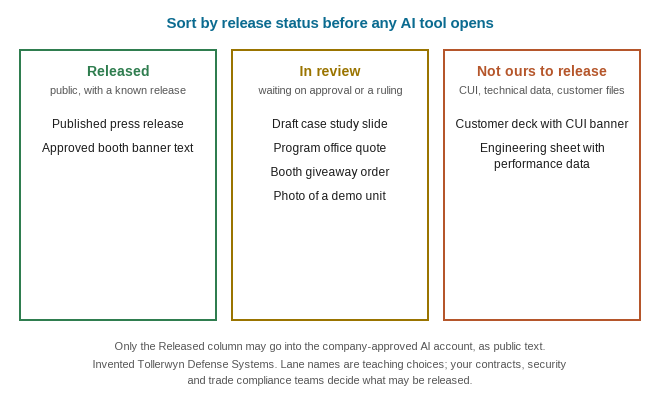
Worked example: the Tollerwyn folder
Invented Tollerwyn Defense Systems’ events team sorts eight files before a show.
| File | Lane | Why |
|---|---|---|
| Published press release | Released | Already public, with a known release |
| Approved booth banner text | Released | Cleared for public display |
| Draft case study slide about an awarded program | In review | Describes a contract; needs written approval |
| Quote from a program office for the case study | In review | Same request as the slide |
| Booth giveaway order | In review | Internal; waits until company AI policy says files like this may go in |
| Photo of a demo unit on the bench | In review | Ask trade compliance before it goes anywhere |
| Customer briefing deck with a CUI banner | Not ours to release | Marked CUI; report where it was found |
| Engineering sheet with performance data | Not ours to release | Possible technical data; trade compliance decides |
Two of eight files can go into the approved AI account today. That is enough to tighten the booth copy this afternoon, while the case study request goes to contracts with the information, medium and purpose named.
Small contractors and startups. No security office, and maybe no written AI policy? The three lanes still work. If you are a subcontractor, the clause has to flow down to you: the prime must “include a similar requirement, including this paragraph (c), in each subcontract,” and “Subcontractors shall submit requests for authorization to release through the prime contractor to the Contracting Officer.” So the person to ask is often your prime’s contracts contact (our reading; check your subcontract). If you use any AI tool, put only Released text in it, and decide in writing which company account that is.
Common mistakes
- Reading unclassified as free to share. The disclosure clause reaches unclassified contract information.
- Treating decontrolled as public. Even the government keeps these apart: NARA’s text says “Decontrolled CUI is still subject to the release procedures of your agency.”
- Assuming anyone in the United States can see anything. A release of technical data to a foreign person here can be a deemed export. Send the question to trade compliance.
- Fixing a misplaced CUI file. Report it instead, and “follow your agency policy and procedures regarding how to report,” which for a contractor means your company’s procedure.
- Asking “can we use this?” Ask for release the way contracts asks: name the information, the medium and the purpose, and leave time.
Related
For the tool side of the same problem, read protect prospect data and capture work in AI tools. For which account a tool runs under, see personal AI accounts and government systems. To plan how a lead export becomes a map without moving the data, try turn a show lead export into an ontology.
Limits
The DFARS clause binds contractors whose contracts include it. NARA’s slide text is agency training. We cite only the ITAR definition of export, not its exemptions. None of this decides whether any real file may be released. The habit to keep: stop asking whether AI is allowed, and start asking whether this is released.
Sources
- DFARS 252.204-7000, Disclosure of Information (OCT 2016), Acquisition.gov
- National Archives, Information Security Oversight Office, "CUI Overview" slide text (training transcript)
- 22 CFR 120.50, Export (ITAR), as displayed on eCFR, up to date as of 11/09/2026
- Adapted from FOUNDINT.AI, "The Trust Dividend: Why Data Privacy Is Your AI Adoption Strategy"