

Article
Personal AI Accounts Don't Belong on Government Systems: A Small-Contractor Rule Sheet
For small defense contractors without a written AI rule: why a personal AI subscription sits outside every control your customer and contract rely on, what WIRED has reported (and Accenture disputes) about one case, how CUI rules and the DFARS 72-hour reporting clock reach you, and a one-page rule you can adopt this week.
ADSEC Ai Policy Govcon Cui Small Business Defense Space
Small-contractor track. This article is written for small defense and space firms: the ten- or forty-person shop that supports a program, often has no written AI policy, and has one person who handles IT, security and contracts between other jobs. If you work at a large prime with a long AI policy already in force, most of this will be familiar.
The gap: whose account is the tool signed in to?
Our framing, not a sourced finding: large primes tend to allow AI tools only on company accounts, inside company systems, with someone watching the logs. Small contractors often have no written rule at all. People reach for whatever makes the work go faster, and the fastest thing to hand is frequently a personal subscription paid for on a personal card.
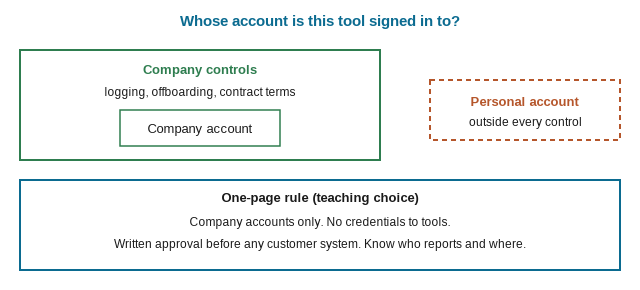
That is the gap this article is about. A personal AI account is outside every control your customer and your contract rely on. Your company can’t see its logs. It can’t shut the account off when someone leaves. It never signed the terms the tool runs under. And nobody at your firm may have asked the one question that matters before a tool goes near a customer system.
The pocket question: whose account is this tool signed in to, and whose system can it reach?
What WIRED has reported, and what Accenture says
One recent report shows why the question matters. WIRED reported, citing unnamed sources, that a contractor ended up “connecting a secure centralized system used by multiple intelligence agencies to their personal account for Claude Code.” According to those sources, the agent “ran on the DOD network for two months before it was identified and the vulnerability could be patched,” and one source told WIRED that “the contractor gave their login credentials to the Claude agent.” WIRED also reported that “There’s no indication that hackers were able to get into a classified or top-secret system.” Accenture, which WIRED’s report names, disputes the account. It told WIRED, “These allegations were thoroughly and independently investigated and found to be without merit.” The Department of Defense told WIRED that “the Department does not comment on the status of its networks or systems.”
We don’t know more than that, and we aren’t adding to it. The account rests on unnamed sources, the company named in it denies the allegations, and the Department gave WIRED no comment on its systems. The lesson below doesn’t depend on whether any of it happened. It depends on a pattern any small firm can check for today.
Why a personal account is the problem
Here is our framing, not a finding from any source cited here. When a tool runs under a company account, the company holds the controls. It decides which tools are approved, sees what they connect to, revokes access when a person changes roles, and can answer a customer who asks what happened. When the same tool runs under a personal account, every one of those controls belongs to an individual and a vendor your company has no agreement with.
An AI agent raises the stakes because it doesn’t just answer questions. Coding agents can read files, run commands and keep working while their owner does something else. Hand one a login, and it acts with that login’s access. If the login reaches a customer system, so does the agent, and so does whatever the agent’s account is set up to keep.
Small firms are not careless by nature. They are short on people. The person who would write the rule is also running the program, chasing an invoice and answering the customer. A one-page rule is the cheapest control you will ever adopt, and the one most small shops skip.
CUI reaches you through the contract
If your firm handles Controlled Unclassified Information (CUI), the federal rules on it apply to you even though they are written for agencies. The CUI regulation at 32 CFR Part 2002 says so directly: “This part does not apply directly to non-executive branch entities, but it does apply indirectly to non-executive branch CUI recipients.” In practice, the obligations arrive through your contract and the agreements that come with it.
The same regulation defines an unauthorized disclosure as one that “occurs when an authorized holder of CUI intentionally or unintentionally discloses CUI without a lawful Government purpose.” Note the word unintentionally. A staffer who pastes CUI into a personal tool to save an hour isn’t acting in bad faith, and the definition still covers what happened.
We aren’t saying that using a personal AI account is, by itself, a violation of this regulation. Neither the regulation nor the clause below mentions AI. We are saying that a personal account makes it hard to show where CUI went, and that is a question you want to be able to answer.
Know your reporting clock before you need it
Some DoD contracts include DFARS 252.204-7012, the clause on safeguarding covered defense information and reporting cyber incidents. Where it’s in your contract, it sets a short clock. The clause defines the term this way: ““Rapidly report” means within 72 hours of discovery of any cyber incident.” It also tells contractors where reports go: “Rapidly report cyber incidents to DoD at https://dibnet.dod.mil.”
The clause sets its own scope, and we aren’t restating or extending it here. Read your contract to see whether the clause is included and what it covers for you, and ask counsel if you aren’t sure. The practical point is simpler: if the clause applies and something goes wrong, 72 hours is not long. A small firm should know before any incident who decides whether to report, who files, and whether they can get into the reporting site.
The one-page rule
The rule below is our teaching choice, not a requirement from any source cited here. Adapt it to your contracts and get counsel to read it before you adopt it.
Illustrative example: “Invented Machining Co.” is invented. No real company or person is described.
Invented Machining Co. has 22 employees and supports two DoD programs. Its owner wrote the rule below on one page and had everyone sign it at the next staff meeting.
- Company accounts only. AI tools are used only on accounts the company owns and can turn off. No personal subscriptions for company work, even free ones.
- No credentials to tools. Nobody gives an AI tool their username, password, token or key for any system. If a tool needs access, the person who owns that system decides how.
- Written approval before any customer system. No AI tool connects to, reads from or runs on a customer or government system without written approval from the customer’s authorized contact.
- No CUI into AI tools without approval. If you aren’t sure whether something is CUI, treat it as CUI and ask.
- Know who reports and where. The rule names one person who decides whether an event is reportable, one backup, and confirms both can reach the reporting site.
- Ask the pocket question out loud. Before connecting anything, someone says whose account the tool is on and whose system it can reach.
At Invented Machining Co., the hardest line was the first. Two engineers had paid for their own coding assistants. The owner moved both to company accounts, paid for them, and kept the bill. It was cheaper than one bad week.
Limits
WIRED’s report rests on unnamed sources, and Accenture says the allegations were investigated and found to be without merit. The Department of Defense gave WIRED no comment on the status of its systems. The regulation and the DFARS clause are general rules; neither mentions AI tools, and we aren’t claiming either one makes personal accounts unlawful. Whether DFARS 252.204-7012 applies to you depends on your contract. The one-page rule is a teaching choice, not legal advice. Your contracts, your customer’s instructions and your counsel come first.
Sources
- Vittoria Elliott, A Defense Contractor Gave Their Personal AI Agent Access to a Secure Pentagon System, WIRED (October 29, 2026)
- 32 CFR Part 2002, Controlled Unclassified Information (eCFR, current)
- DFARS 252.204-7012, Safeguarding Covered Defense Information and Cyber Incident Reporting (acquisition.gov)