

Tutorial
Find Out What Is Under an AI Marketing Tool Before Your Company Buys It
For marketing teams at large defense and space primes: before any AI tool trial starts, write down nine answers, from how the offer reached you to the model underneath, where it runs, who controls it and how your data comes back, then send only complete records to IT security and supply chain.
Time needed: About an hour to fill in the record for a handful of tools; vendor answers and reviews take as long as they take
Before you start:
- A list of the AI tools your marketing team wants to try, and how each offer reached you
- The names of your IT security, supply chain, trade compliance, contracts and procurement contacts
- Your company's rules for AI tools, company accounts and vendor contact
Policy Ai Supply Chain Procurement Phishing Vendor Review Security Defense Space
Who this is for: marketing teams at big defense and space primes that keep hearing about AI tools for captions, graphics, lead scoring and press drafts. At your company AI tools arrive only through IT and procurement, on company accounts. Company IP stays out of outside chatbots, the mail system holds suspicious messages, nobody opens unknown links or booth QR codes, and supply chain and IT security vet every new supplier. If you work at a small contractor or startup with no AI policy, your labeled box sits near the end, after the common mistakes.
This is general information, not legal, security, supply chain or export-control advice. Your IT security, supply chain, trade compliance and contracts teams decide which tools the company buys and what goes into them.
Teaching example: Invented Ystrawick Space Systems and its “Sample AI tool intake record (invented)” are made up. The eight tools are generic labels, not real products, and no real vendor, model provider, prime, show or agency is described.
Three offers and no answers
Invented Ystrawick Space Systems makes satellite ground equipment. A lead-scoring add-on looked sharp at the show booth, and the rep left a QR code. A week later an email invites the marketing team to a free trial of a proposal-graphics generator. A colleague has already signed up for a caption writer with a work email.
When supply chain asks which model does the work in any of them, where it runs and who owns the company that runs it, the honest answer is “we did not ask.”
The AssociationAI original behind this post asks whether an AI vendor adds anything beyond a model it rents. A defense marketing team asks a different question, and price has nothing to do with it. If a tool runs on someone else’s model, that model’s provider is a supplier behind your supplier, and your customer’s supply chain expectations reach it. A tool that rents its model has two suppliers, and only one of them came to the booth. The question to carry: who is behind the vendor, and did anyone check before we started?
For what a platform is built from, see our 10/31 tutorial on proprietary platform claims. How long a tool keeps your inputs, and whether it learns from them, is covered in our 11/04 tutorial. This tutorial covers who is in the chain, and it ends in a record you can hand to IT security and supply chain. Once a tool is approved, our 11/18 article on asking your web analytics questions covers using it.
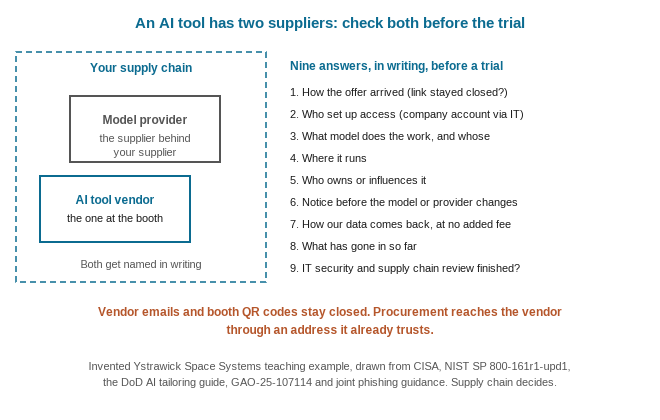
The nine answers
The order of the answers and the lab’s rules are our teaching choices. Where your IT security, supply chain, trade compliance or contracts team works differently, follow them. Every vendor answer goes in writing, through procurement.
-
How did the offer reach you? The joint phishing guidance from CISA, NSA, FBI and MS-ISAC (October 2023) warns that “Malicious actors pose as trustworthy sources (e.g., colleagues, acquaintances, or organizations) to lure victims into providing their login credentials.” It recommends teaching staff to spot suspicious messages, “not interacting with those suspicious items,” and reporting any link or email someone did open. It also describes mail systems where, “If an email fails the check, it is deemed a spoofed email address, and the mail system will quarantine and report it as malicious.” Company-policy framing: the trial invite and the booth QR code stay closed. Write down how the offer arrived before you write down what it costs, and let procurement reach the vendor through an address it already trusts. If someone already opened the link, report it to security today.
-
Who set up access? Company-policy framing: a company account set up by IT, or nothing. A trial someone opened on a work email gets moved to a company account or closed. A personal account is a stop, because it sits outside everything IT can see or shut off.
-
What model does the work? The CISA Software Acquisition Guide (August 2024) opens by noting that “Technology acquisitions are challenged by the level of transparency provided by suppliers of software and cyber-physical devices relative to their development and third-party management practices.” Among its supplier questions: “Does the supplier maintain provenance data for internal and third-party components?” NIST SP 800-161r1-upd1 ties supply chain risk to “an enterprise’s decreased visibility into and understanding of how the technology they acquire is developed, integrated, and deployed,” and says outsourcing “reduces the acquirer’s visibility into and control of the outsourced functions.” The DoD AI Cybersecurity Risk Management Tailoring Guide, Version 2 (14 July 2025), says “there are unique threats around acquiring AI systems,” including “purchasing compromised commercial solutions, or utilizing vulnerable cloud or vendor architectures.” Scope: the CISA guide gives “recommendations for agency personnel,” NIST writes for federal agencies, and the DoD guide calls its content “tailoring guidance and best practices” for DoD organizations. None of them binds your company directly. Our reading: a tool that sends your text to another company’s model has made that company part of your supply chain. Get the model and its provider named in writing. If the vendor will not name the model, the review has nothing to review.
-
Where does it run, and who owns or influences it? NIST’s table of supply chain risk factors includes “Foreign control of or influence over the source,” with examples such as foreign ownership and the legal regime where the source operates, along with “Provenance and pedigree of components” and “Supply chain relationships and locations.” Marketing records the vendor’s written answers: the hosting region and the ownership disclosure. Supply chain and trade compliance decide what those answers mean.
-
Will they warn you before the model changes? The CISA guide asks: “Does the supplier notify users of the impending end of software support and the date of software end-of-life?” Our reading: for an AI tool, a swapped model or provider is the closest thing to that moment. A new model under the same logo is a new supplier, so ask for written notice before it happens.
-
How was the tool itself built? (optional, for IT security) The CISA guide asks whether the supplier enforces policies on “AI generated code, and AI powered toolchains,” and whether the product depends on “AI generated source code or libraries.” It notes that generative AI and LLMs “share a common attribute of indeterminant transparency for code generation, testing, and release criteria” (the guide’s own spelling). It also asks: “has the supplier received a successful third-party FedRAMP High or Moderate Baseline certification?” These are agency questions; pass them to IT security rather than asking them yourself.
-
How does your data come back? GAO-25-107114 (November 2024) defines restrictive software licensing practices as “vendor processes that limit, impede, or prevent agencies’ efforts to use software in cloud computing,” and describes a case “requiring the agency to pay to regain ownership of the data at the end of the contract.” In that report, which drew on six randomly selected agencies and eleven selected cloud investments within them, GAO found that “Restrictive software licensing practices adversely impacted five of the six selected agencies’ cloud computing efforts.” GAO also found that “none of the six selected agencies had sufficient guidance for effectively managing impacts from restrictive practices.” That finding is about federal cloud software, not AI tools or contractors. Our reading: ask for your data back at no added fee, in writing, before anything goes in.
-
What has gone in, and has review finished? NIST: “Regardless of who performs the services, the acquirer is ultimately responsible and accountable for the risk to the enterprise’s systems and data that result from the use of these services.” The DoD guide says DoD organizations must hold their suppliers “to the same security standards as that of the organization maintaining and using the AI system.” Scope: that line is written for DoD organizations. Our reading: your AI vendor, and the model provider behind it, sit inside your customer’s view of its own suppliers. Company-policy framing: until IT security and supply chain finish their review, a trial sees public or released material only, and company work stays out.
Try it now: open the AI tool supply chain check lab, load Case F and spot which tool fires R1, R3 and R12 together. Then load Case B and see why Tool 7 lands on R8 rather than R9.
- Run the record through the lab, then send it on. Fill in the nine answers for each tool, read the verdicts, fix every VERIFY with a written answer through procurement, and stop every STOP with the office that owns it. Send only PASS records to IT security and supply chain, with the vendor’s written answers attached.
The worked example
Invented Ystrawick Space Systems’ marketing team lists eight AI tools. Its clean record, the lab’s Case A:
| Tool | What it is | How it arrived | Access | What has gone in |
|---|---|---|---|---|
| 1 | Drafting assistant in the approved office suite | IT catalog | Company account | Company work, after review |
| 2 | Lead-scoring add-on from the booth | QR code, not opened | Not signed up | Nothing |
| 3 | Caption writer in the social scheduling tool | IT catalog | Company account | Public material |
| 4 | Proposal-graphics generator from an emailed invite | Email, not opened | Not signed up | Nothing, review requested |
| 5 | Chat for the website analytics tool | IT catalog | Company account | Company work, after review |
| 6 | Video caption and transcript service | Colleague referral | Company account | Public material |
| 7 | Press-release first-draft service | Colleague referral | Not signed up | Nothing |
| 8 | Intent-data dashboard with AI summaries | Colleague referral | Company account | Company work, after review |
Every tool in Case A has its model named or documented in writing, a U.S. hosting region, an ownership disclosure, written change notice and no-fee data return. Tools 1, 3, 5, 6 and 8 have finished IT security and supply chain review.
Case C shows how fast that slips. The lead-scoring add-on from the booth is running on a personal account with company work in it: STOP on R2, and it also matches R3 and R12. The website analytics chat had company work go in while review was still pending: STOP on R3, also R12. And the intent-data dashboard’s vendor declined to name its model: STOP on R4.
Check your work
STOP means nobody uses the tool as things stand. VERIFY means a written answer or a finished review is still missing. PASS means the lab found nothing to flag, and that is all it means: no security, supply chain or export-control office has approved anything. Your tallies for each case should read:
| Case | STOP | VERIFY | PASS |
|---|---|---|---|
| A (clean record) | 0 | 0 | 8 |
| B (booth follow-ups) | 1 | 3 | 4 |
| C (already in use) | 3 | 1 | 4 |
| D (nearly ready) | 0 | 4 | 4 |
| E (hand-typed values) | 2 | 2 | 4 |
| F (mixed signals) | 1 | 3 | 4 |
Across the six cases, ten tool rows match two or more rules. The lab shows every match in the “Also matched” column, but the verdict comes from whichever rule sits highest on the ladder.
Common mistakes
- Opening the trial link to see what it is. Procurement contacts the vendor instead.
- Asking what it costs before asking what is under it. The model provider is a supplier too.
- Accepting a vague answer about the model. Get the model and provider named in writing.
- Starting the trial while review is pending. Public or released material only, until it comes back.
Small contractors and startups. No supply chain office? Keep the same nine answers in one shared record, name one person who signs off before any trial, and keep company work out until that person has every answer in writing. The phishing guidance notes that its guidance for network defenders “may not be feasible for organizations with limited resources,” and says “Activating a strong MFA is the best way that small businesses can protect their internet facing business accounts from phishing related threats.” Turn on strong multi-factor sign-in for every account you do open. If a contract or a prime’s flow-down terms say more, they decide.
Limits
These sources are a CISA acquisition guide and a NIST publication written for federal agencies, a DoD tailoring guide written for DoD organizations, one GAO report on six agencies’ cloud software licensing and one joint phishing guide. None measures how many AI marketing tools run on another company’s model or how often that causes harm, so this tutorial makes no such claim. A PASS in the lab is not an approval. Your IT security, supply chain, trade compliance and contracts teams decide.
Sources
- Information and Communications Technology Supply Chain Risk Management Task Force (CISA), "Software Acquisition Guide for Government Enterprise Consumers: Software Assurance in the Cyber-Supply Chain Risk Management (C-SCRM) Lifecycle" (August 2024)
- NIST SP 800-161r1-upd1, "Cybersecurity Supply Chain Risk Management Practices for Systems and Organizations" (May 2022, includes updates as of November 1, 2024)
- DoD CIO, "DoD Artificial Intelligence Cybersecurity Risk Management Tailoring Guide," Version 2 (14 July 2025)
- U.S. Government Accountability Office, "Cloud Computing: Selected Agencies Need to Implement Updated Guidance for Managing Restrictive Licenses," GAO-25-107114 (November 2024)
- CISA, NSA, FBI and MS-ISAC, "Phishing Guidance: Stopping the Attack Cycle at Phase One" (October 2023)
- Adapted from AssociationAI, "Is Your AI Vendor Just a Wrapper? A Buyer's Guide"