

Article
Ask Your Web Analytics a Question Without Letting the Answer Leave
For marketing and web analytics staff at large defense and space primes: before anyone types into the AI chat box in an analytics product, settle whose AI is answering, which fields stay out, who checks the numbers and who reviews a chart before it leaves the company.
Measurement Web Analytics Ai Opsec Prompt Injection Public Release Security Defense Space
Who this is for: marketing, digital and web analytics staff at big defense and space primes who report on website traffic. At your company AI is either banned or allowed only on the company account IT set up, customer information never goes into an outside chatbot, suspicious email is quarantined and unknown links stay closed, and anything shown outside the company goes through public affairs. Small contractors and startups have their own labeled box after the release section.
This is general information, not legal or security advice. Which AI tools may touch company data, and what leaves the company, is for your IT team, public affairs and security office to settle.
Teaching example: Invented Kestrimar Avionics and its website are made up. No real company, program, program office, agency, show or analytics product is described, and no real visit data appears here.
The Monday question
Invented Kestrimar Avionics makes counter-drone sensors. The big show ended Thursday. On Monday the business development lead walks over to the marketing analyst with two questions: which agencies read the new counter-drone capability page this week, and did anyone from a program office come back twice?
The analytics product the company licenses now has an “Ask” box. A teammate suggests a faster route: export the visit log, with the organization names a lookup add-on attaches to each visit, and paste it into the chatbot on a personal phone. The export also carries site-search phrases, referring pages and campaign tags. The chatbot would answer in seconds, sound sure of itself, and the answer would land on a slide that goes to the customer next week.
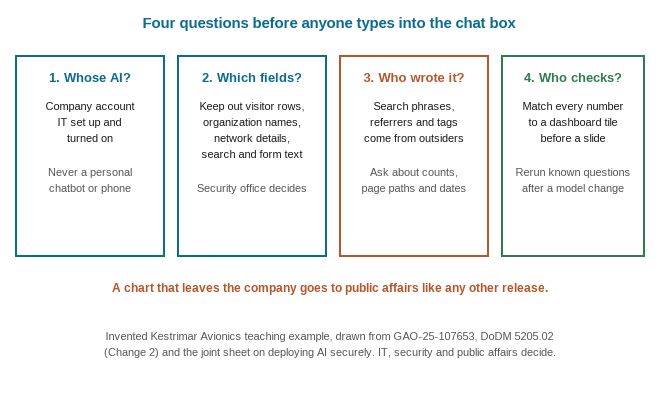
At a prime, most of that plan stops on its own. The AI button stays off until IT turns it on, and nobody pastes a visitor export into a personal chatbot. The setup steps are IT’s job. The questions are yours, and there are four of them: whose AI is answering, what the data says once it is gathered in one place, who wrote the words inside it, and whether the answer is right. Carry one question into every chat: who else learns something when we ask this, and who checked the answer?
If you need to pin down what each dashboard number counts first, start with our 10/27 tutorial on event dashboard numbers. For reading a tool’s training and retention terms, see our 11/04 tutorial. This piece is about the questions themselves.
How fast this moved in government
The federal side shows how quickly these features arrived. Across the 11 selected agencies GAO reviewed with AI use case inventories, GAO-25-107653 (July 2025) reports that “generative AI use cases increased about nine-fold, from 32 to 282” between the 2023 and 2024 inventories, a count that leaves out DoD because it is exempt from the inventory requirement. That figure describes federal agencies’ own inventories. It says nothing about contractors or about analytics tools in particular.
The same report notes that the agencies kept limits in place. GAO found that “all 12 selected agencies that allow the use of generative AI reported that the agency limits or restricts that use in some capacity.” GSA and DHS “limit commercial generative AI use to publicly available information only, in order to prevent sensitive data from being collected through generative AI tools.” Our reading: your customers already hold their own staff to rules like these, and a contractor that treats its web data with the same care is easy for them to understand.
Whose AI is answering?
At most primes an AI feature inside a licensed product stays switched off until IT enables it under the company account, and personal chatbots never see company data. That is company-policy framing, and it settles the first question before it starts.
The joint NSA, CISA and FBI information sheet “Deploying AI Systems Securely” (April 2024) is written for the team that runs the AI. It is “for organizations deploying and operating AI systems designed and developed by another entity,” and it says its best practices “are not applicable for organizations who are not deploying AI systems themselves and instead are leveraging AI systems deployed by others.” So the sheet speaks to the AI your own IT team stands up and operates, not to a feature someone else runs for you.
For that company-run AI, the sheet is plain about who leads. “If an organization outside of IT is deploying or operating the AI system, work with the IT service department to identify the deployment environment and confirm it meets the organization’s IT standards.” And: “Follow organization-approved IT processes and procedures to deploy the AI system in an approved manner.”
Our reading: if marketing wants a chat feature that the company runs itself, IT decides where it lives and how it is set up. For a chat box built into a vendor’s product, the sheet doesn’t apply, but the same instinct does, and the decision is IT’s. Marketing’s part is to ask for it through the normal request and to wait.
What the data says once it is gathered
A single visit to a capability page tells an outsider very little. A table of which organizations read which capability pages after which show tells them a lot. That is the part of this article that matters most.
DoDM 5205.02, the DoD OPSEC Program Manual, as amended by Change 2 effective October 29, 2020, applies to DoD Components. It defines critical information as information about DoD “activities, intentions, capabilities, or limitations” that an adversary seeks for advantage, and it notes that “The organization’s administrative staff may have valuable information that should also be assessed for its criticality.” It defines an indicator as data derived from “friendly detectable actions and open-source information” that adversaries “can interpret and piece together” to reach conclusions.
The manual directs DoD Components to “deny adversaries the opportunity to take advantage of publicly available information, especially when aggregated,” and to weigh the “susceptibility of the information to data mining.” It also says “Compilation or aggregation of data may lead to OPSEC or classification issues.” In the GAO report, DoD officials raise a related worry about AI itself: “generative AI models could aggregate various unclassified information contained in the model’s training data and unintentionally output classified information.” That concern is about what a model was trained on, not about your website.
Scope matters here. The manual binds DoD Components, and it reaches contractors only through their contracts: “Commanders and directors shall ensure that contractors supporting DoD activities use OPSEC to protect critical information for specified contracts and subcontracts.” It says nothing about a company’s web analytics. We are not calling the manual current, and we are not calling a visit table critical information.
Our reading: a table of customer visits by page and date looks like the kind of pattern those definitions describe. Ask your security office whether customer-visit data belongs on the company’s protected list. Until it answers, keep visitor-level rows, organization names and network details out of every chat, approved or not.
Strangers wrote part of your data
Not every word in an analytics table came from your team. The joint sheet recommends that operators “Implement validation and sanitization protocols for all input data to reduce the risk of undesired, suspicious, incompatible, or malicious input being passed to the AI system (e.g., prompt injection attacks).”
Our reading: site-search phrases, referring-page addresses, campaign tags and form text are typed or built by people you have never met. When a chat feature reads them, it is reading input you did not write, the kind of outside input the joint sheet means when it names prompt injection attacks. Keep chat questions to counts, page paths and dates that the company controls. Never wire a chat answer to send an email, change a campaign or update a record on its own.
Answers that sound right
GAO reports what agency officials told it about these tools: that “generative AI can produce biased outputs or hallucinations,” meaning “outputs that seem plausible but are ultimately false,” and that users can “experience a false sense of certainty in the system’s outputs.” Those are officials’ views as GAO reported them, not GAO measurements.
The joint sheet adds a habit worth borrowing for company-run AI: “When updating the model to a new/different version, run a full evaluation to ensure that accuracy, performance, and security tests are within acceptable limits before redeploying.”
Our reading: if a number from the chat box is headed for a slide, a person checks it against the dashboard tile that counts the same thing first. Ask the question a second way when the answer surprises you. Keep a handful of questions whose answers you already know, and rerun them whenever the vendor announces a model change.
Logs, and who gets to ask
For AI the company runs, the sheet recommends that teams “Monitor the system’s behavior, inputs, and outputs with robust monitoring and logging mechanisms to detect any abnormal behavior or potential security incidents,” that access to the AI model itself be limited “to authorized personnel only,” and that they educate users about “phishing prevention, and secure data handling.”
Company-policy framing: the chat history is a company record. Only the analysts who already see visitor-level data get to ask questions about it. And an unexpected email with a link to an outside dashboard is reported to security, not clicked, however familiar the logo looks.
Before an answer leaves the building
DoDM 5205.02 describes a content review as “an evaluation of information intended for release outside the control of the organization, including release to the public.” Its scope is the same as above: DoD Components, and contractors through their contracts.
Our reading, and company-policy framing: a chart from the chat box that goes to a customer, a teaming partner or a reporter is a release. It goes to public affairs like any other slide. For Kestrimar, the business development lead gets page-level counts by week, matched to the dashboard, with no organization names, and the security office gets a note asking whether the visit table belongs on the protected list. The same day, the AI side of buying tools gets its own check in our 11/18 tutorial on what’s under an AI marketing tool.
Small contractors and startups. No IT department or security office? Name one person who decides whether the analytics product’s AI feature gets turned on, and turn it on only under the company’s own account, never a personal one. Keep visitor-level exports out of every chatbot. Ask only about counts, pages and dates, check each answer against your dashboard before you repeat it, and treat any chart you send outside as public. If you hold a contract with OPSEC terms, those terms decide, so read them first.
Common mistakes
- Pasting the export into a personal chatbot. The fastest route is the one that leaves the company.
- Treating search phrases as your own words. Outsiders typed them.
- Trusting the confident answer. Match it to the dashboard tile first.
- Sending the chart straight to the customer. It is a release, and public affairs sees it first.
Limits
These sources are one GAO report about federal agencies, not contractors; one DoD manual written for DoD Components, cited as amended by Change 2; and one joint information sheet scoped to organizations that deploy AI themselves. None measures how often contractor analytics data is exposed through AI tools or how often analytics chat answers are wrong, so this article makes no such claim. Your IT team, security office and public affairs decide.
Sources
- U.S. Government Accountability Office, "Artificial Intelligence: Generative AI Use and Management at Federal Agencies," GAO-25-107653 (July 2025)
- DoD Manual 5205.02, "DoD Operations Security (OPSEC) Program Manual," November 3, 2008, as amended by Change 2 (effective October 29, 2020); check the DoD issuances page for the latest version
- NSA Artificial Intelligence Security Center, CISA, FBI and international partners, "Deploying AI Systems Securely: Best Practices for Deploying Secure and Resilient AI Systems," Joint Cybersecurity Information, April 2024 (FBI IC3 copy)
- Adapted from AssociationAI, "Ask Your Website Data Questions in Plain English"