

Tutorial
Record What an AI Tool Keeps Before Capture Work Goes In
A six-tool record for defense and space marketing teams: read each AI tool's own terms for whether it trains on what you type and how long it keeps it, note what the team will put in, date the check, and stop company work at any tool whose terms say yes or say nothing.
Time needed: About 30 minutes
Before you start:
- A list of the AI tools your marketing team actually uses, with the plan or tier for each
- The current terms, policy pages and settings screens for each tool
- The name of your security or contracts reviewer
ADSEC Data Governance Govcon Defense Space
Illustrative example: “Halden Ridge Systems,” its reviewer Dana Okafor and the six tools below, labeled Invented Tool A through Invented Tool F, are invented. None is a real product.
Halden Ridge’s marketing team uses six AI tools for drafts, slides, meeting notes, transcripts and copy. Proposal themes, capture notes and customer names go into some of them every week. Before the next pursuit kicks off, the marketing operations lead wants one page that says, for each tool, whether it trains on what the team types and how long it holds on to it.
The pocket question for each tool: what do its own terms say about training and keeping inputs, and when did we last read them?
Why record it
Two government documents frame the question. Neither one is a rule for your company’s own tools.
OMB Memorandum M-25-22 is guidance to federal agencies on buying AI. It tells agencies that, in their contracts, certain government information “must only be collected and retained by a vendor when reasonably necessary to serve the intended purposes of the contract,” and that non-public agency data shouldn’t be used “to further train publicly or commercially available AI algorithms, consistent with applicable law, absent explicit agency consent.” That’s what your government buyers are told to ask their own vendors. It’s a useful model for the questions your team asks its tools.
Joint guidance from Australia’s cyber agency, written with CISA, the FBI and the NSA, tells organizations using a third-party AI system to “understand if your organisation’s inputs will be used to retrain the AI system’s model.” For a defense supplier’s marketing team, that’s the first line to fill in the record.
The steps
- Pick the tool and the plan you actually use. Terms often differ between free, team and enterprise tiers. Record the tier.
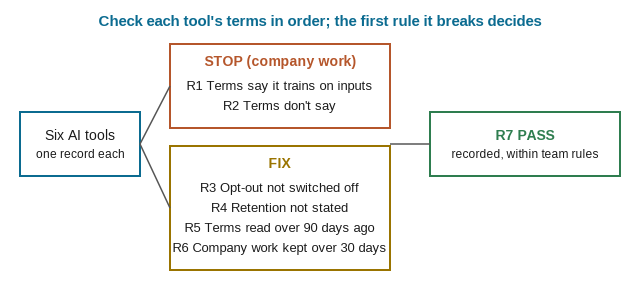
- Find the training statement. Read the tool’s own terms and policy pages and record one of four answers: No, Yes, Opt-out available or Not stated. If there’s an opt-out, switch it off and write down where the setting lives.
- Find retention. Record how many days the tool keeps inputs, or “Not stated” if the terms are silent.
- Note what the team will put in. Company work (capture notes, customer names, drafts) or public material only (published press releases, posted job ads). The record treats them differently.
- Apply the team rules. Company work stays out of any tool whose terms say it trains on inputs or don’t say. Company work kept longer than 30 days goes to your reviewer. The 30-day line is our teaching choice, not a requirement from either source.
- Date the check. Write down the day you read the terms. The record flags any tool whose terms were read more than 90 days ago; that 90-day window is also our teaching choice.
Try it now: open the AI tool terms record, load Case E, and see why Invented Tool B passes while Invented Tool D stops. It reads only what you type into it, never a real tool’s terms.
Check your work
Rules run in order, and the first one a tool breaks sets its result. The baseline has every tool used for company work, not training on inputs, keeping inputs 30 days and read 10 days ago.
- A, clean record: STOP 0, FIX 0, PASS 6.
- B, training: Invented Tool B’s terms say Yes and Invented Tool D’s say nothing: STOP 2, FIX 0, PASS 4.
- C, opt-out and retention: Invented Tool C’s opt-out isn’t switched off; Invented Tool E’s is, but its retention isn’t stated: STOP 0, FIX 2, PASS 4.
- D, age and retention: Invented Tool A’s terms were read 120 days ago and Invented Tool F keeps inputs 45 days: STOP 0, FIX 2, PASS 4.
- E, what goes in: Invented Tool B trains on inputs but gets public material only, so it passes; Invented Tool D says nothing on training or retention and was read 200 days ago, and stops on training: STOP 1, FIX 0, PASS 5.
- F, edges: Invented Tool A read exactly 90 days ago and Invented Tool C keeping exactly 30 days both pass, as does Invented Tool F at 365 days with public material only; Invented Tool E at 91 days gets a FIX: STOP 0, FIX 1, PASS 5.
Common mistakes
- Reading the free tier’s terms when the team pays for a different plan.
- Treating “Not stated” as “No.”
- Finding the opt-out and never switching it off.
- Letting a tool approved for public material quietly start getting capture notes.
- Never rereading the terms after the first check.
Limits
The record reflects each tool’s terms on the day someone read them, and terms change. It isn’t a security or contracts review, and neither source sets rules for a contractor’s own tool choices. Ask your security or contracts reviewer before company work goes into any tool.
Next
For the outreach side of the same season, see the two federal rule sets behind AI voice invitations.