

Tutorial
Put Meeting Recordings, Transcripts and AI Notes on Your Retention Schedule
For marketing, events and communications staff at large defense and space primes: sort one month of meeting recordings, transcripts, chat logs and AI notes against the company records schedule, mark each file keep, check or remove, and run the same questions in a browser lab.
Time needed: About 45 minutes to sort one month of meeting files; records, legal and contracts review is separate
Before you start:
- Your company's records retention schedule, or the person who owns it
- A list of the meeting files your team made or received in one recent month (names only)
- A contact in contracts or finance who can say which work supports a contract
Policy Records Retention Meetings Transcripts Far Nara Defense Space
Who this is for: marketing, events and communications people at a large defense or space prime that already runs a company records schedule. AI tools are banned or fenced to a company account, odd email goes to quarantine, and company information stays out of public chatbots. A labeled box for small contractors and startups follows the common mistakes.
This is general information, not legal or records-management advice. Your company’s records schedule, legal team and contracts office decide what stays, how long it stays, and how it is destroyed.
Teaching example: Invented Vorrastel Space Systems and its “Sample meeting-file retention sheet (invented)” are made up. The eight files are generic labels, not real products, and no actual vendor, prime, show or customer appears.
The cleanup plan
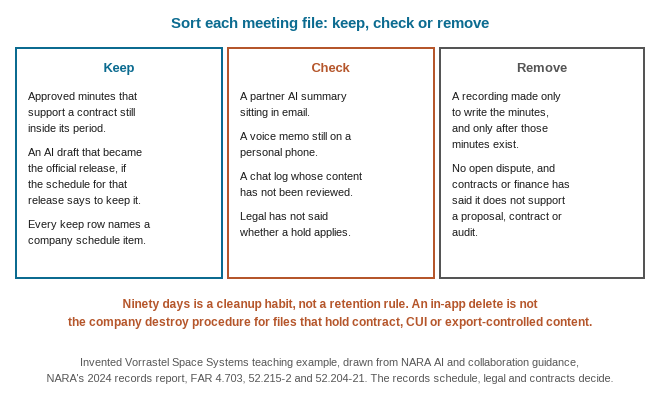
The show contract is signed, and the events lead at Invented Vorrastel Space Systems wants the shared drive cleaned up before year end. The folder from the agency kickoff holds a two-hour recording, its automatic transcript, a chat log, the agency’s AI summary that arrived by email, the approved minutes, and an AI first draft of the contract-win release. Someone in the pricing call last spring also kept a voice memo on a phone. The cleanup plan is “delete anything older than 90 days.” No one has checked whether any of it supports the contract the company is now being paid under, whether the booth builder’s claim from the last show is still open, or what a plain delete does to a file that held export-controlled detail.
A defense prime already has a retention schedule, written by a records team marketing never meets. What the schedule rarely names is the pile a single partner kickoff now leaves behind. This tutorial sorts that pile, one file at a time, with eight questions: what it was for, whether it is a stepping stone to another record, whether it supports a contract, whether a dispute is open, where it sits, what is in it, which schedule item covers it, and how it would be destroyed. The question to keep in your pocket: what was this file for, and who else is counting on it? A browser lab on this site runs the same eight questions against an invented sheet, then prints a verdict for each file.
NARA’s bulletin and AI memo are written for federal agencies and their duties under the Federal Records Act. They are a model here, not your company’s schedule. The FAR clauses quoted below reach a company only if they are in its contract. If your contract includes them, contracts or finance will say so.
The steps
-
Make the list. NARA Bulletin 2023-04, “Managing Records Created on Collaboration Platforms,” says “This is true for federal employees as well as for agency contractors, volunteers, and external participants working on behalf of the agency.” It names “shared documents, chats, and meeting recordings” among the common records those platforms may create. The bulletin is written for federal agencies. FAR 4.703, if it is in your contract, covers data “regardless of type and regardless of whether such items are in written form, in the form of computer data, or in any other form.” FAR 52.204-21 (Nov 2021), if it is in your contract, defines information to include “audiovisual” forms. Our reading: a recording, a transcript, a chat log and an AI summary each go on the list as their own line.
-
Ask what each file was for. NARA’s memo on applying the Federal Records Act to AI materials (the PDF itself carries no date; NARA’s transmittal page AC 11.2026 dates it August 21, 2026) treats as likely records “Meeting summaries generated by AI that are circulated to other employees or that serve as the official meeting record.” It does not treat as records “Meeting notes created for the user’s recollection that are not circulated to others or used as the official meeting record.” It also says the schedule for an AI-made product is the one for that product: “The fact that AI was used is secondary.” The bulletin says “The content of a meeting recording determines its retention.” The memo says “This memo addresses records management requirements under the FRA only and does not establish policy related to AI governance, e-discovery, privacy, security, or ethical use.” It reaches contractors working on an agency’s behalf through this definition: “‘Made’ means created or recorded by agencies, agency employees, or contractors working on their behalf, in the course of their official duties.” That definition does not automatically cover a company’s own files. Our reading: sort company files the same way, by what they were used for, not by which tool made them.
-
Find the stepping stones. The memo describes transitory records (needed under 180 days, not needed for financial or legal obligations; General Records Schedule 5.2 item 010) and intermediary records (used to create a later record; GRS 5.2 item 020). The bulletin says “If the meeting is recorded only for the purpose of generating meeting minutes, the recording may be destroyed in accordance with GRS 5.2, item 020, Intermediary Records, once the meeting minutes are created.” It also says “To qualify as intermediary, a record must not be required to meet legal or fiscal obligations, or to initiate, sustain, evaluate, or provide evidence of decision-making.” And: “No, agencies are not required to record every video conference or produce a transcription and capture chats.” The General Records Schedule is for agencies; it is a model here, not a company’s schedule. Our reading: if the company schedule has a short-lived category, these are the files that belong in it, and only after the later record exists.
-
Mark the contract tie and the clock. If FAR 4.703 is in the contract, contractors keep records for “3 years after final payment” as the usual period, longer when “A retention period longer than that cited in 4.703 (a) is specified in any contract clause,” and “For the record retention time periods prescribed, contractors shall not destroy, discard, delete, or write over such computer data.” The audit and records clause at FAR 52.215-2 (Jun 2020), if it is in the contract, keeps records available “until 3 years after final payment under this contract or for any shorter period specified in subpart 4.7, Contractor Records Retention, of the Federal Acquisition Regulation (FAR), or for any longer period required by statute or by other clauses of this contract.” Our reading: contracts or finance decides whether a file supports a proposal, contract cost or audit; marketing records the answer and the date the period ends.
-
Check for open disputes. The same clause keeps records about appeals, litigation or claims available “until such appeals, litigation, or claims are finally resolved.” Company-policy framing: legal says whether anything is open; nobody deletes until legal has answered.
-
Check where it lives. The bulletin tells agencies using a platform run by another agency or an outside group to weigh further questions, including “What if the provider has a shorter retention period than participating agencies for the records created in the collaboration platform?”, and to “determine records management responsibilities at the beginning of the collaboration.” FAR 52.204-21, if it is in the contract, asks contractors to “Verify and control/limit connections to and use of external information systems.” Our reading: a partner’s AI summary or a file on a personal phone sits outside your schedule; ask the records team whether a copy belongs in the company system and how the outside copy gets removed. For the call that produced the file, see When someone else’s AI notetaker joins your call. For a vendor’s own retention terms, see record what an AI tool keeps before capture work goes in. For a file that sat on a personal account, see personal AI accounts and government systems.
-
Check what is in it, and how it would be destroyed. If FAR 52.204-21 is in the contract, federal contract information is information “not intended for public release, that is provided by or generated for the Government under a contract to develop or deliver a product or service to the Government,” and the clause asks contractors to “Sanitize or destroy information system media containing Federal Contract Information before disposal or release for reuse.” (Our rule, not the clause’s text: the clause does not mention app deletes.) We do not count a delete button in an app as that step; files with contract, CUI or export-controlled content go to IT security’s procedure. This tutorial does not give sanitization steps. In the lab, that reading appears as VERIFY R5, labeled “(Our rule)”: the planned action is “Delete in the app,” and the file holds FCI, CUI or export-controlled content. The lab message quotes only the clause’s text about sanitizing or destroying media that holds federal contract information, and says counting an app delete as that step is our reading.
-
Name the schedule item, then run the lab. Every file marked keep gets an item from the company schedule, written in the records team’s words, not a guess from a nearby heading. The benchmark below shows why the name matters.
Try it now: open the meeting record retention check lab and load Case C. Watch Item 4, the minutes that still support a contract and hold CUI, when the planned action is “Delete in the app”: STOP R2 fires first, and VERIFY R5 is listed with it.
Why the schedule item matters
In NARA’s Federal Agency Records Management 2024 Annual Report, dated December 17, 2025, of the agencies that said they used an approved General Records Schedule 6.1 for electronic messages other than email, NARA found that 47% had answered incorrectly. NARA suggests agencies may not know the requirement to expand approved schedules to cover electronic messages. That finding is about federal agencies, not contractors. Our reading: if federal agencies misread whether their schedule covers chat and messages, a marketing team should ask its records team rather than assume.
The worked example
Invented Vorrastel Space Systems. The minutes of the proposal color review (Item 4) support a contract still inside its retention period and carry CUI. A coordinator marks it “Delete in the app” to clear space. Two rules fire: STOP R2 (the contract period is still running) and VERIFY R5 (Our rule: CUI set for a plain app delete instead of the company’s destroy procedure). The sheet shows STOP R2, the first match, and lists both. The voice memo of booth conversations (Item 8) now sits on a personal phone: VERIFY R8. The vendor demo chat log (Item 6) has not been reviewed for content: VERIFY R9.
Check your work
The lab prints one leading verdict for each file, and still lists every rule that matched. A STOP means do not delete or destroy as planned. A VERIFY means someone has more work before any action. A PASS means none of the teaching rules fired, and that is not a records decision. The first matching rule sets the verdict. Your counts should come out like this:
| Case | STOP | VERIFY | PASS |
|---|---|---|---|
| A, clean sheet | 0 | 0 | 8 |
| B, open dispute | 1 | 2 | 5 |
| C, app delete | 1 | 2 | 5 |
| D, outside copies | 0 | 3 | 5 |
| E, as typed | 1 | 3 | 4 |
| F, mixed files | 0 | 3 | 5 |
Five rows match more than one rule: B Item 7 (R1 and R2), C Item 4 (R2 and R5), D Item 3 (R4 and R8), E Item 4 (R1 and R2), and F Item 8 (R4, R5 and R8).
The lab uses invented files and teaching rules. It does not compute a retention end date; “Retention period still running” is a yes or no the contracts office answers. It is not legal or records-management advice, and a PASS is not permission to delete. If a row lists more than one rule, fix every one of them, starting with the first match, before anyone marks that file for removal.
Run your own month’s list the same way. Every keep row has a company schedule item. Every remove row has a legal answer and, if the file supported a contract, a contracts or finance answer. Files that sat outside the company system have a note on the outside copy.
Common mistakes
- Treating ninety days as a retention rule. Ninety days is a cleanup habit, not a schedule item.
- Sorting by the tool that made the file. Sort it by what it was for.
- Deleting the recording before the minutes exist. A recording made to write the minutes has done its job once the minutes exist, and only then.
- Clearing a file with the in-app delete button. If legal has not answered, the file stays. If it holds contract, CUI or export-controlled content, it goes to IT security’s procedure.
Small contractors and startups. No records team? One person owns the list. Put every meeting recording, transcript, chat log and AI summary on it, ask contracts or finance which files support a contract, and ask counsel before anything is deleted. If a contract includes the FAR records or safeguarding clauses, those clauses decide; read them first. Keep the list on a company system, and do not paste file names, summaries or excerpts into a public chatbot while you sort them.
Related
The call that left the files behind is in when someone else’s AI notetaker joins your call. A vendor’s own retention terms are in record what an AI tool keeps before capture work goes in. Work that lived on a personal device is in personal AI accounts and government systems.
Limits
These sources are two NARA guidance documents and one NARA report written for federal agencies, plus three FAR provisions that reach a company only through its contract. None measures how often marketing teams delete meeting files too soon or how often an in-app delete is used on files that should have gone through a company destroy procedure, so this tutorial makes no such claim. A PASS in the lab is not a records decision. Your company’s records schedule, legal team and contracts office decide.
Sources
- National Archives and Records Administration, "Guidance on Applying the Federal Records Act to Artificial Intelligence Materials" (memo; dated August 21, 2026 on NARA transmittal page AC 11.2026)
- NARA, transmittal page AC 11.2026, dating the Federal Records Act and AI memo August 21, 2026
- NARA Bulletin 2023-04, "Managing Records Created on Collaboration Platforms"
- NARA, "Federal Agency Records Management 2024 Annual Report," December 17, 2025
- Federal Acquisition Regulation 4.703, Policy (Contractor Records Retention)
- FAR 52.215-2, Audit and Records-Negotiation (Jun 2020)
- FAR 52.204-21, Basic Safeguarding of Covered Contractor Information Systems (Nov 2021)
- Adapted from FOUNDINT.AI, "Write and Run a Records Retention and Destruction Policy"