

Article
Inaudible Ad Beacons and the Show Phone's Microphone
For marketing, business development, capture support and events staff at large defense and space primes: 2016 and 2017 research shows that a phone microphone can hear inaudible tones used to place the phone, link it to other devices and infer what it heard. The useful control is which apps may use the microphone, and whether any feature they offer needs it.
ADSEC Trade Shows Opsec
Who this is for: marketing, business development, capture support and events people at a large defense or space prime. Show phones are company phones IT manages. Where the company allows an AI tool at all, it stays on an account IT runs, and nothing from the company goes into a public chatbot. Unknown links and unexpected email land in quarantine. Readers at a small contractor or a startup will find a labeled box after the common mistakes.
For general information; this is not security, compliance or legal advice. Which apps may go on a company phone, and what each may access, is settled by IT and the security office.
The research below is from 2016 and 2017 studies of consumer apps, stores and advertising practices. None of it is a report of an incident at a defense show, a hotel or a named company.
The phone hears more than the person carrying it
A show phone is a radio, a camera and a location beacon, and this site has covered all three. It is also a microphone. In a 2017 IEEE European Symposium on Security and Privacy proceedings paper, Arp and colleagues write: “A recent practice embeds ultrasonic beacons in audio and tracks them using the microphone of mobile devices.” The same paper says “they embed these beacons in the ultrasonic frequency range between 18 and 20 kHz of audio content and detect them with regular mobile applications using the device’s microphone” (Arp et al., 2017). Most people in a hall or a lobby cannot hear that range. A phone can, if an app on it is allowed to use the microphone.
None of the sources in this article studied a defense show, a defense hotel or a defense marketing team. The point is the sensor every attendee already carries, not a known incident. This article describes what those 2016 and 2017 sources found. It is not a guide to adding a tone to a file or to writing an app that listens for one.
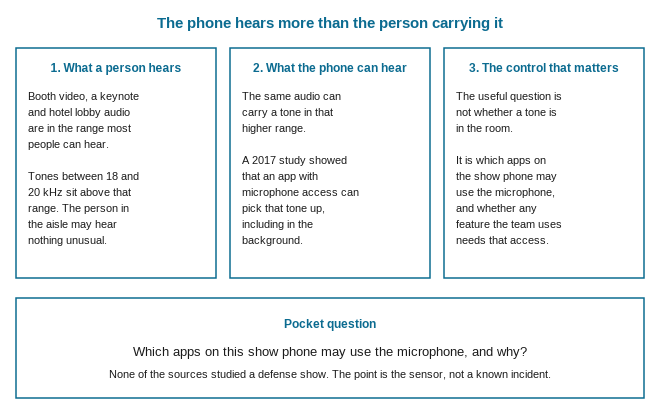
What a beacon can tell a listener
The same paper says what that side channel is for. “This side channel allows an adversary to identify a user’s current location, spy on her TV viewing habits or link together her different mobile devices” (Arp et al., 2017). “Adversary” is the paper’s word, not a claim about a named state actor or a named company. Once such an app is on the phone, the authors write, “she neither knows when the microphone is activated nor is she able to see which information is sent to the company servers” (Arp et al., 2017).
A later proceedings paper in Proceedings on Privacy Enhancing Technologies 2017 (2) places the same kind of ultrasound work in a wider set of uses. Mavroudis and colleagues write: “This technology is already utilized in a number of different realworld applications, such as device pairing, proximity detection, and cross-device tracking.” Some of those uses tell the person and start only when asked. The risk this article is about is the other kind: listening that the person does not see.
What the 2017 study measured
The Arp paper reports several findings. They measure different things. They are not added together here, and they are not turned into a rate or a share of all apps.
Arp and colleagues “detect signals in 4 of 35 stores in two European cities that are used for location tracking.” That figure is a count of stores in that 2017 visit, not a claim about U.S. show halls or hotels.
In a scan of 1,320,822 Android applications, the same paper says “our scan returns 39 unique SilverPush matches within our Android application dataset,” and that this was a “SilverPush implementation embedded into applications from India and the Philippines” (Arp et al., 2017).
Arp and colleagues counted 234 Android app samples containing SilverPush ultrasonic listening code by January 2017, a 2017 snapshot found by searching VirusTotal (Arp et al., 2017). That count is Android only, after false positives were removed, and is not a current count and not a share of all apps.
The same scan, the authors write, “yields 2 and 1 samples with functionalities of Lisnr and Shopkick, respectively” (Arp et al., 2017). Of those samples they say: “The user is thus aware of the deployed technology and needs to start the audio analysis manually” (Arp et al., 2017). Judge a use by whether the person is told, and by when the microphone is on.
Why the permission screen did not settle it
An app that wants to hear this audio still needs permission. Arp and colleagues write that “an app still requires the RECORD_AUDIO permission for recording audio.” They also offer this view, which they do not attach to a measured share: “Unfortunately, users tend to blindly grant permissions to Android applications, if they are interested in their functionality” (Arp et al., 2017). Treat that as the authors’ statement, not as a rate.
Android’s later run-time prompts, they write, “might alleviate the risk, but can unfortunately not entirely prevent it” (Arp et al., 2017). The PoPETs paper makes a related systems point. Mavroudis and colleagues “first observe that the lack of OS features results in violations of the principle of least privilege: an app that wants to use this technology currently needs to require full access to the device microphone.” These are descriptions of 2016 and 2017 mobile systems. This article does not claim that today’s Android or iOS screens work the same way.
What the regulator did
On March 17, 2016, staff at the U.S. Federal Trade Commission sent warning letters, and the release says: “The letters were issued to 12 app developers whose apps are available for download in the Google Play store and appear to include the Silverpush code.” The release says those apps “were capable of listening in the background and collecting information about consumers without notifying them,” and that “app developers ask users for permission to use the device’s microphone, despite the apps not appearing to have a need for that functionality” (FTC, March 17, 2016). The same release notes “that Silverpush has stated publicly that its service is not currently in use in the United States” (FTC, March 17, 2016). Print that next to the letters so the letters are not read as a finding that U.S. television ads then carried the beacons.
A sample letter linked from that release says: “This functionality is designed to run silently in the background, even while the user is not actively using the application.” It also says “your application requires permission to access the mobile device’s microphone prior to install, despite no evident functionality in the application that would require such access” (FTC sample letter). The Commission’s later cross-device tracking staff report (January 2017) recalls that “Staff recently sent warning letters to app developers who had allowed third parties to install audio beacons in their apps, through software called Silverpush, without informing consumers who downloaded the apps.”
These are warning letters, not findings against any developer, and not an action beyond the letters. This article does not treat them as a STOP for any named app, and it does not name the recipients. The FTC did not name them either.
Cross-device linking
The same January 2017 FTC staff report defines the broader practice: “Cross-device tracking occurs when platforms, publishers, and ad tech companies try to connect a consumer’s activity across her smartphones, tablets, desktop computers, and other connected devices.” It then says: “A common method of probabilistic tracking is IP address matching.” The report’s example is a home network: “Because devices on the same local network often have the same public IP address, the ad platform might infer that a computer, smartphone, and tablet that use the same public IP address belong to the same household” (FTC, January 2017). Our reading: the same kind of public IP match could be applied to devices that share a hotel or show network.
Ultrasound is one more way to tie devices together, alongside that network method. It is not the same mechanism as Wi-Fi identifier tracking, which this site has covered separately.
When the listener is hostile
The PoPETs authors also show how a deployment can be abused. They “show that ultrasound cross-device tracking deployments can be abused to perform stealthy deanonymization attacks,” and “to inject fake or spoofed audio beacons, and to leak a user’s private information” (Mavroudis et al., 2017). That is a research demonstration, not a report that anyone used those attacks against a defense company, a show or a hotel.
What a strict-policy team can control
The sender of the sound is often not in the traveler’s hands. Arp and colleagues write: “Moreover, the emitting sender is not always in the user’s control, for example during the location tracking.” Their own countermeasure line is plain: “If the device is not listening secretly, a transmitted audio beacon is harmless” (Arp et al., 2017). The control that a strict-policy prime already has is the microphone permission on each app, on a company phone IT manages.
Before travel, list which apps on each company show phone hold microphone access, and send any that do not need it to IT. The companion walkthrough, Send the Event App to IT Before Anyone Installs It, turns that list into one request sheet per app. Treat any app that asks for the microphone with no feature that uses it as a question for IT, not as a prompt to accept.
When the company plays its own audio (booth loops, product videos, hosted dinners), confirm with the agency or AV supplier that no third-party audio watermark or beacon kit is in the file. That question is our idea; no source in this article names it for booth media.
In capture and business development travel briefs, add one line: phones hear more than people do, and a microphone permission is the control that matters. Ethical uses exist, including pairing and proximity detection that tell the user and start only when asked, as the PoPETs paper notes. Judge a use by consent and by when the microphone is on.
A show phone hears more than the person carrying it. Ask which apps may listen, and why.
Common mistakes
- Treating “location off” and “Bluetooth off” as the whole device brief. Those matter, and this site has walked through them. They do not answer which apps may use the microphone.
- Reading a 2017 count as if it still describes today’s apps. The 2017 paper’s 234 figure is an Android snapshot from a VirusTotal search, not a current count.
- Tapping Allow on a microphone prompt in a hotel lobby the night before a show. If no feature you use needs the microphone, that prompt is a question for IT.
- Assuming a warning letter is a finding, or that U.S. ads were carrying the beacons. The letters are letters. Silverpush had said the service was not then in use in the United States.
- Feeding a list of show-phone apps, or their permission screens, into a tool the company does not run. At a strict-policy prime, that list stays off public chat products.
Small contractors and startups. When staff carry personal phones for show work, the same question applies, and it is harder to answer because nobody manages those phones. Pick one owner for the check, keep company work in company accounts, and write down which apps on each phone may use the microphone before the trip. Large primes usually settle this through IT; you may be settling it yourselves. (Our suggestion; no source names this for small contractors.)
Further reading
See also Bluetooth and device risks at shows and hotels, the staff phone location check, the limits of MAC randomization, and the request sheet for each event app.
Limits
These sources are one 2017 IEEE European Symposium on Security and Privacy proceedings paper, one 2017 Proceedings on Privacy Enhancing Technologies paper, one FTC press release and sample letter from March 17, 2016, and one FTC staff report from January 2017. They describe consumer apps, stores and advertising practices in that period. None measures how often inaudible beacons appear at defense shows or hotels, and none measures which apps sit on defense company phones, so this article makes no such claim. IT and the security office decide which apps may go on a company phone, and what each may access.
Sources
- Daniel Arp, Erwin Quiring, Christian Wressnegger, and Konrad Rieck, "Privacy Threats through Ultrasonic Side Channels on Mobile Devices," a 2017 IEEE European Symposium on Security and Privacy proceedings paper
- Vasilios Mavroudis, Shuang Hao, Yanick Fratantonio, Federico Maggi, Christopher Kruegel, and Giovanni Vigna, "On the Privacy and Security of the Ultrasound Ecosystem," Proceedings on Privacy Enhancing Technologies 2017 (2)
- Federal Trade Commission, "FTC Issues Warning Letters to App Developers Using 'Silverpush' Code," March 17, 2016
- Federal Trade Commission, sample warning letter on Silverpush code, linked from the March 17, 2016 release
- Federal Trade Commission, "Cross-Device Tracking," An FTC Staff Report, January 2017