

Article
A Changing Wi-Fi Address Is One Layer, Not a Cloak
Phones change their Wi-Fi address to resist tracking. Naval Academy studies in 2017 and 2021 found that protection improving but uneven. Here's how a policy-bound events team reads that evidence, and why IT sets the settings.
ADSEC Opsec Mobile Travel Events Defense Space
Who this is for: marketing and events staff at large defense and space primes who travel to shows, hotels and offsites carrying laptops and phones your company manages. The rules for those devices on the road come from IT and security, and you follow them. This post explains why that policy treats a changing Wi-Fi address as one layer among several. It doesn’t ask you to change any setting, and it isn’t written for a contractor without a policy.
Before the next show, someone on the team will say that their phone randomizes its address, so the venue Wi-Fi can’t follow them. It sounds settled. Two research papers, four years apart, suggest a better question to ask in return: which year’s evidence is that claim leaning on, and what did that evidence test?
What the feature is
The 2017 paper opens with a plain definition: “Media Access Control (MAC) address randomization is a privacy technique whereby mobile devices rotate through random hardware addresses in order to prevent observers from singling out their traffic or physical location from other nearby devices.”
Put simply, every Wi-Fi device has a hardware address that nearby equipment can see. If that address never changes, anyone listening at a hotel, an airport or a show hall can recognize the same device each time it appears. Randomization swaps the real address for temporary ones so the sightings are harder to link.
Who did the research
Both papers appeared in Proceedings on Privacy Enhancing Technologies (PoPETs), a peer-reviewed venue. The 2017 lead author lists “work done partly while at the US Naval Academy (USNA)”, and the 2021 paper’s first page gives “Corresponding Author: Ellis Fenske: USNA” as its contact line. The 2021 paper also prints its review dates: “Received 2020-11-30; revised 2021-03-15; accepted 2021-03-16.”
The two studies share several authors, so the 2021 paper is the same Naval Academy group returning to its own question, not an independent check on it. The 2017 paper also states that its “Views and conclusions are those of the authors and should not be interpreted as representing the official policies or position of the U.S. government.” Neither paper names a lay audience. Our reading of the venue is that both were written for privacy researchers, which is why we quote them closely rather than summarize their methods.
What the 2017 study found
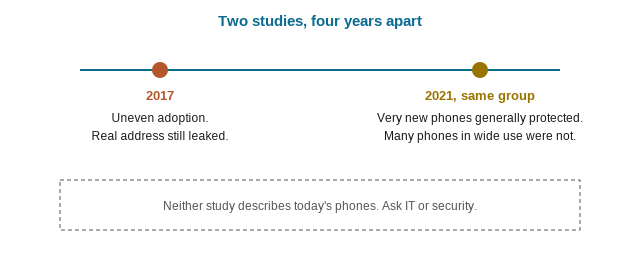
In 2017, the group described the feature as patchy. They wrote: “Adoption of this technology, however, has been sporadic and varied across device manufacturers.” Where it was switched on, it didn’t always hold: “devices commonly make improper use of randomization by sending wireless frames with the true, global address when they should be using a randomized address.”
Their overall verdict that year was blunt: “Our analysis illustrates that MAC address randomization policies are neither universally implemented nor effective at eliminating privacy concerns.” That sentence sums up several separate weaknesses the paper tested. We don’t describe them here; for a policy-following team, the conclusion is what matters.
What the 2021 follow-up found
The same Naval Academy group returned in 2021. Looking back, they wrote that “Early MAC address randomization implementations suffered from logic bugs and information leakages that defeated the privacy benefits realized by using temporary, random addresses, allowing devices and users to be tracked in the wild”.
This time they worked hands-on with a large set of phones: “We tested each of these phones in a lab setting to determine whether it uses randomization, under what conditions it randomizes its MAC address, and whether it mitigates known tracking vulnerabilities.”
The result was mixed. As of their 2021 study, they found that “very new phones with updated operating systems generally provide a high degree of privacy to their users” (their words). In the same sentence they added that “there are still many phones in wide use today that do not effectively prevent tracking” (and that “today” was 2021).
They were also careful about what part of their data can carry: “We caution the reader against drawing conclusions from the results in Table 1 since not only is our corpus a non-representative sample of behavior in the wild”. That warning covers their in-the-wild data, and it’s a good habit to borrow. A study tells you what its authors tested, on the devices they had, when they had them.
Why the picture stayed uneven
The 2021 paper names the pattern directly: “randomization technology has not been deployed cleanly or consistently across the range of modern mobile devices.” It also offers a cautious sense of direction: “In time, these technologies appear to be converging towards consensus, but the path is slow and staggered, moving in fits and starts.”
One detail matters for anyone carrying a phone through a show hall. Among the devices it tested, the paper found some “devices that provide effective protections only while the device is not actively in use.” So a device’s state, not only its setting, can shape what the feature delivers. We won’t explain the tests behind that finding; the point for a traveling team is simply that randomization is on doesn’t describe every moment of the day.
Why IT, not the traveler, holds the setting
The 2021 paper notes a practical tension: “some networks are designed assuming a consistent and stable MAC address per device”. A company network, a sign-in page or a device-management tool may expect each device to keep one address.
Our reading: that tension is one reason a company’s IT team, not the person traveling, decides how each device behaves on each kind of network. A setting that helps on a hotel network can break something on the office network. Our pre-trip network address check walks through the network kinds and hands every mismatch to IT or security.
Fixes belong to the makers
The 2017 authors put the fix at the level of the whole market: “To be truly effective, randomization should be universally adopted.” They added that “these best practices can only be truly effective when enforced across the spectrum of devices.” In 2021 the recommendation was similar: “Devices should deploy privacy protections consistently no matter the device state”.
Our reading: those recommendations are addressed to the companies that build devices and operating systems. A marketing lead can’t repair uneven randomization from the settings menu, and under a strict policy shouldn’t try.
Read the dates
These are a 2017 study and a 2021 study. Together they give a dated, two-point picture: uneven and leaky in 2017, better on very new phones but still uneven across the phones in use in 2021. They do not tell us how today’s phones behave, and neither do we. For the behavior of the devices your company issues, ask your IT or security team; they’re the ones who know which models and settings are on the trip.
What a policy-following team does
This is our framing, not a finding from either paper:
- Leave company-managed settings as IT set them. Randomization is one line on the travel device checklist, not the whole list.
- Follow the travel guidance you already have for hotel and venue Wi-Fi. If look-alike networks are your worry, our earlier post on spotting look-alike networks at a show covers that.
- Send questions about current device behavior to IT or security, not to forums or a colleague’s memory of a news story.
- Practice the routine in the venue network address check, then run it on your real trip plan and confirm each device with IT or security.
One boundary is worth keeping clear. Counting how many people pass through a briefing room, which we covered in aggregate Wi-Fi sensing, is a different subject from whether one person’s device can be followed. This post is only about the second.
When someone says my phone randomizes its address, the useful reply isn’t to argue. It’s to ask which year’s study they mean, what it tested, and whether IT has already set the policy that applies. Usually it has.
Sources
- Jeremy Martin, Travis Mayberry, Collin Donahue, Lucas Foppe, Lamont Brown, Chadwick Riggins, Erik C. Rye and Dane Brown, "A Study of MAC Address Randomization in Mobile Devices and When it Fails," Proceedings on Privacy Enhancing Technologies 2017(4):365-383, DOI 10.1515/popets-2017-0054
- Ellis Fenske, Dane Brown, Jeremy Martin, Travis Mayberry, Peter Ryan and Erik Rye, "Three Years Later: A Study of MAC Address Randomization In Mobile Devices And When It Succeeds," Proceedings on Privacy Enhancing Technologies 2021(3):164-181, DOI 10.2478/popets-2021-0042