

Article
Your Company AI Can Miss the Middle of a Show Contract
For events, sponsorship and field marketing staff at a major prime in defense or space, limited by a strict AI policy: a long exhibitor or sponsorship agreement can fit in the approved company assistant and still not be used evenly, especially the fine print in the middle, so read those money terms yourself.
Events Ai Literacy Sponsorships Contracts Defense Space
Who this is for: events, sponsorship and field marketing staff at a major prime in defense or space, limited by a strict AI policy to company accounts that IT has signed off on. You sign exhibitor agreements, sponsorship contracts and show service orders, with fees and deadlines spread through long documents. A box for small contractors and startups sits after the applications.
This article is about how AI tools handle long documents and is not legal advice. Your contracts team decides what a show or sponsorship agreement commits the company to.
Teaching example: Invented Brindlecourt Aerospace, its events lead, and the sponsorship agreement and services manual are made up. No real company, show or contract is described. None of the research below tested contracts; the contract story is our practice.
One contract, three readings
Invented Brindlecourt Aerospace’s events lead receives a 60-page sponsorship agreement and a 120-page exhibitor services manual for a spring show. Both go into the company’s approved AI assistant, with a request for every fee, deadline and penalty. The answer looks tidy: booth payment dates up front, move-out rules at the end. It says nothing about the cancellation schedule in section 14, or about a late-order surcharge in the middle of the manual. Nobody notices until the invoice arrives.
That story is our practice, not a finding from any paper below. None of those studies tested a contract, a show manual or a defense document. What they did test is whether a long text that fits in a model is used evenly, and whether fine detail in the middle is the first thing to slip. A contract can fit in the window and still not get used evenly.
Fitting in the window is not the same as being used
Mosh Levy and Alon Jacoby, at Bar-Ilan University, and Yoav Goldberg, at Bar-Ilan University and the Allen Institute for AI, tested five models on reasoning questions as the input got longer, and published the result in the 2024 ACL long-papers volume (Levy et al., ACL 2024). They write: “Our findings show a notable degradation in LLMs’ reasoning performance at much shorter input lengths than their technical maximum.” (Levy et al., ACL 2024). In the same paper they report that, even on an input of 3,000 tokens, “on average over all tested models, a drop in accuracy from 0.92 to 0.68” (Levy et al., ACL 2024). That figure is a drop in accuracy on their true or false reasoning questions, averaged over the five models they tested. It is not a recall score, and it is not a share of contract terms missed.
They also write that “Accuracy decreases as input length grows regardless of where the key paragraphs are placed within the input.” (Levy et al., ACL 2024). And they argue that “for a model to be considered capable at long range, it must maintain its performance at any length it technically supports” (Levy et al., ACL 2024). For an events team, the practical point is simpler: a sponsorship agreement that fits in the approved assistant has not been shown to have been used all the way through.
Fine detail in the middle is what slips first
HAMLET is a benchmark from the Korea Advanced Institute of Science and Technology, published in the 2025 EMNLP proceedings (Lee et al., EMNLP 2025). The authors gave six models whole, recently published novels, averaging 101K tokens, and in some cases as much as 114K tokens as input, then asked for a query-focused summary and scored recall by whether each key fact appeared in that summary (Lee et al., EMNLP 2025).
The finest-grained facts came through worst when they sat in the middle of the book, meaning queries tied to chunks between 20 percent and 80 percent of the way through (Lee et al., EMNLP 2025). In HAMLET, that leaf-level recall score gap was “up to 0.10 lower than at the document’s beginning or end” (Lee et al., EMNLP 2025). That figure is a difference in the paper’s recall score, not a percentage and not a share of contract terms missed. The same passage says “detailed information is more vulnerable to the lost-in-the-middle effect” (Lee et al., EMNLP 2025). The fee, the date and the cancellation clause in a show contract are the kind of small print that finding is about. Asking for the small print by name is our practice, drawn from that finding; no pin tests contracts.
These limits belong with that number. HAMLET “our benchmark currently focuses on literary novels” and “the current coverage is limited to English” (Lee et al., EMNLP 2025). The authors also report that “LLMs exhibit higher recall consistency (i.e., lower recall gaps) on analytical content, likely due to its more explicit and localized structure compared to narrative content.” (Lee et al., EMNLP 2025). A contract is closer to analytical text than to a novel, so the middle gap on a contract could be smaller. No contract was tested.
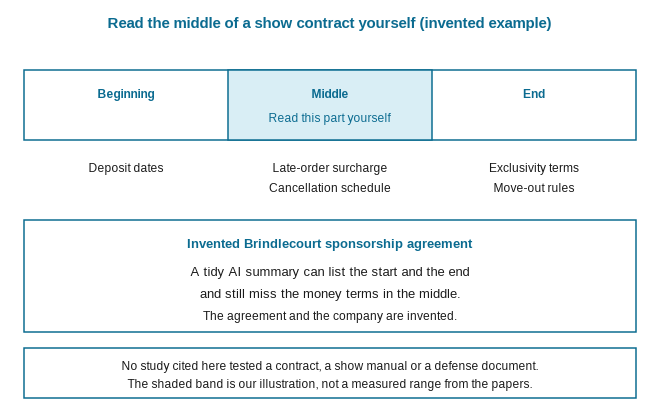
The figure is our own illustration, not a finding from HAMLET, and it does not show a real contract.
Knowing where an answer sits is not the same as using it
Muhan Gao, TaiMing Lu, Kuai Yu, Adam Byerly and Daniel Khashabi, all at Johns Hopkins University, probed three open-source models on two test tasks and published the result in the 2024 Findings of EMNLP (Gao et al., Findings of EMNLP 2024). They found that models can register where the target information sits and still fail to use it, which they call a “know but don’t tell” phenomenon (Gao et al., Findings of EMNLP 2024).
The same study reports that information from the middle of the context took deeper layers to retrieve, and that this delayed extraction led to a noticeable drop in accuracy (Gao et al., Findings of EMNLP 2024). Their limitation section says: “the model might know the location but still, fail to integrate it into a coherent and accurate answer.” (Gao et al., Findings of EMNLP 2024). That is not a finding about show contracts. It is a reason not to treat a tidy summary as proof that the middle was used.
What does not close the gap
In HAMLET, models of different sizes were compared on the same middle-of-the-book test, and “the two groups show negligible differences in vulnerability to the lost-in-the-middle effect”, which the authors read as a sign that raising parameter size alone does not fix the recall issue (Lee et al., EMNLP 2025). A bigger approved model is no fix. That line is our practice, drawn from that finding, not a test of your company’s tool.
Levy et al. looked at a different lever: prompting the model to work step by step. That raised accuracy, but the gain stayed about the same at every length and did not close the drop that came from a longer input (Levy et al., ACL 2024). Neither paper is a reason to skip a human read of the money terms.
What a prime’s events team can do
These steps are our practice, for a team that already works only in the approved company assistant.
- Ask about one section at a time. For example, ask what section 14 says about cancellation charges, not for a summary of all fees.
- Ask for the small print by name: the dollar amount, the date, the percentage. A general summary is where fine detail drops out first. (Our practice, drawn from the HAMLET detail finding.)
- Ask the tool to give section numbers for each fee it lists, then open those sections and read them.
- Read the middle of the document yourself for money terms. That is where HAMLET found recall of detail dropping.
- Treat silence as a gap, not as proof that there is no fee. A summary that never mentions the middle of the document has not shown that the middle is clean.
- Do not assume a bigger approved model fixes this. (Our practice, drawn from the HAMLET size finding.)
- Keep contracts on the approved company account, and only where your AI policy allows contract documents at all. A show contract never goes into a personal AI account. (Our rule.)
The approved assistant can save time on the first pass; the money terms still get a human read. A neighboring events check, on unsolicited hotel and list offers rather than on the contract itself, is in Check the Show Site Before You Answer a Hotel or List Offer.
Small contractors and startups. A supplier signing its first booth or sponsorship agreement may have no contracts team and no approved AI tool. Read the payment, cancellation and exclusivity sections in full, mark the page numbers on a one-page sheet, and ask the show organizer in writing about anything unclear before you sign. If you do use an AI tool, use one your company account controls and check every fee it lists against the page. (Our suggestion; none of the three studies tested a contract, and none is written for a first-time exhibitor.)
This article is about how AI tools handle long documents and is not legal advice. Your contracts team decides what a show or sponsorship agreement commits the company to.
Where this fits on ADINT
Keeping company AI on an approved account is also in Hidden Instructions in the Mail and Files Your Company AI Reads. Money promises in a sponsorship setting are in Keep Every Supplier Day Sponsorship Promise, With Evidence.
Limits
The sources are one EMNLP 2025 benchmark of query-focused summaries of English literary novels, one Findings of EMNLP 2024 study that probed three open-source models on two test tasks, and one ACL 2024 study of reasoning accuracy as input length grew, with five models. None of them tested contracts, show manuals or defense documents. HAMLET’s 0.10 figure is the authors’ own text summary of a recall score gap at the finest fact level, in the middle of a novel, not a percentage. Levy et al.’s 0.92 to 0.68 figure is accuracy on their reasoning questions at 3,000 tokens, not a contract result. Applying any of this to a show or sponsorship agreement is our practice. Your contracts team decides what an agreement commits the company to.
Sources
- Yuho Lee, Jiaqi Deng, Nicole Hee-Yeon Kim, Hyangsuk Min, Taewon Yun, Minjeong Ban, Kim Yul and Hwanjun Song (Korea Advanced Institute of Science and Technology), "Towards a Holistic and Automated Evaluation Framework for Multi-Level Comprehension of LLMs in Book-Length Contexts" (HAMLET), Proceedings of the 2025 Conference on Empirical Methods in Natural Language Processing, Anthology ID 2025.emnlp-main.1241, DOI 10.18653/v1/2025.emnlp-main.1241
- Muhan Gao, TaiMing Lu, Kuai Yu, Adam Byerly and Daniel Khashabi (Johns Hopkins University), "Insights into LLM Long-Context Failures: When Transformers Know but Don’t Tell", Findings of the Association for Computational Linguistics: EMNLP 2024, Anthology ID 2024.findings-emnlp.447, DOI 10.18653/v1/2024.findings-emnlp.447
- Mosh Levy (Bar-Ilan University), Alon Jacoby (Bar-Ilan University) and Yoav Goldberg (Bar-Ilan University; Allen Institute for AI), "Same Task, More Tokens: the Impact of Input Length on the Reasoning Performance of Large Language Models", Proceedings of the 62nd Annual Meeting of the Association for Computational Linguistics (Volume 1: Long Papers), Anthology ID 2024.acl-long.818, DOI 10.18653/v1/2024.acl-long.818
- Adapted from AssociationAI.ai, "Why an AI Tool Can Miss What Is in the Middle of a Long Document, and What That Means for Bylaws, Board Packets and Transcripts"