

Tutorial
Check the Show Site Before You Answer a Hotel or List Offer
For events, exhibit and field marketing staff at large defense and space primes with strict security policies: check every unsolicited hotel, list, directory or booth-service offer against the show's own website, and use the companion lab to see which offers to stop or hold before anyone books, pays or replies.
Time needed: About 20 minutes to work through one inbox of offers, then a few minutes for each new offer as it arrives
Before you start:
- The show's official website, opened by typing the address or from a bookmark you already saved, not from a link in the offer
- The offers sitting in the events inbox, including mail, texts and voicemails
- The name of the person on the events or security team who will receive every unnamed offer
Events Trade Shows Security Fraud Defense Space
Who this is for: events, exhibit and field marketing staff at a large defense or space prime, working with that company’s strict security policies. You book hotel blocks, buy booth services, and get unsolicited offers of rooms, attendee lists, directory listings and booth upgrades before every big show. A later box is written for small contractors and startups.
Teaching example: Invented Kestrelmoor Systems, its eight offers and every answer in the lab are made up. No real sender, email, phone number or vendor is shown in the sample rows.
One inbox, offer by offer
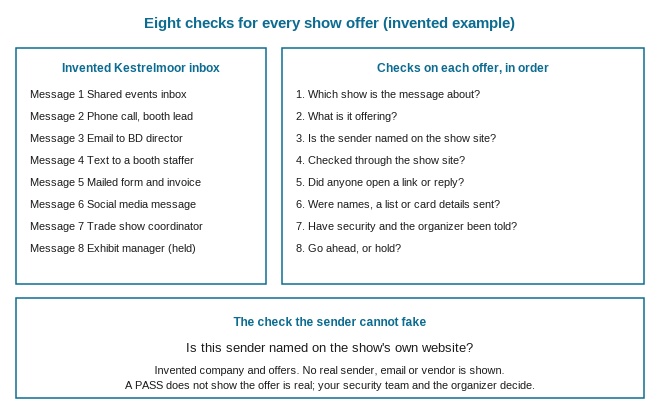
Invented Kestrelmoor Systems’ exhibit lead is six weeks out from a large defense show, and one inbox holds eight offers: rooms at a better rate than the official block, an attendee list, a show guide listing with an invoice, and booth upgrades, arriving by email, phone, text, mail and social media. Some messages use a show’s name. This is Case A in the lab, and every sender, offer and answer is invented.
The show’s own website, reached by a path you control, is a sender check the sender cannot fake for you. Type the address or open a bookmark you saved when the exhibit contract was signed, not a link from the message. The same idea, in a supplier-payment setting, is in The Booth Builder Changed Banks? How a Defense Marketing Team Handles Payment Change Emails. Look the sender up before anyone replies, even to say no.
Why these offers get a closer look
In a press release on April 1, 2024, the day its new impersonation rule took effect, the FTC said of consumer reports: “Combined, reported losses to these impersonation scams topped $1.1 billion for the year, more than three times what consumers reported in 2020.” (FTC, April 1, 2024). Those figures are consumer reports about government and business impersonators, not losses by defense companies or show exhibitors. None of the sources in this tutorial gives a rate for show scams, and this tutorial prints none.
A better hotel rate from a company you cannot find on the show site is the warning, not the deal.
What two organizers said about their own shows
Each notice below was written for that organizer’s own show. The lab treats a matching offer at that show as a STOP. Extensions to other events are labeled as our rules later.
AUSA’s 2026 annual meeting housing page said: “These companies are not affiliated in any way with AUSA and it is highly recommended that you do not use their services.” (AUSA, 2026 Exhibitor Housing). The same page said: “At past events, exhibitors and attendees have used these companies and lost deposits or did not receive the hotel rooms they reserved.” (AUSA, 2026 Exhibitor Housing). Book rooms through the housing provider that AUSA’s site names, not through a company that site does not name.
AUSA’s 2026 notice on unauthorized solicitors said: “Any housing information not found on AUSA’s official website is unofficial” (AUSA, Unauthorized Solicitors). An unofficial hotel offer for that meeting, from a company the AUSA site does not name, is STOP R1. At AUSA, an attendee list for sale is not AUSA’s list. The same notice said: “AUSA DOES NOT distribute any attendee lists or any attendee information and DOES NOT offer list rental services” (AUSA, Unauthorized Solicitors). A list sold as the AUSA attendee list is STOP R2, even if the sender appears to be a named partner, because AUSA said it does not distribute the thing being sold.
The Sea-Air-Space attend page, which describes Sea-Air-Space 2027 (April 4 to 7, 2027), says: “The Navy League and Sea-Air-Space do not use third-party companies to book hotel rooms.” (Sea-Air-Space, Attend). A hotel offer for that show from a company the attend page does not name is STOP R3. Book through the official hotel the show site names. The attend page also says: “If you are contacted, please notify the Navy League immediately.” (Sea-Air-Space, Attend).
AUSA’s 2026 meeting had already taken place by the date of this post. The notices are still the organizer’s published words about that meeting, and they are the basis for STOP R1 and STOP R2.
What general phishing advice adds
NIST’s Small Business Cybersecurity Corner page on phishing, created October 22, 2021 and updated October 16, 2026, says: “You can also receive attacks through text messages, phone calls, social media messages, or even physical postal mail.” (NIST, Phishing). The lab’s eight rows are labeled by channel for that reason. NIST also says: “Verify the request by using known contact information or information from a public company website, not from the message itself.” (NIST, Phishing). And: “Don’t engage with the sender, and do not click any link in the email (including unsubscribe).” (NIST, Phishing).
CISA’s page “Avoiding Social Engineering and Phishing Attacks”, dated February 01, 2021, is archived. Beside that first citation we print CISA’s own note: “In an effort to keep CISA.gov current, the archive contains outdated information that may not reflect current policy or programs.” (CISA, Avoiding Social Engineering and Phishing Attacks). The same page says: “Do not provide personal information or information about your organization, including its structure or networks, unless you are certain of a person’s authority to have the information.” (CISA, Avoiding Social Engineering and Phishing Attacks). It also says: “Do not use contact information provided on a website connected to the request; instead, check previous statements for contact information.” (CISA, Avoiding Social Engineering and Phishing Attacks).
NIST’s page is written for small businesses, and CISA’s is archived, so the lab keeps those checks as VERIFY R5, VERIFY R6 and VERIFY R7.
The steps
-
Open the show site yourself. Type the address or use a saved bookmark. A sender nobody has confirmed through the show’s own site is VERIFY R7.
-
Treat an unofficial hotel offer at AUSA or Sea-Air-Space as a stop. An unnamed company on an AUSA hotel offer is STOP R1. An unnamed company on a Sea-Air-Space hotel offer is STOP R3. Do not book. Send the message to your security team and to the organizer.
-
Treat a list sold as AUSA’s attendee list as false on its face. That is STOP R2. Do not buy it or answer the seller.
-
For any other show, hold the same kind of hotel or list offer and ask the organizer. A hotel offer from a company another show’s site does not name is VERIFY R8, labeled “(Our rule, drawn from AUSA and Navy League advice)”. An attendee list from a company a show other than AUSA does not name on its site is VERIFY R9, labeled “(Our rule, drawn from AUSA advice)”. Each rule quotes the organizer, says the organizer wrote it for its own show, and then says we apply it to every show as our own rule.
-
Do not sign a listing form or pay a show guide invoice from an unnamed company. That is VERIFY R13, labeled “(Our rule)”. Send the invoice to accounts payable marked unverified.
-
Order booth services only through the exhibitor services the show’s own site lists. An unnamed booth-service offer is VERIFY R14, labeled “(Our rule)”.
-
Forward every unnamed offer, and tell security the same day if someone already clicked, replied, or sent names or card details. An unreported unnamed offer is VERIFY R11, labeled “(Our rule)”. If only security has it, VERIFY R12 tells you to write the organizer at the address on its own site. Names, a rooming list or card details sent to an unconfirmed sender are VERIFY R5. A link opened or a reply sent too soon is VERIFY R6. Tell security today. If card details went out, the card holder should also call the card issuer.
-
Fill in every answer. A blank or unlisted answer is VERIFY R4, labeled “(Our rule)”.
Try it now: open the show offer sender check lab. The lab loads Case A first. Look at Message 1 (STOP R1, also R11), Message 3 (VERIFY R9, labeled “(Our rule, drawn from AUSA advice)”) and Message 5 (VERIFY R13). Then load Case B and watch Message 2, which matches both R3 and R11.
The worked example
In Case A, Message 1 is an unofficial AUSA hotel offer that has not been reported: STOP R1, also matching R11, so nobody books, and the message goes to security and to AUSA. Message 3 is an attendee list for another show from an unnamed company: VERIFY R9, so the team asks that organizer, through its own site, whether it rents a list at all. Message 5 is a show guide listing already forwarded: VERIFY R13, so nobody signs or pays. The other five offers pass: a Sea-Air-Space hotel offer from the official hotel the show site names, AUSA and Sea-Air-Space booth services from the organizer, another show’s hotel from a named partner, and a held AUSA booth order. That PASS means no teaching check fired on that row. It does not show the offer is real.
Check the counts on each case
Open every case in the lab and match its STOP, VERIFY and PASS counts to the table below. STOP means do not book, pay or reply; the rule rests on that organizer’s notice for its own show. VERIFY means settle the row before anyone acts, and read the label. PASS means no teaching check fired on that row.
| Case | STOP | VERIFY | PASS |
|---|---|---|---|
| A, eight offers in one inbox | 1 | 2 | 5 |
| B, a hotel offer and a list | 2 | 2 | 4 |
| C, names sent and a reply | 0 | 3 | 5 |
| D, card details and a blank | 1 | 3 | 4 |
| E, lists and a held offer | 0 | 4 | 4 |
| F, mixed problems | 2 | 2 | 4 |
Twelve messages match more than one check: A Message 1 (R1 and R11), A Message 3 (R9 and R11), B Message 2 (R3 and R11), B Message 4 (R2 and R10), C Message 3 (R5 and R14), C Message 6 (R6, R7, R11 and R14), D Message 1 (R1, R5 and R11), D Message 4 (R12 and R14), E Message 5 (R6, R11 and R13), E Message 8 (R11 and R14), F Message 4 (R2 and R10) and F Message 6 (R5 and R7). In Case D, one status has spaces around it and is trimmed before it is matched, and a blank answer is VERIFY R4. No case is all PASS.
When the list is real
A list that comes from the organizer, or from a partner the show site names, may be real. A real list is still people’s names, so it goes to privacy review before it goes anywhere else. That check is VERIFY R10, labeled “(Our rule)”: before anyone pays, ask your privacy and legal team what the people on it agreed to, keep it in the approved CRM, and do not load it into any AI tool. See also Before You Hand Over the Attendee List: A Vendor Resale-Terms Check.
Common mistakes with hotel and list offers
- Answering first, and checking the show site later. The reply, even an opt-out, can tell the sender the address is live (Our reading.)
- Using the phone number or booking link in the message. That path belongs to the sender, not to the organizer.
- Treating a bought list as just another spreadsheet. If the list is real, it holds people’s names and contact details.
- Reading a PASS as a green light. A clean row only means no teaching check fired.
Small contractors and startups. A first-time exhibitor with no security team can still run the sheet. Bookmark the show’s housing and exhibitor services pages the day the contract is signed, and check every offer against those bookmarks. Book rooms only through the link on the show site. If you already paid a company the show site does not name, call your card issuer and tell the organizer. (Our suggestion; the organizer notices are written for their own shows.)
This lab is practice for spotting show offers, not a security review. Your security team and the show organizer decide whether an offer is real.
Related
A neighboring events post is the tutorial on having IT review an event app before anyone installs it. The payment-change check is linked above.
Limits
These sources are one AUSA notice and one AUSA housing page written for the 2026 Annual Meeting, which had already taken place by the date of this post; one Sea-Air-Space attend page that describes the 2027 show; one NIST small business page updated October 16, 2026; one CISA page dated February 01, 2021 that CISA keeps in its archive, with CISA’s note that the archive may not reflect current policy or programs; and one FTC press release of April 1, 2024. The FTC figures are consumer reports, not losses by exhibitors. The three STOP checks rest only on each organizer’s notice for its own show. The two rules that carry those notices to other shows are our rules. None of the sources measures how often show exhibitors get these offers. Every check in the lab is a teaching choice.
Sources
- Association of the United States Army (AUSA), "Unauthorized Solicitors," 2026 Annual Meeting site
- Association of the United States Army (AUSA), "Exhibitor Housing," 2026 Annual Meeting site
- Sea-Air-Space (Navy League of the United States), "Attend"
- National Institute of Standards and Technology, "Phishing," Small Business Cybersecurity Corner, created October 22, 2021, updated October 16, 2026
- Cybersecurity and Infrastructure Security Agency, "Avoiding Social Engineering and Phishing Attacks," February 01, 2021 (archived content)
- Federal Trade Commission, "FTC Announces Impersonation Rule Goes into Effect Today," press release, April 1, 2024