

Tutorial
Before You Hand Over the Attendee List: A Vendor Resale-Terms Check
Before registrant or staff data goes to an event, list or ad vendor, read the vendor's data terms for resale. A five-check routine for defense and space marketing teams, built around what federal law says data brokers may not do with sensitive data and foreign adversaries. This isn't legal advice.
Time needed: About 25 minutes
Before you start:
- The current data terms for each vendor that will receive registrant or staff data
- A list of the fields you plan to send each vendor
- The name of your contracts or legal reviewer and your security contact
ADSEC Events Data Governance Personal Data Vendors Defense Space
Illustrative example: “Invented Prime Co.” and Invented Vendor 1 through Invented Vendor 6 are invented. No real company, vendor or person is described.
This isn’t legal advice. It’s a routine for reading vendor terms before you send data. Take any real question to your contracts or legal reviewer.
Invented Prime Co.’s events team is about to send registrant data to six vendors. Each has data terms that mention “partners” or “affiliates.” Nobody on the team has checked whether that means resale, or whether anyone’s military status would ride along.
The pocket question: if this vendor resold what we gave it, would that include anyone’s military status or location?
What the federal law covers, and what it doesn’t
Division I of Public Law 118-50, the Protecting Americans’ Data from Foreign Adversaries Act of 2024, sets a rule for data brokers. It says: “It shall be unlawful for a data broker to sell, license, rent, trade, transfer, release, disclose, provide access to, or otherwise make available personally identifiable sensitive data of a United States individual” to foreign-adversary countries or entities they control.
Two limits matter. First, the law covers data brokers, and it defines one as an entity that “makes available data of United States individuals that the entity did not collect directly from such individuals to another entity that is not acting as a service provider.” Second, it covers transfers to foreign adversaries only. It doesn’t ban resale in general, and it doesn’t tell you what to put in a vendor contract. Whether any vendor is a data broker under the law is a question for counsel.
On enforcement, the law says: “A violation of this section shall be treated as a violation of a rule defining an unfair or a deceptive act or practice”.
Why it’s still a useful lens
The law’s list of sensitive data is a good checklist for what you send. It includes “Information that reveals the status of an individual as a member of the Armed Forces.” It also covers precise location, defined in part as “within a range of 1,850 feet or less.” The list has other categories too; these two are the ones a defense events team is most likely to hold.
Using that list to read vendor terms is our teaching choice.
The checks
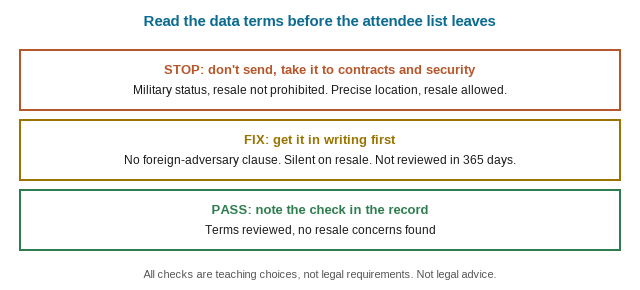
Every check and threshold below is our teaching choice, a suggestion for your own contract asks, not a requirement of the law. Each vendor meets the checks in order, and the first that matches decides.
- STOP if military status could be resold. If the data includes military status and the terms don’t prohibit resale, don’t send it. Take it to contracts and security.
- STOP if precise location could be resold. If the data includes precise location and the terms allow resale, don’t send it.
- FIX if there’s no written foreign-adversary clause. Ask the vendor for a written commitment not to make your data available to foreign-adversary countries or entities they control.
- FIX if the terms are silent on resale. Get a written answer before you send.
- FIX if the terms haven’t been reviewed in 365 days. Re-read them. The 365-day line is our teaching choice; 364 days passes.
Anything that clears all five is PASS. Note the check in the record.
Try it now: open the vendor resale terms check, load Case D, then work out why Invented Vendor 6 gets FIX rather than STOP even though its data includes precise location.
What to do with a STOP
Our suggestion: don’t send the field. Remove military status or precise location from the file, or hold the whole transfer, and take the terms to contracts and security. A STOP is a decision to pause, not an accusation against the vendor.
Check your work
The baseline is resale prohibited, no military status, no precise location, a written clause and terms reviewed 30 days ago.
- A, all six clear: all six vendors pass.
- B, blocked vendors: Vendor 1 has military status with silent terms and Vendor 2 with resale allowed; Vendor 3 has precise location with resale allowed: three vendors stop and three pass.
- C, terms gaps: Vendor 2 lacks the clause, Vendor 4 is silent and Vendor 5 was reviewed 400 days ago: three vendors need a fix and three pass.
- D, near misses: Vendor 1 has military status with resale prohibited but no clause, so it’s FIX on the clause; Vendor 6 has precise location with silent terms, which is FIX, since the location STOP needs resale allowed: two vendors need a fix and four pass.
- E, first match wins: Vendor 1 stops on military status ahead of its other gaps; Vendor 2 stops on location; Vendor 3, silent with no clause, is FIX on the clause; Vendor 4 at 365 days is FIX: two vendors stop, two need a fix, and two pass.
- F, boundary calls: 365 days is FIX and 364 PASS; military status with silent terms is STOP and with resale prohibited PASS; location with silent terms and no clause is FIX, and with resale allowed STOP: two vendors stop, two need a fix, and two pass.
Common mistakes
- Reading “partners” as “service providers” without asking.
- Sending a whole roster when the vendor needs three fields.
- Treating a vendor’s answer by phone as a written commitment.
- Assuming the federal law covers domestic resale. It doesn’t.
Limits
This tutorial rests on one law, which covers data brokers and transfers to foreign adversaries only. It doesn’t address later rules or state laws. The checks and the 365-day threshold are teaching choices. This isn’t legal advice; ask counsel.