

Article
The Booth Builder Changed Banks? How a Defense Marketing Team Handles Payment Change Emails
For marketing, events and BD staff at large defense and space primes: what Inspector General alerts say about hijacked vendor inboxes, fake W-9s and SAM.gov tricks, and why your part of any request to change where money goes is to report it, not pass it on.
ADSEC Payments Email Security Events Government Contracting Defense Space
Who this is for: marketing, events and business development staff at large defense and space primes, where finance owns supplier bank records, security owns suspicious email, and the AI, email and device rules are already written. You don’t change anyone’s payment details, and nothing here asks you to. This post explains why the rules around payment change requests look the way they do. A labeled box near the end is for small contractors and startups.
Illustrative example: Tavrenhold Aerospace and Brightfen Exhibits are invented for this example. No real company, show or person is described.
A routine email, mid-show
It’s the second morning of a regional show. The events lead at Invented Tavrenhold Aerospace is at the booth when a message arrives from the usual contact at Invented Brightfen Exhibits, the firm that built the booth. The email says Brightfen has moved to a new bank, attaches new account details and a fresh W-9, and asks that this week’s final invoice be paid to the new account.
The address is the one she has used all year. Nothing looks wrong, and that is the whole difficulty.
What the government alerts describe
Several federal alerts describe this pattern. They report schemes and allegations, not court findings.
A 2026 Commerce Department Inspector General fraud alert says criminals “gain access to and hijack government employee, grantee, or contractor/vendor email accounts and insert themselves into an existing payment conversation without the victim’s knowledge.” The new bank instructions arrive “sometimes supported by a fraudulent W-9 or other authentic-looking bank documents.” The alert explains why the trick lands: “Because the message appears to come from a known contact and fits an ongoing transaction, the recipient may send federal funds to an account controlled by the criminals.”
The Internet Crime Complaint Center (IC3), run by the FBI, walked through the mechanics in Public Service Announcement I-040620-PSA, published April 6, 2020. In IC3’s description, business email compromise targets organizations that pay by wire or ACH, and it often starts when someone takes over a genuine company mailbox, by tricking a person or by breaking in. Then “cyber criminals impersonate email communications between compromised businesses and third parties, such as vendors or customers, to request pending or future payments be redirected to fraudulent bank accounts.” IC3 also warns that “a successful email account compromise at one business can pivot to multiple victims within an industry.”
Our reading for show season: an exhibit house that bills many exhibitors is the kind of shared vendor that line describes.
One number, read narrowly
The same PSA gives one figure: “Between January 2014 and October 2019, the Internet Crime Complaint Center (IC3) received complaints totaling more than $2.1 billion in actual losses from BEC scams using two popular cloud-based email services.”
Keep its limits attached. It counts complaints to IC3, over almost six years, for scams using two cloud email services the alert doesn’t name. It isn’t a rate, a figure for defense companies, or the total for business email compromise as a whole.
When the government is the payer
A defense company also gets paid, and schemes aim at that side too.
A recent GSA Inspector General scam alert, undated on its page, says “scammers are impersonating GSA officials and sending fraudulent emails to GSA contractors, including companies holding Multiple Award Schedule contracts and entities registered in SAM.gov.” Its account of the method: “Scammers obtain the name and title of an actual GSA official, create a realistic signature block, and use it to impersonate that official in an email.” The mail comes from a look-alike domain, and “recipients may not immediately notice that the sending domain is not legitimate.”
A September 2023 USAID Inspector General alert describes a case reported to it. An awardee’s executive was hit by malware, and “fraudsters used their real email address to instruct the awardee’s financial team to change its SAM.gov information.” In the alert’s words: “USAID deposited funds into the scammer’s bank account rather than the awardee’s.”
Earlier, DOE Policy Flash 2018-18, dated March 27, 2018, told Energy Department contracting staff that “individuals have used public information to impersonate legitimate entities and establish entity registrations within SAM.” According to DOE, “these individuals have redirected payments from the Government to the fraudulent entities registered in SAM.”
Our framing: if you staff a public BD inbox or run event registration, a message wearing a contracting official’s name may reach you before it reaches contracts.
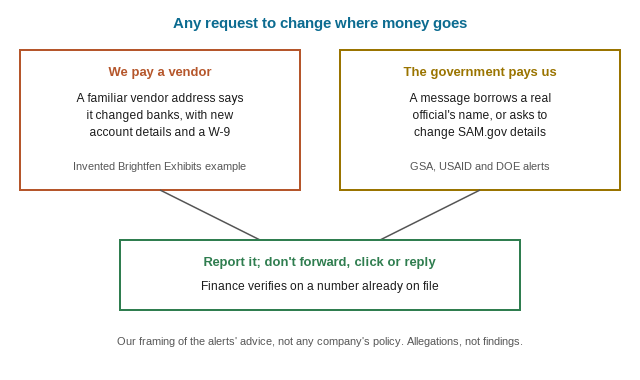
Why the rules at a large company look this way
Our framing of familiar controls, each tied to an alert’s advice, not any named company’s policy.
- Call back on a number already on file. IC3’s advice is to “Verify all payment changes and transactions in person or via a known telephone number.” USAID adds: “Do not call numbers provided by the unsolicited emails.” That is why finance ignores the number on the new letterhead.
- Two people approve bank changes. Commerce OIG says to “Require dual approval and separation of duties for grantee/contractor payment setup, banking changes, grant drawdowns, checks, ACH transfers, and wire payments.” A forwarded email can’t change anything on its own.
- The name on the message proves nothing. Commerce OIG: “A familiar display name does not confirm the sender’s identity.”
- Mail settings you may have noticed. IC3 told IT administrators: “Add an email banner to messages coming from outside your organization.” Its list also says: “Prohibit automatic forwarding of email to external addresses.” An outside-sender banner shows only that a message came from outside the company. On a familiar vendor’s address, it can’t tell you whether that mailbox has been taken over.
Your part when one arrives
Our framing for staff at a company with rules like these:
- Don’t reply, click or open. USAID: “Do not click any links or download any attachments from unsolicited emails or text messages to update or verify account information.” That includes the new W-9.
- Don’t forward the bank details to accounts payable. That moves a risky request one step closer to payment.
- Report it through your company’s route, the suspicious email button or security channel, and tell finance through a contact you already have. GSA’s advice to its own contractors, written for a different setting, is “Report internally first.” GSA OIG also asks people to “retain a copy, including headers if possible, to include with your report.”
- Leave the call to finance. Your vendor contact may be innocent; their mailbox may be the one taken over.
- Keep it out of AI tools, including your company-approved account. A chatbot can’t tell you whether an account is real. This is company-policy framing, not a source finding.
If money already moved
IC3 says: “If you discover unauthorized payments, contact your financial institution immediately to request recall of the funds.” At a prime, that call belongs to finance and security. Marketing supplies the timeline: when the message arrived, who saw it, what was forwarded. None of these alerts promises the money comes back.
Small contractors and startups. IC3 says “Small and medium-size organizations, or those with limited IT resources, are most vulnerable to BEC scams because of the costs of robust cyber defense.” With no finance department, the founder or office manager is the second approver. Put the call-back rule in writing: no bank change until someone phones the vendor on a number you collected yourself. Take contracting officers’ details from your own contract files, not from an email. Ask whoever runs your email to switch on an outside-sender banner and block automatic forwarding to outside addresses.
Related
Screening who you pay is a separate check: see our OFAC screening tutorial. For the accounts a scammer might target, see marketing account sign-in policy. To practice tracing claims to an official text, try today’s rule alert line check lab.
Limits
These five sources run from 2018 to 2026, each written for its own agency’s world. None measures risk at defense companies or trade shows. This is general information, not legal advice.
Sources
- FBI Internet Crime Complaint Center, Public Service Announcement I-040620-PSA, "Cyber Criminals Conduct Business Email Compromise through Exploitation of Cloud-Based Email Services, Costing US Businesses More Than $2 Billion" (April 6, 2020)
- GSA Office of Inspector General, "Scam Alert: Scammers Impersonating GSA Contracting Officials to Target Vendors and Contractors" (undated on the page)
- USAID Office of Inspector General, "Business Email Compromise Scheme Alert" (Fraud Alert, Sept 2023)
- U.S. Department of Energy, Office of Acquisition Management, Policy Flash PF 2018-18, "Fraudulent Activities Within the System for Award Management (SAM) Environment" (March 27, 2018)
- U.S. Department of Commerce Office of Inspector General, "Fraud Alert" on business email compromise and federal grant payments (2026)
- Adapted from FOUNDINT.AI, "When a Grantee's Bank Details Suddenly Change: Verifying Payment Requests and Spotting Impersonation"