

Tutorial
Before You Pay the Booth Builder Abroad: An OFAC Check for Marketing Teams
International shows mean foreign vendors and fast invoices. Here is how a defense or space marketing team screens each payee, its owners and its signer against OFAC's lists, applies the 50 Percent Rule, and keeps a dated record, plus when to stop and hand off to compliance or counsel. General information, not legal advice.
Time needed: 10 to 20 minutes per payee
Before you start:
- The legal name, owners and signer for each overseas payee, or a contact who can supply them
- Access to OFAC's Sanctions List Search tool and a place to keep dated records
- A named compliance contact or counsel to call if anything looks like a match
Events Trade Shows Compliance Defense Space
Illustrative example: “Halberd Point Systems,” the “Meridian Maritime Expo” and every payee and person below are invented for teaching.
Halberd Point Systems, a U.S. company, owes three vendors at an overseas show before a November 16, 2026 payment run: a booth builder, an interpreter agency and a hospitality suite venue. Marketing assumed procurement had screened them, and procurement assumed nobody screens a show budget.
By the end: a dated record per payee for name, owners and signer.
Marketing usually isn’t the compliance function, so this guide covers what to collect and when to hand off. It is general information drawn from OFAC’s own pages, not legal advice, and it does not cover export controls, ITAR or any specific sanctions program. On any possible match, stop and call counsel.
Why a marketing team is on the hook
OFAC’s FAQ 11 is plain: “All U.S. persons must comply with OFAC sanctions, including all U.S. citizens and permanent residents regardless of where they are located, all individuals and entities within the United States, and all U.S. incorporated entities and their foreign branches.”
The risk is blocking. FAQ 9: ""Blocking” refers to freezing assets or other property.” FAQ 10 adds that “persons appearing on OFAC’s List of Specially Designated Nationals and Blocked Persons (SDN List) are blocked pursuant to OFAC regulations and other authorities …” and that “generally U.S. persons are prohibited from engaging in transactions involving blocked persons wherever such blocked persons are located …”
OFAC’s compliance framework says it “strongly encourages organizations subject to U.S. jurisdiction … to employ a risk-based approach to sanctions compliance by developing, implementing, and routinely updating a sanctions compliance program (SCP).” It also notes: “Many organizations conduct screening of their customers, supply chain, intermediaries, counterparties, commercial and financial documents, and transactions in order to identify OFAC-prohibited locations, parties, or dealings.” That is encouragement, not a mandate on marketing teams.
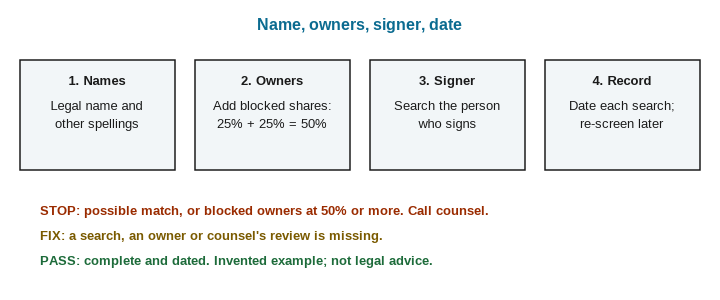
Step 1: Gather four facts per payee
Ask each vendor for its legal name, other names or spellings, its owners and their shares, and who will sign the contract. A vendor that won’t name its owners has given you an answer.
Step 2: Search every name and save the result
Run the legal name and each other name through OFAC’s Sanctions List Search tool. Save the result with the date. A clean result is not a clearance. FAQ 469: “OFAC does not issue non-inclusion certificates to show an entity or individual is not listed on one of OFAC’s sanctions lists, nor does OFAC publish a “safe list.””
Step 3: Add up the owners
A clean name search only covers the name. FAQ 401: “OFAC’s 50 Percent Rule states that the property and interests in property of entities directly or indirectly owned 50 percent or more in the aggregate by one or more blocked persons are considered blocked.” Search each owner and add up the blocked owners’ shares. Two at 25 percent each make 50, and 50 counts.
FAQ 398: “OFAC’s 50 Percent Rule speaks only to ownership and not to control.” It goes on: “OFAC may, however, designate the entity under an available sanctions criteria or otherwise identify the entity as blocked property if determined to be controlled by one or more designated persons and add the entity to OFAC’s List of Specially Designated Nationals and Blocked Persons (SDN List).”
Try it now: the payee screening record loads three invented show vendors. Enter what each search found, the owners’ shares and who signs, and it marks every payee STOP, FIX or PASS and writes a dated record. It searches no list and isn’t legal advice.
Step 4: Search the signer
FAQ 400 gives a concrete case: “U.S. persons may not, for example, enter into contracts that are signed by a blocked individual.” Search the person signing.
Step 5: Don’t lean on an exemption alone
Exemptions and general licenses exist. OFAC says “exceptions may vary in type and scope across different sanctions programs.” The lab puts it plainly: “Exemptions and general licenses depend on the program and the facts.” Get counsel’s review first.
Step 6: Date the record and re-screen
Keep each name, date, result, share and signer, and search again before any later installment. The lab treats a search more than 30 days before the payment date as stale; that window is a teaching choice, because OFAC’s FAQs set no re-screen schedule.
Check your work
The lab’s six cases:
- A, clean run: all three payees PASS.
- B, possible match on the venue: the venue STOPs. Hold the payment and call counsel.
- C, two blocked owners at exactly 50 percent combined: the booth builder STOPs.
- D, possible match on a signer, with other names also unsearched: the interpreter agency STOPs on the signer first.
- E, control plus an unreviewed exemption: the venue STOPs (“Control isn’t ownership under the 50 Percent Rule, but OFAC may still designate a controlled entity.”); the interpreter agency gets FIX until counsel reviews.
- F, stale search and unknown owners: two FIX results: a search 32 days old, and unknown owners.
Failure case
The team searches three vendor names, finds nothing and pays. Nobody asked who owns the booth builder. If blocked owners hold half of it between them, its own clean search doesn’t help.
Common mistakes
Counting one blocked owner at a time. The rule adds them up.
Reusing an old search. Re-screen before each payment.
Limitations
FAQ numbers and wording match OFAC’s pages as read October 30, 2026; OFAC revised some of this wording in late October 2026. The lab models direct ownership only.
Sources
- OFAC FAQs, "Basic Information on OFAC and Sanctions" (as read October 30, 2026)
- OFAC FAQs, "Entities Owned by Blocked Persons (50% Rule)" (as read October 30, 2026)
- OFAC, "A Framework for OFAC Compliance Commitments"
- Adapted from FOUNDINT.AI, "Screen a Grantee, Vendor or Payee Against OFAC Sanctions Lists Before You Pay"