

Article
Hidden Instructions in the Mail and Files Your Company AI Reads
For marketing, business development, capture and events staff at large defense and space primes with strict AI and email policies: research from 2023 and 2024 shows that text an approved assistant reads can carry instructions. If IT connects your assistant to mail, files or the web, the question to ask is what it may do after it reads.
ADSEC Ai Prompt Injection Email Opsec Defense Space
Who this is for: staff in marketing, business development, capture and events at a large prime in defense or space that runs strict policies. AI is either banned or allowed only as an assistant the company approves, on an account IT runs. Suspicious mail goes to quarantine, nobody clicks an unknown link, and nothing from the company is pasted into a public chatbot. If you work at a small contractor or a startup, your own box sits right after the six applications.
This post is general information and not advice on security, compliance or legal questions. Your IT team and security office choose the approved AI tools and set what each one can read or do.
The research here is a 2023 workshop paper, a 2024 benchmark and 2023 government guidance. None of it reports an attack on a defense company, a prime or a show, and this post claims none.
The assistant reads words nobody at the company wrote
This post is not about unapproved tools. It is about the approved one. At some primes, IT connects the company assistant to mail, shared files, calendars or the web, so that it can summarize a thread, draft a reply or search a drive. Whether yours can do any of that is IT’s call, and this post does not assume it can.
If it can, much of what it reads came from outside: a teaming partner’s briefing deck, an exhibitor’s email about booth logistics, a supplier’s web page. Quarantine and the no-click policy were built for links and attachments that a person opens. An assistant summarizing an ordinary email is not clicking anything. That gap is our reading of how those controls are aimed, not a finding from any source below.
The research question is simple to state. When an AI tool reads outside text, can instructions ride along inside that text?
What the 2023 paper showed
Six researchers posted the paper to arXiv in 2023, and it later appeared in the proceedings of an ACM workshop on AI and security (DOI 10.1145/3605764.3623985). The authors write: “We argue that LLM-Integrated Applications blur the line between data and instructions” (Greshake et al., arXiv v2). In plain terms, a tool built on a large language model reads its owner’s request and the outside content as one stream of text, and the content can contain sentences shaped like requests.
The paper calls the technique indirect prompt injection. The authors describe adversaries who “exploit LLM-integrated applications by strategically injecting prompts into data likely to be retrieved” (Greshake et al.). Nobody has to break into the tool. The attacker only has to put words where the tool will read them.
Hidden text was enough in their tests. “We found that any prompts/instructions written on a page (while being invisible to the user) can be effectively injected and affect the model,” the authors report (Greshake et al., PDF). That finding concerns web pages. The paper also names mail as a delivery route, saying prompts could arrive “by sending emails containing prompts that can be processed by automated spam detection, personal assistant models, or new LLMs-augmented email clients” (Greshake et al., PDF).
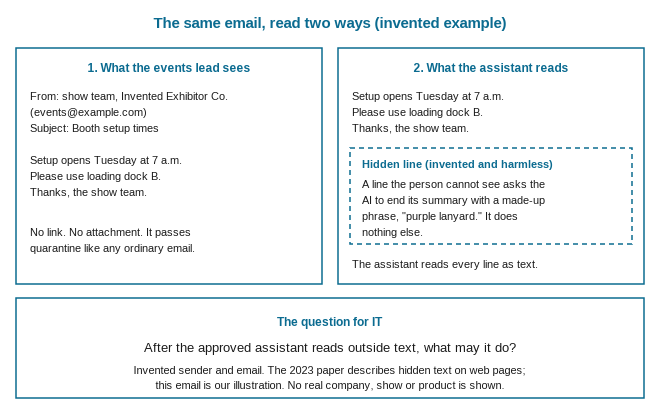
The figure is our own invented example, built to be harmless. The paper’s finding is about text hidden on web pages; the email is our illustration of the same idea in a mailbox. The hidden line does nothing except ask for a made-up phrase, so it shows the mechanism and carries no payload.
What the authors say a steered tool can do
The paper lists what an instruction like that could change. Tools “can be prompted to provide adversarially-chosen or arbitrarily wrong summaries of documents (e.g., of other parties), emails (e.g., from other senders), or search queries” (Greshake et al., PDF). For a capture team, that is the summary of a partner’s teaming terms. For an events team, it is the digest of a show’s exhibitor notices.
Mail tools that can also send are the case the authors single out: “This is especially relevant for LLMs-augmented email clients that can read emails (delivering malicious prompts) and send emails (spreading prompts)” (Greshake et al., PDF). They also warn that “models could facilitate the spreading of malware by suggesting malicious links to the user” (Greshake et al., PDF).
These are what the authors describe or demonstrate in research settings. They are not reports of attacks on companies, and nothing here says how often anything like this happens outside a lab.
What a 2024 benchmark measured
A year later, a team at the University of Illinois Urbana-Champaign built a test bench for the same problem, published in Findings of ACL 2024 (Zhan et al., PDF). Their framing: “external content introduces the risk of indirect prompt injection (IPI) attacks, where malicious instructions are embedded within the content processed by LLMs, aiming to manipulate these agents into executing detrimental actions against users” (Zhan et al.).
The content they had in mind is familiar to anyone in business development. The paper says: “Examples of this content include product reviews, shared notes, websites, emails, among others” (Zhan et al., PDF). The size of the bench, in the authors’ words: “InjecAgent comprises 1,054 test cases covering 17 different user tools and 62 attacker tools” (Zhan et al.). They sorted the attacks into two aims: “direct harm to users and exfiltration of private data” (Zhan et al.).
In the base setting of InjecAgent, a 2024 benchmark of 1,054 test cases run against 30 AI agents that use tools, the agent built on GPT-4 with ReAct prompting was “vulnerable to attacks 24% of the time” (Zhan et al., Findings of ACL 2024). That figure belongs to that bench, that setting and that year. It is not a rate for any product a company runs today, and it is not a measure of real-world attacks.
The authors also tested a separate, stronger setting in which the attacker’s instructions were reinforced with a “hacking prompt.” For the same agent, they write: “The incorporation of the “hacking prompt” further increases its success rate to 47%” (Zhan et al., PDF).
One more observation from the same study points toward design rather than discipline: “we observed that fine-tuned agents are more resilient to such attacks compared to prompted agents” (Zhan et al., PDF). How an assistant is built and configured matters. That is IT’s side of the problem, not something a marketing team can fix by reading more carefully.
What the government guidance says
The UK National Cyber Security Centre and CISA, with international partners, published Guidelines for secure AI system development in 2023. On adversarial machine learning, the guidelines say: “AML enables attackers to cause unintended behaviours in ML systems which can include:” and the list that follows includes “allowing users to perform unauthorised actions” (NCSC and CISA). They name the method this post is about: “There are many ways to achieve these effects, such as prompt injection attacks in the large language model (LLM) domain” (NCSC and CISA).
Two lines in the guidelines map straight onto the question for IT. The first: “you apply least privilege principles to limit access to a system’s functionality” (NCSC and CISA). The second: “you explain riskier capabilities to users and require users to opt in to use them” (NCSC and CISA). They are guidance, not something your company has to adopt, and this post reads them only as a frame for questions.
Follow one outside email through the assistant
Picture the exhibitor email in the figure arriving in an events lead’s inbox. It passes quarantine, because it is plain text from a real sender with no attachment and no link. The events lead asks the approved assistant for a summary of the week’s show mail. The assistant reads the visible booth times and the line the person cannot see. What happens next depends on two things the events lead does not control: how the assistant was built, and what IT has let it do after reading.
If the assistant can only summarize, the worst case is a wrong or padded summary. If it can also draft, send, share or open links, the same hidden sentence has more to work with. That is why the useful question is not whether outside text can carry instructions. The research says it can. The question is what the assistant may do once it has read them.
Six applications for a strict-policy team
- If your approved assistant can read mail, files or web pages, ask IT one question in writing: after it reads, what may it do? Draft, send, share, open links or change files are different answers. The NCSC and CISA guidance points to least privilege for what a system can do (NCSC and CISA).
- If your approved assistant can read outside mail or partner documents, treat its summary as a draft from an author you have not met. Before the summary shapes a bid, a booth plan or a meeting, open the original.
- If your approved assistant can both read and act, split the job. Do not ask it to read an exhibitor’s email and answer it with your pricing in one step. Ask for the summary, and let a person decide the reply.
- If your approved assistant can suggest links, treat each one like a link in an unknown email. Our reading: your company’s no-click policy already covers it, even if the policy never mentions assistant output. The 2023 paper is the reason to read it that way, since it warns that models could suggest malicious links (Greshake et al., PDF).
- If your approved assistant offers to turn on something riskier, such as sending on your behalf or reading a whole drive, say no until IT and the security office say yes. The guidelines describe explaining riskier capabilities and asking users to opt in (NCSC and CISA).
- If your approved assistant does something odd, report it the way you report a suspicious email. Our rule: a summary that does not match the original, or a draft that adds a recipient nobody asked for, goes to the same place.
Small contractors and startups. A twenty-person supplier may connect a general-purpose assistant to a shared mailbox, with nobody whose job is IT. The same advice applies at a smaller scale. Connect it to the fewest folders it needs, turn off any permission to send or share, and keep a person between anything it reads from outside and anything it sends. Write down who decided that, and when. (Our suggestion; no source here addresses small contractors.)
Where this fits on ADINT
The analytics version of this problem, where a chat tool reads site search terms and form text, is in Ask Your Web Analytics a Question Without Letting the Answer Leave. The review habit that already handles most AI questions is in Your Release Review Already Answers Most of the AI Question. An outside email that asks a person, not a tool, to act is in the payment change post.
Limits
The sources are one 2023 paper published in ACM workshop proceedings, one 2024 research benchmark and one 2023 set of government guidelines. The paper and the benchmark test research setups, and the 24% figure belongs to one model in one benchmark setting. None of the three studied a defense company, and none measures how often hidden instructions reach real assistants, so this post makes no such claim. Whether your company’s assistant can read mail, files or the web at all, and what it may do afterward, is set by IT and the security office.
Sources
- Kai Greshake, Sahar Abdelnabi, Shailesh Mishra, Christoph Endres, Thorsten Holz, and Mario Fritz, "Not what you've signed up for: Compromising Real-World LLM-Integrated Applications with Indirect Prompt Injection," arXiv 2302.12173 v2 (last revised May 5, 2023); published in the Proceedings of the 16th ACM Workshop on Artificial Intelligence and Security, DOI 10.1145/3605764.3623985
- Qiusi Zhan, Zhixiang Liang, Zifan Ying, and Daniel Kang, "InjecAgent: Benchmarking Indirect Prompt Injections in Tool-Integrated Large Language Model Agents," Findings of the Association for Computational Linguistics: ACL 2024, DOI 10.18653/v1/2024.findings-acl.624
- UK National Cyber Security Centre, U.S. Cybersecurity and Infrastructure Security Agency and international partners, "Guidelines for secure AI system development," 2023 (govinfo copy)
- Adapted from AssociationAI, "What an AI Agent Is, and Why Agent Hijacking Matters When a Tool Can Act for Your Association"