

Tutorial
Map Each Line of an AI Summary to Its Section
For marketing, communications and capture marketing staff at a major prime in defense or space, limited by a strict AI policy: give each line of an AI summary the section it came from, record which third of the document that section sits in, and use the companion lab to see which lines to stop or hold before the brief goes out.
Time needed: About 25 minutes to work through one eight-line brief, then a few minutes for each new summary
Before you start:
- The long document the summary was made from, such as an industry day transcript and its Q&A, opened in a tool where you can search
- The AI summary itself, with one line per claim if you can split it
- The name of the capture or communications lead who will decide what goes in the brief
Market Intelligence Ai Literacy Events Defense Space
Who this is for: capture, communications and marketing teams at a major prime, held to a strict AI policy that permits only the approved company assistant. The work is in defense or space. You turn long program office documents, such as an industry day transcript and its Q&A, into a messaging or booth brief. A later note is aimed at a small contractor or a startup.
Teaching case: Invented Corvennish Aerospace, its capture marketing lead, the 72-page industry day transcript and Q&A, the eight summary lines and every answer in the lab are made up. No real program office, solicitation or transcript is described.
This lab is practice for checking an AI summary against its document, not a review of any real program. Your capture and communications leads decide what goes in the brief.
One transcript, eight lines
Invented Corvennish Aerospace’s capture marketing lead has a 72-page industry day transcript and Q&A and two days to turn it into a booth messaging brief. The company’s approved assistant returns eight tidy lines. They read well. One points to a section the transcript does not have. One gives a dollar figure that appears nowhere in the transcript. Nothing comes from the middle third, where the program office answered the small business teaming questions. Every line and answer in the lab is invented.
That story is our practice, not a finding from any paper below. The research did not test industry day transcripts or defense briefs. It did show that people judge long summaries more consistently claim by claim than as a whole (Krishna et al., EACL 2023), that a section pointer does not replace reading the source (Krishna et al., EACL 2023), and that in tests of long-input models, the middle can be where they lose track (Veseli et al., COLM 2025).
Why a line needs a section
Kalpesh Krishna and Mohit Iyyer, at the University of Massachusetts Amherst, Erin Bransom, Bailey Kuehl, Pradeep Dasigi and Kyle Lo, at the Allen Institute for AI, and Arman Cohan, at the Allen Institute for AI and Yale University, published LongEval in the 2023 EACL proceedings (Krishna et al., EACL 2023). They deployed the guidelines on two long-form summarization datasets, SQuALITY and PubMed, and report that “switching to a finer granularity of judgment (e.g., clause-level) reduces inter-annotator variance in faithfulness scores” (Krishna et al., EACL 2023). Their guidelines also say: “Annotators should be instructed to read the entire source document and to not rely solely on highlighted hints, since that could bias their judgments” (Krishna et al., EACL 2023). Their checkers reported that hints were only sometimes useful, and that they read the entire source along with keyword searches (Krishna et al., EACL 2023).
The section number tells you where to look. It does not mean anyone looked. The LongEval authors also found that “summary sentences in both datasets were overloaded with information,” so they split sentences on conjunctions and punctuation to get more atomic units (Krishna et al., EACL 2023). One line, one claim: split the line before you check it. Those studies tested checkers and summaries of stories and medical papers, not a defense marketing brief; the sheet below applies the findings as our own rule. This tutorial is adapted from an AssociationAI.ai post on checking an AI summary against its source document, linked in the source list, and recast here for a prime’s industry day brief.
Why the sheet records thirds
Anshuman Chhabra, Hadi Askari and Prasant Mohapatra, all at the Department of Computer Science, University of California, Davis, published a short paper in the 2024 NAACL proceedings on where summary sentences come from (Chhabra et al., NAACL 2024). They define position bias as “the tendency of models to prioritize information from certain parts of the source text, potentially overlooking crucial details in other parts of the input article,” and they estimated it by “generating a distributional mapping between summary sentences and the article sentences used to generate the summary” (Chhabra et al., NAACL 2024).
The result from that paper is not that summaries skip the middle. The authors found low position bias on three of their four datasets, and strong lead bias only in the extreme short-summary setting, where very long articles were paired with summaries of only one or two sentences, a pattern they said was absent from the gold summaries (Chhabra et al., NAACL 2024). Recording which third of the document each brief line comes from, and reading a third that has no line, is our practice, not a finding that every summary skips a third.
Blerta Veseli and Alexander Koller, at Saarland University, Julian Chibane, at the Max Planck Institute for Informatics, and Mariya Toneva, at the Max Planck Institute for Software Systems, have a paper in the Conference On Language Models 2 pre-proceedings (COLM 2025) (Veseli et al., COLM 2025). The findings and affiliations quoted here are from the arXiv copy, whose header says it was published at COLM 2025 (Veseli et al., COLM 2025).
In that COLM 2025 study from Saarland University and two Max Planck institutes that tested open-source, instruction-tuned models with context windows from 8K to 128K, the authors report that the weak spot for facts placed mid-input “is strongest when inputs occupy up to 50% of a model’s context window” (Veseli et al., COLM 2025). Beyond that point, they write, “the primacy bias weakens, while recency bias remains relatively stable” (Veseli et al., COLM 2025). That 50% figure is a share of each model’s context window, not of a document. The tasks were retrieval and reasoning questions, not summaries, and the approved company assistant was not tested.
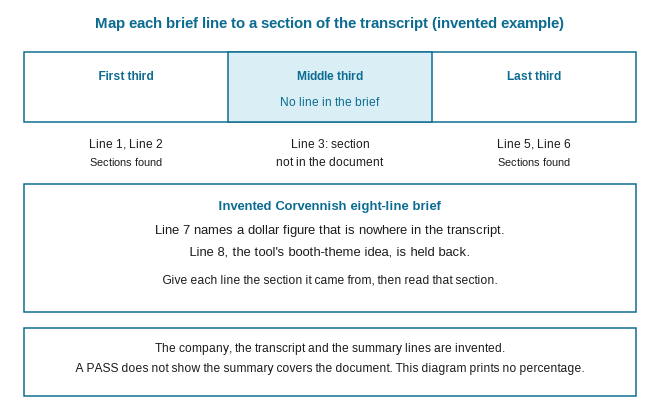
The figure is our illustration, not a paper finding.
The sample sheet
The lab is a one-page sheet with eight rows, one per summary line, including what the program office wants next year, questions on small business teaming, a dollar ceiling mentioned in the Q&A, and the tool’s idea for a booth theme, which starts held back. For each line you answer six questions: whether a section was named and found; which third it sits in; what you found on reading it; whether any figure, date or name matches the page; whether the line is a fact from the document or the tool’s own advice; and whether it goes in the brief or is held back. Two document answers sit under the rows: what the tool said about the file it read, and whether spot questions on the middle were asked and answered.
A STOP on a line means the section that line points to is not in the document, or a figure, date or name in the line is nowhere in the document. Those are literal checks against the document itself, not guidance from a paper. A STOP on the document means the tool said it cut the file short, so the summary was not made from the whole document. Everything else in the lab is a VERIFY labeled “(Our rule)” or “(Our rule, drawn from …)”, and those rules never claim the papers tell readers to do anything. A PASS only means no check fired.
The steps
-
Give each summary line the section it came from, then open that section and read it. A line that names a section the document does not have is STOP R1. A fact line that gives no section is VERIFY R8, labeled “(Our rule)”. (Our practice, drawn from the Chhabra mapping method.)
-
Read the section and choose a reading answer. If the section says something different from the line, that is VERIFY R4, labeled “(Our rule)”. If you have not read it yet and the line is still set to go in the brief, that is VERIFY R7, labeled “(Our rule, drawn from the LongEval study of how people check long summaries)”.
-
Split a line that makes more than one claim and check each claim on its own. If only part of the line is in the section, that is VERIFY R6, labeled “(Our rule, drawn from the LongEval study of how people check long summaries)”. The researchers tested models and checkers, not a defense marketing brief; we apply the finding as our own rule.
-
Check every figure, date and name against the page. A figure, date or name that is nowhere in the document is STOP R2. A figure that differs from the section is VERIFY R5, labeled “(Our rule)”. Copy it from the page.
-
Record which third of the document each line comes from. If one third has no line in the brief, read that third yourself. That is VERIFY D4, labeled “(Our rule, drawn from research by Chhabra and colleagues on summaries)”. This step and D4 are our practice, not a finding that summaries skip a third.
-
Put three questions to the tool that only the middle third can answer, and compare each reply with the page. A wrong middle answer is VERIFY D3, labeled “(Our rule, drawn from research by Veseli and colleagues on long inputs)”. If nobody asked yet, that is VERIFY D5, labeled “(Our rule)”. The Veseli tests were on retrieval and reasoning, not summaries; we apply the finding as our own rule.
-
Confirm the tool read the whole file. If the tool said it cut the file short, that is STOP D1: the summary was not made from the whole document. If nobody knows, that is VERIFY D6, labeled “(Our rule)”. Ask for the last section heading it saw and compare it with the document.
-
Hold the tool’s own suggestions, or mark them as AI suggestions. If a suggestion is set to go in the brief, that is VERIFY R9, labeled “(Our rule)”. A missing or unlisted choice, or a clash such as a found section with no third, is VERIFY R3, labeled “(Our rule)”. A missing or unlisted document answer is VERIFY D2, labeled “(Our rule)”.
Try it now: open the summary section coverage check lab. Case A is already on the page when you open it. Start with Line 3 (STOP R1, also R7), Line 5 (VERIFY R7) and Line 7 (VERIFY R5). Then switch to Case B and watch the document verdict, STOP D1.
The worked example
In Case A, Line 3 names a section that is not in the document and has not been read: STOP R1, also matching R7, so the line comes out of the brief. Line 5 is a fact set to go in the brief but has not been read: VERIFY R7, so someone opens the section. Line 7 has a figure that differs from the section: VERIFY R5, so the figure is copied from the page. The other five lines pass, including the tool’s booth-theme idea, which is held back. A PASS on that row only means none of the teaching checks fired. It is not a finding that the line is right. The document verdict in Case A is PASS D7, which also does not show that the summary covers everything.
Check each case against these tallies
Load each case on the page and confirm the STOP, VERIFY and PASS tallies, and the document verdict, against the table below. STOP means the section is not in the document, a figure, date or name is nowhere in the document, or the tool said it cut the file short. VERIFY means settle the row or the document answers before the brief goes out. PASS means no teaching check fired.
| Case | STOP | VERIFY | PASS | Document |
|---|---|---|---|---|
| A, a missing section | 1 | 2 | 5 | PASS D7 |
| B, a cut file | 1 | 2 | 5 | STOP D1 |
| C, an empty third | 0 | 2 | 6 | VERIFY D4 |
| D, a wrong middle answer | 0 | 3 | 5 | VERIFY D3 |
| E, no middle questions | 1 | 2 | 5 | VERIFY D5 |
| F, file not confirmed | 1 | 1 | 6 | VERIFY D6 |
| G, spaced and blank answers | 0 | 2 | 6 | PASS D7 |
| H, an invalid file answer | 0 | 1 | 7 | VERIFY D2 |
Ten lines match more than one check: A Line 3 (R1 and R7), B Line 2 (R2 and R4), B Line 8 (R7 and R9), C Line 1 (R7 and R8), D Line 4 (R5 and R6), E Line 2 (R5 and R7), E Line 7 (R1 and R2), F Line 3 (R2 and R7), G Line 6 (R3 and R5) and H Line 4 (R4 and R5). Case D also matches D3 and D4 at the document level. In Case G, a middle answer has spaces around it and is trimmed before it is matched, and a blank reading is VERIFY R3. In Case H, the file answer “Maybe” is not a choice on the sheet, so the document verdict is VERIFY D2.
Coverage mistakes that leave a brief weak
- Trusting a section number. The number tells you where to look. It is not a check.
- Merging two claims in one line. Split the line, find the section for each claim, and drop any claim no section supports.
- Skipping the middle questions. If a third of the transcript has no line in the brief, read that third before the brief goes out.
- Treating the tool’s advice as a fact. A booth theme the tool came up with stays out of the brief, or is marked as a suggestion.
- Treating a PASS as a go-ahead. A clean row only means none of the teaching checks fired.
Small contractors and startups. At a fifteen-person space startup the founder may read the industry day transcript alone the night before a call. Use the same sheet with three columns (line, section, read it?). Search the transcript for each line’s key words. If the summary says nothing from the middle third, read the middle third before the call. (Our suggestion.)
This lab is practice for checking an AI summary against its document, not a review of any real program. Your capture and communications leads decide what goes in the brief.
Related
A neighboring article on long documents in the approved assistant is Your Company AI Can Miss the Middle of a Show Contract, which uses different sources. The same approved-assistant setting is in an earlier post on hidden instructions in mail and files. Treating an AI question as a release question is in Your Release Review Already Answers Most of the AI Question.
Limits
These sources are one NAACL 2024 short paper from the University of California, Davis, on position bias in summaries, tested on four English datasets, with low bias on three of them and lead bias in the extreme short-summary setting; one COLM 2025 paper from Saarland University and two Max Planck institutes, whose text is taken from the arXiv copy, tested only on open-source, instruction-tuned models with context windows from 8K to 128K, on retrieval and reasoning questions rather than summaries; and one EACL 2023 guidelines paper, LongEval, tested on two long-form summarization datasets, SQuALITY and PubMed. Chhabra et al. note that position bias still “needs to be evaluated on many more datasets”, and that their work used English language datasets (Chhabra et al., NAACL 2024). The thirds, the spot questions and the section-mapping sheet are our practice, not a method any of these papers tested on transcripts or briefs.
Sources
- Anshuman Chhabra, Hadi Askari and Prasant Mohapatra (Department of Computer Science, University of California, Davis), "Revisiting Zero-Shot Abstractive Summarization in the Era of Large Language Models from the Perspective of Position Bias", Proceedings of the 2024 Conference of the North American Chapter of the Association for Computational Linguistics: Human Language Technologies (Volume 2: Short Papers), DOI 10.18653/v1/2024.naacl-short.1
- Blerta Veseli (Saarland University), Julian Chibane (Max Planck Institute for Informatics), Mariya Toneva (Max Planck Institute for Software Systems) and Alexander Koller (Saarland University), "Positional Biases Shift as Inputs Approach Context Window Limits", Conference On Language Models 2 pre-proceedings (COLM 2025)
- Kalpesh Krishna (University of Massachusetts Amherst), Erin Bransom, Bailey Kuehl, Pradeep Dasigi and Kyle Lo (Allen Institute for AI), Mohit Iyyer (University of Massachusetts Amherst) and Arman Cohan (Allen Institute for AI and Yale University), "LongEval: Guidelines for Human Evaluation of Faithfulness in Long-form Summarization", Proceedings of the 17th Conference of the European Chapter of the Association for Computational Linguistics, DOI 10.18653/v1/2023.eacl-main.121
- Adapted from AssociationAI.ai, "Check Whether an AI Summary Used the Whole Document Before It Goes to the Board"