

Tutorial
Give the Customer-Day Desk a Card That Hands Off, Not Improvises
For events and marketing staff at large defense and space primes: build an eight-line arrival desk card from the approved brief, give every exception a named owner (security office, trade compliance, venue, event lead), check each line in a lab with invented data, and keep attendee details off the card.
Time needed: About 45 minutes to draft and rehearse; security and venue confirmation are separate
Before you start:
- The current approved brief for your customer day or supplier day, with its revision number
- The names of the roles that own each exception: event lead, security office, trade compliance and venue lead
- Your company's rules for attendee data and AI tools
Events Customer Day Front Desk Security Export Control Accessibility Defense Space
Who this is for: events and marketing staff at a big defense or space prime who run an unclassified customer day or supplier day, at a company site or a show venue. Security, trade compliance and the venue each own part of that day, and AI is either banned or allowed only through a company account. Most hard questions at the door belong to someone else, so this tutorial builds a desk card whose job is to recognize those questions and hand them off in one sentence. Small contractors and startups have their own labeled box at the end.
This is general information, not legal, security or export-control advice. Your security office, trade compliance team and venue decide their parts.
Teaching example: Invented Pellinmoor Aerospace, its customer day and its Sample customer day brief, revision 3 (invented) are made up. No real company, customer, program, agency, base or person appears.
Why the desk needs a card
Desk volunteers are friendly and want to help. Without a card, they fill gaps: they promise a guest a quick look at the lab, guess which room a session moved to, or tell an inspector to wait in the lobby. An AI-drafted script makes that worse, because it answers every gap with a confident sentence nobody arranged.
The question to ask of every line on the card: who decides this, and did the desk just decide for them?
The sources, and how far they reach
Four federal regulations, read as eCFR text with the amendment dates in the source list. Each covers one kind of exception. Turning them into card lines is our reading.
The steps
The step order, the eight lines and the lab’s rules are our teaching choices. Where your company’s procedures differ, follow them.
-
Start from the approved brief, never the attendee list. The card copies the current revision of the brief, and nothing else. If your company allows its approved AI account for this, it may see the brief only, and every line it drafts must point back to a line in the brief. Attendee details never go on the card or into any AI tool.
-
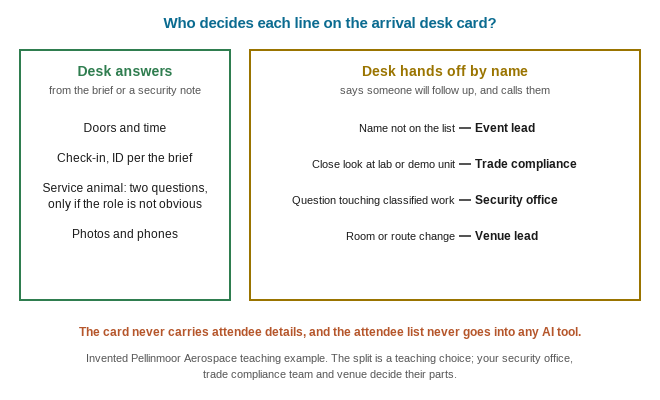
List the eight things guests ask at the door. Doors and time, check-in, a name not on the list, a request for a close look at hardware or the lab, a question touching classified work, a guest with a service animal, a room or route change, and photos and phones. For each line, note where its facts came from, who decides, what the desk says or does, and whether the line itself carries any attendee detail.
-
Hand anything classified to the security office. The NISPOM’s visit rules in 32 CFR 117.16 apply when “it is anticipated that classified information will be disclosed during a visit,” and say “The number of classified visits will be held to a minimum.” Need-to-know “rests with the individual who will disclose classified information during the visit.” For a conference or exhibit where classified information is disclosed, the section warns that “Disclosure of classified information to large diverse audiences such as conferences increases security risks,” and for a meeting a cleared contractor runs, the authorizing agency “Must approve security arrangements, announcements, attendees, and the location of the meeting.” Our reading: the desk at an unclassified customer day does not answer, schedule or confirm anything classified. It says someone from security will follow up, and calls them.
-
Give inspectors a phone number, not a tour. The same section lets government “inspectors, investigators, or auditors” visit a contractor’s facility if they “present appropriate USG credentials upon arrival.” Our reading: the card names who to call (the security office), not what the inspector may see.
-
Send every close-look request to trade compliance. Under the export rules, a look can be a release. The EAR’s release section counts “Visual or other inspection by a foreign person of items that reveals” technology, and “Oral or written exchanges with a foreign person” about it. The EAR’s export definition, in our paraphrase, treats passing technology to a foreign person who is inside the United States as an export too. The desk can’t know a guest’s nationality or what a look would reveal, and it shouldn’t ask. So a request to walk through the lab or handle a demo unit goes to trade compliance, every time. (The ITAR version of this idea, applied to files rather than guests, is in our 11/13 article on release lanes.)
-
Use the two-question script for service animals. First, the scope: 28 CFR 36.302 covers only public accommodations, and a company’s own site may not be one; whether your venue or site is one, and who answers for it, is for legal and the venue. Under that rule, a public accommodation “shall not ask about the nature or extent of a person’s disability, but may make two inquiries”: whether the animal is required because of a disability, and what work or task it has been trained to perform. It “shall not require documentation,” and generally may not ask at all when the animal’s role is “readily apparent.” Teaching choice: the card uses the two-question script either way.
-
Leave names and routes with their owners. Only the event lead settles a name missing from the list. Only the venue lead confirms a new room or route. The desk never invents either. This is company-policy framing, not a rule from any source.
Try it now: open the arrival desk card check lab, pick Case B and see why Line 4 stops on the close-look rule when it also promises an outcome.
- Fix, initial and rehearse. Fix every STOP, clear every VERIFY, and have the security office and trade compliance initial their lines. Then two colleagues run all eight lines with invented guests. Any line that makes the desk decide something it doesn’t own goes back to the brief.
The worked example
Invented Pellinmoor Aerospace, a mid-size propulsion supplier, hosts an unclassified customer day at its own site. Its finished card, which is the lab’s Case A, reads:
| Line | Covers | Facts from | Who decides | Desk does |
|---|---|---|---|---|
| 1 | Doors and time | Current approved brief | Desk staff | Answers from the brief |
| 2 | Check-in | Current approved brief | Desk staff | Asks for ID, as the brief says |
| 3 | Name not on the list | Current approved brief | Event lead | Hands off |
| 4 | Close look at the lab or a demo unit | Security or trade compliance note | Trade compliance | Hands off |
| 5 | Question touching classified work | Security or trade compliance note | Security office | Hands off |
| 6 | Guest with a service animal | Current approved brief | Desk staff | Two questions, only if the role isn’t obvious |
| 7 | Room or route change | Current approved brief | Venue lead | Hands off |
| 8 | Photos and phones | Security or trade compliance note | Security office | Answers from the note |
No line carries a guest’s name, company or badge number.
Check your work
STOP keeps a line off the printed card. VERIFY asks for a second look. PASS says only that no rule in the lab fired. Your tallies should read:
| Case | STOP | VERIFY | PASS |
|---|---|---|---|
| A, clean card | 0 | 0 | 8 |
| B, AI-drafted card | 3 | 1 | 4 |
| C, wrong owners | 2 | 2 | 4 |
| D, promises and gaps | 1 | 4 | 3 |
| E, as typed | 2 | 1 | 5 |
| F, loose ends | 1 | 3 | 4 |
Eight lines across the six cases trip two rules at once. The earlier rule in the list decides.
Common mistakes
- Printing the attendee list at the desk. Check names quietly in the approved system. The card holds roles and wording, not people.
- Letting the desk offer a quick look. Even a friendly glance at a bench can be a release. Trade compliance decides.
- Asking for papers. Not for a service animal, and not at the door unless the brief says so.
- Keeping an old revision. When the brief changes, reprint every copy of the card.
- Reading PASS as a sign-off. Security, legal and trade compliance still decide; the lab only checks the card’s shape.
Small contractors and startups. No security office or trade compliance team? Name the person who covers each role (the facility security officer if you hold a facility clearance, or the founder) and put that role on the card. Without someone who can answer export questions, offer no lab visits or hardware close-ups at all. Keep attendee details off the card and out of every AI tool, approved or not.
Related
The step before the door is the online form: fix the registration form before the next reminder. For the photos your team takes once guests are inside, read real faces, real permission.
Limits
The NISPOM section governs cleared contractors and classified visits; the EAR governs exports; the ADA rule governs public accommodations. We quote only the parts named above. The lab’s rules, their order and its choices are deliberately simple teaching choices, not requirements from any of the four regulations. None of this decides whether any real request, tour or guest is allowed. Your security office, trade compliance team, legal and the venue do.
Sources
- 32 CFR 117.16, Visits and meetings (National Industrial Security Program Operating Manual), eCFR text, Title 32 last amended 8/17/2026
- 15 CFR 734.13, Export (Export Administration Regulations), eCFR text, Title 15 last amended 11/09/2026
- 15 CFR 734.15, Release (Export Administration Regulations), eCFR text
- 28 CFR 36.302, Modifications in policies, practices, or procedures (ADA Title III; service animals), eCFR text, Title 28 last amended 10/27/2026
- Adapted from FOUNDINT.AI, "Give Your Welcome Team an Arrival Plan They Can Use"