

Article
Real Faces, Real Permission: Defense Marketing Without AI People or Borrowed Endorsements
For marketing, brand and events staff at large defense and space primes: why a rule against AI-made people holds up, and the three real-photo checks (a uniform, a federal official, a DVIDS image) that decide whether a picture suggests the government vouches for you.
Policy Brand Photography Endorsement Ai Images Defense Space
Who this is for: marketing, brand and events people at a large defense or space prime, where company policy bans AI-generated images of people or allows them only through a company account and a review, and where public affairs, legal and security look at what gets published. You don’t write that policy and you don’t clear photos. This post explains why a ban on AI-made people is sound, then spends most of its time on the harder question: when a real photo suggests the government vouches for your company. There’s a labeled box for small contractors and startups at the end.
This is general information, not legal advice. Your public affairs, legal and security reviewers decide what your company publishes.
Teaching example: Invented Thessridge Defense Systems is invented for this example. No real company, show, service, unit, program, official or person is described.
Two requests on a Monday
The events team at Invented Thessridge Defense Systems is back from a regional show, and two requests are waiting. Recruiting wants an AI-made “team” picture for a careers page, because the real engineers can’t be photographed. Social wants to post the best frame from the booth: a visitor in Army uniform shaking hands with the program lead, right under the company logo.
Under a strict image policy, the first request gets a one-line answer. The second sits in review for days, and nobody explains why.
Why an AI-made person is not a shortcut
The ban is company policy, not something a study proves. Research can explain why the rule makes sense.
In a 2023 Psychological Science study, Miller and colleagues report from their Experiment 1 that “White AI faces were judged as human significantly more often than White human faces, MAI = 65.9% versus Mhuman = 51.1%”. Each figure is the average share of faces a participant judged human. Read the scope alongside the numbers: Experiment 1 only, with 124 adults recruited on Prolific, all White U.S. residents aged 18 to 50, looking at AI faces generated with StyleGAN2 (screened for obvious rendering flaws) and matched real faces, all of them White. It is a result about that sample and those faces. It is not a finding about AI images in general, or about every viewer.
In the same experiment, “the top three most humanlike faces were actually AI-generated,” and the authors found that “the tendency for AI hyperrealism is exacerbated by overconfidence.” In their discussion, the authors note that faces picked for real-world use, fraud included, get screened for flaws first, as theirs were, and they suggest that teaching people how real AI faces look “could likewise reduce risks by making the public appropriately skeptical.”
Our reading: if viewers can’t reliably tell the difference, an AI-made person in your marketing is a claim about someone who does not exist. At a company with a strict policy, that ends the discussion.
The harder half: real photos that say someone vouches for you
At a strict prime, the AI-face question is usually closed before marketing asks it. The open question is what a real photo says about who vouches for you. Three kinds of picture carry rules of their own.
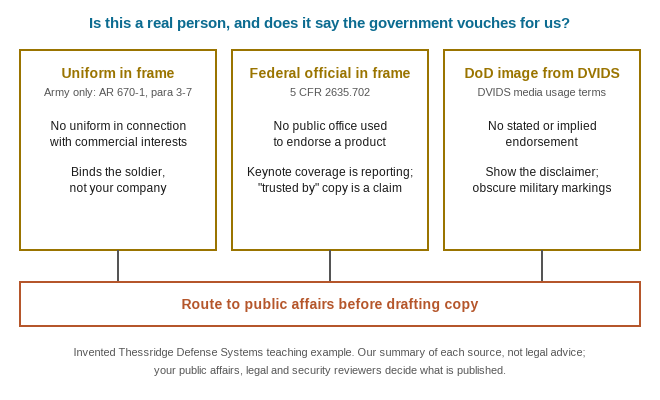
A uniformed soldier in the frame (Army only)
This point is about the Army and only the Army. AR 670-1, the Army’s uniform regulation (26 January 2021, administrative revision dated 4 March 2025), covers Regular Army soldiers along with Guard and Reserve soldiers. Its paragraph 3-7 says “Wearing Army uniforms is prohibited in the following situations:” and the first item is “In connection with the furtherance of any political or commercial interests, or when engaged in off duty civilian employment.”
That rule binds the soldier, not your company. We haven’t checked the uniform rules of the Navy, Air Force, Marine Corps or Space Force, so don’t assume they read the same. Our reading: a uniform in your photo carries its own rulebook, and that rulebook is about the soldier, not your brand. A photo that turns a uniformed visitor into part of your sales message puts that person in a spot their own regulation addresses. Send it to public affairs before anyone writes a caption.
A federal official in the frame
The executive branch ethics standards, read in 5 CFR 2635.702 (eCFR text; Title 5 last amended 11/09/2026), say “An employee may not use their public office for their own private gain; for the endorsement of any product, service, or enterprise”. Nor may employees let their title or position be used “in a manner that could reasonably be construed to imply that their agency or the Government sanctions or endorses their personal activities or those of another.” The section’s own example is a consumer product safety commissioner, who “may not appear in a television commercial and endorse an electrical appliance produced by a former employer”.
The rule binds federal employees; how it bears on your use of a photo is for legal. Our reading: event coverage of an official’s keynote is reporting. The same photo under a “trusted by” banner is a claim.
A DoD image from DVIDS
DVIDS carries DoD’s media usage terms, which the page sources to “Pages 45-47 of DoD Instruction 5410.19 Volume 1”. The DVIDS terms say DoD imagery may not be used in a way that could imply endorsement of any company or other non-federal entity, contractors named explicitly, and “Endorsement of a non-federal entity, event, product, service, or enterprise may be neither stated nor implied.”
Commercial use there means use “for advertisements, marketing, promotion, solicitation, or fundraising purposes”. Commercial users are required, as far as practicable, to display a disclaimer, which reads in full: “The appearance of U.S. Department of War (DoW) visual information does not imply or constitute DoW endorsement.” They “are also requested to obscure all distinctive U.S. military markings (e.g., tail or hull number, unit insignia, Service name)”.
Three more lines on the same page are easy to miss. Posting an image there does “not waive any publicity or privacy rights of any individuals portrayed.” Service names, insignia and seals “may be protected as trademarks or service marks and may not be used in commerce without prior written permission.” And some images on the site belong to other rights holders. A DoD image being free to download does not make it free to imply anything.
What marketing does with this
This part is company-policy framing: what we’d suggest at a company with these rules, not a requirement from any of the four sources.
- Don’t propose AI-made people. If brand policy allows AI imagery at all, it runs in the approved account, under the same review.
- Tag early. Any photo with a uniform, a federal official or DoD imagery goes to public affairs and legal before anyone drafts copy around it.
- Use your own people, with consent, through your company’s process.
- Have a fallback. When people can’t be cleared, use hardware without customer markings, the venue, or detail shots with no one in frame. Check backgrounds for screens and badges either way.
- Keep event photos out of public AI tools. Never upload pictures with identifiable people to “clean them up.”
Worked example: the Thessridge queue
| Request | Which check | What happens |
|---|---|---|
| AI-made “team” picture for the careers page | Company image policy | Declined; recruiting books a shoot with consenting employees, or uses a hardware image |
| Visitor in Army uniform shaking hands under the logo | AR 670-1, paragraph 3-7 (Army only) | Goes to public affairs before any caption is written |
| Keynote photo of a program official for the show recap | 5 CFR 2635.702 | Goes to legal; captioned as event coverage, no “trusted by” copy |
| DVIDS photo of the company’s system in the field, for a product page | DVIDS terms | Goes to public affairs; disclaimer added, markings obscured, owner checked |
| Booth detail shot with no people | None of the three | Background check, then normal brand review |
Three of five go to reviewers on day one, with the reason attached, instead of stalling.
Small contractors and startups. No public affairs office? The three checks still apply; the person deciding is the founder or whoever signs off on the website. Use your own team, with written consent. Leave uniformed visitors and officials out of promotional posts unless you’ve asked counsel. If you use a DVIDS image commercially, add its disclaimer and obscure the markings, as the terms ask.
Common mistakes
- Applying the Army rule to every service. AR 670-1 covers the Army. Ask public affairs about the others.
- Treating “trusted by” as harmless. Next to an official’s photo, it reads as the government’s word.
- Assuming public means usable. DVIDS images come with endorsement terms, privacy and publicity rights, and trademarks.
Related
For screens, badges and whiteboards in booth frames, see check booth photos before a 3D scene. If a demo unit is in the shot, the release lanes in our 11/13 article still apply. And for the people who greet guests at your own event, try give the customer-day desk a card that hands off.
Limits
The Miller result comes from one experiment, one sample and White faces only. AR 670-1 is the Army’s rule for its own people, and the ethics rule binds federal employees. None of this decides whether any real photo may be published. The habit to keep: before a photo goes out, ask whether the person is real, and whether publishing them says the government vouches for you.
Sources
- Miller EJ, Steward BA, Witkower Z, Sutherland CAM, Krumhuber EG, Dawel A. "AI Hyperrealism: Why AI Faces Are Perceived as More Real Than Human Ones." Psychological Science, 2023 (author manuscript, UCL Discovery, CC BY-NC 4.0)
- DVIDS, "Copyright Information" (DoD visual information usage terms, sourced on the page to DoD Instruction 5410.19 Volume 1)
- 5 CFR 2635.702, Use of public office for private gain (Standards of Ethical Conduct for Employees of the Executive Branch), eCFR text, Title 5 last amended 11/09/2026
- Department of the Army, AR 670-1, "Wear and Appearance of Army Uniforms and Insignia," 26 January 2021, administrative revision dated 4 March 2025
- Adapted from AssociationAI, "Your Best Models Are Your Staff: Ditch the Fake People Photos"