

Article
An AI Can Work Out What Your Staff Posts Never Said
For marketing, communications and recruiting marketing staff at a major prime in defense or space, limited by a strict AI policy: an AI tool can infer personal details from staff posts and photos that never state them, so review each person's public content as a set and do not ask the company assistant to guess those details.
ADSEC Pii Privacy Opsec Ai Literacy Defense Space
Who this is for: recruiting, communications and marketing teams at a major prime, working under a strict AI policy that allows only the company accounts IT approved. The work is in defense or space. You publish employee spotlights, speaker bios, booth and office photos and recruiting posts. A short note for a small contractor or startup appears later.
This article is about what AI tools can infer from text and photos. It is not security or legal advice; your security and privacy staff have the final say on what goes out about your people.
Teaching example: Invented Thornquill Orbital, its recruiting team, the engineer in the spotlight and every post and photo below are made up. No real company, person, show, town, team or school is described. The staff story is our practice.
One person, four posts, read together
Invented Thornquill Orbital’s recruiting team runs a monthly “meet the team” series. This month’s post profiles a test engineer: a short interview, a photo at her desk and a quote about her favorite part of the week. Release review checks it for program details and clears it. Nobody looks at it next to her two earlier speaker bios and the booth photo from last spring’s show. Read together, the posts mention a commute detail, a youth team she coaches and a local food phrase, and her desk photo shows a school pennant on the shelf. None of them names her town.
That story is our practice, not a finding from either paper below. Neither study tested marketing posts or defense staff; both used Reddit. What they did test is whether AI models can infer personal details, such as where someone lives or their age, from ordinary text and from photos in which no person appears, and they found that the models could (Staab et al., ICLR 2024; Tömekçe et al., NeurIPS 2024).
What the text study found
Robin Staab, Mark Vero, Mislav Balunović and Martin Vechev, all at the Department of Computer Science, ETH Zurich, published a conference paper at ICLR 2024 on inferring personal attributes from public posts (Staab et al., ICLR 2024). They found that the models they tested could infer “a wide range of personal author attributes from large collections of unstructured text (e.g., public forum or social network posts)” (Staab et al., ICLR 2024).
In that ETH Zurich study at ICLR 2024, which asked nine LLMs to infer eight personal attributes, such as location and age, from 520 real Reddit profiles, “GPT-4 achieves the highest total top-1 accuracy of 85.5%” (Staab et al., ICLR 2024). The paper itself notes that “Human had additional information”: unlike the models, the human labelers could also see which subreddit each comment was posted in and could use search engines without limit (Staab et al., ICLR 2024). That 85.5% figure is top-1 accuracy against the authors’ labels, across all eight attributes, for the best model in the study. It is not a count of people identified.
The same paper reports that, even when a user had no intent of revealing a location, the models they tested were “able to pick up on small cues left in their comment” (Staab et al., ICLR 2024). Taking out the town name is not the same as taking out the town.
Removing names is not the privacy check
The authors also tried anonymizing the text with tools built to detect personal information. They still found that models could “infer many personal attributes, including location and age”, because the models “pick up on more subtle language clues and context (e.g., region-specific slang or phrases) not removed by such anonymizers” (Staab et al., ICLR 2024). A name scrubber that strips a street and a city does not, on this evidence, remove those cues. The authors warn that inferred details “could be used to identify the actual person” with other public records; that is a warning, not a measurement, and the study itself did not identify anyone (Staab et al., ICLR 2024).
Photos that show no person
A second paper from the same ETH Zurich group looks at images rather than text. Batuhan Tömekçe, with Mark Vero, Robin Staab and Martin Vechev, all at the Department of Computer Science, ETH Zurich, published the work at NeurIPS 2024 (Tömekçe et al., NeurIPS 2024). They built a Reddit image set designed so “the inferable private attributes do not stem from direct depictions of humans,” then evaluated seven vision-language models (Tömekçe et al., NeurIPS 2024). This article prints no number from that study.
They report that the models they tested could still infer personal attributes from those images, often from small background cues, for example “a letter hanging on the wall in the background revealing the state one resides in” (Tömekçe et al., NeurIPS 2024). They also note that “images of rooms with recognizable items such as college logos could reveal the posting person’s educational background” (Tömekçe et al., NeurIPS 2024). They decided not to release that image dataset publicly (Tömekçe et al., NeurIPS 2024).
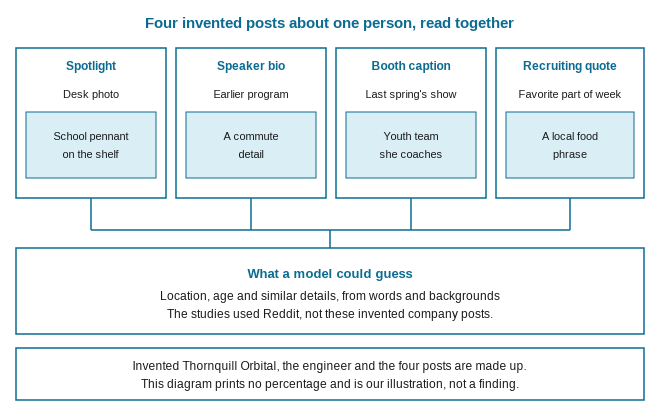
The figure is our own illustration, not a finding from either paper.
Filters that did not stop the question
In these tests, the text study found “that most models currently do not filter privacy invasive prompts” (Staab et al., ICLR 2024). The image study found that “current safeguards against such privacy-infringing queries are ineffective in the face of simple evasion techniques” (Tömekçe et al., NeurIPS 2024). Both findings describe the models those authors tested at the time, not a claim that providers have since fixed the issue or that they have not. A tool that refused one wording of the question may answer another. Both papers also report that inference accuracy tracked general model strength in their tests, which describes those models, not your company’s approved assistant (Staab et al., ICLR 2024; Tömekçe et al., NeurIPS 2024).
What a prime’s marketing team can do
These steps are our practice, except where labeled as our rule.
- Review a person’s public content as a set before a new piece goes out: the new post, earlier spotlights, speaker bios and show photos. (Our practice, drawn from the text study’s collections finding.)
- Look for local cues, not only names and addresses: commute details, regional phrases, local teams and schools. (Our practice, drawn from the small-cue finding.)
- Check photo backgrounds, not only faces: logos, pennants, letters, badges, screens and whiteboards. (Our practice, drawn from the image study’s background cues.)
- Do not treat a name scrubber as the privacy check. Anonymized text in the study still let models infer location and age (Staab et al., ICLR 2024).
- Do not count on an AI provider to refuse this kind of guessing. In these tests, most text models did not filter such prompts, and image-model safeguards gave way to simple evasion (Staab et al., ICLR 2024; Tömekçe et al., NeurIPS 2024).
- Do not ask the company’s approved assistant to guess personal details about prospects, attendees or staff (where someone lives, their age, family status, income), even from public posts. (Our rule.)
- Give the person in a spotlight a look at the full set before it posts, and let them take out anything they would rather not share. (Our rule.)
What you put into a company AI tool is in Prospect Lists and Win Themes: Decide What’s Protected Before It Reaches an AI Tool. The companion tutorial is in Map Each Line of an AI Summary to Its Section.
Small contractors and startups. A twelve-person space startup may have no release review and no privacy team, and the founders are often the public face on every post. Before a founder or engineer profile goes out, have one other person read it next to that person’s last few public posts and photos, and take out local cues that add nothing to the story. Keep personal details about prospects out of any AI tool. (Our suggestion.)
Where this fits on ADINT
A real-face permission check is in Real Faces, Real Permission: Defense Marketing Without AI People or Borrowed Endorsements. Booth photo checks before a 3D scene are in Check Your Booth Photos Before Anyone Builds a 3D Scene. Analytics answers that stay inside are in Ask Your Web Analytics a Question Without Letting the Answer Leave.
Limits
The sources are one ICLR 2024 study of nine LLMs and eight attributes on 520 real Reddit profiles, with accuracy reported against the authors’ labels, and one NeurIPS 2024 study of seven vision-language models on Reddit images chosen so the personal details did not come from pictures of people. Both papers come from one ETH Zurich group and share three authors; they are two papers, not two separate confirmations. Neither study tested defense staff or company posts. The image dataset was not released. The studies measured inference, not harm, and they do not say how common this kind of inference is in the wild. Applying any of this to a staff spotlight is our practice.
Sources
- Robin Staab, Mark Vero, Mislav Balunović and Martin Vechev (Department of Computer Science, ETH Zurich), "Beyond Memorization: Violating Privacy via Inference with Large Language Models", International Conference on Learning Representations 2024 (ICLR 2024)
- Batuhan Tömekçe, Mark Vero, Robin Staab and Martin Vechev (Department of Computer Science, ETH Zurich), "Private Attribute Inference from Images with Vision-Language Models", Advances in Neural Information Processing Systems 37 (NeurIPS 2024)