

Article
AI Will Not Fix Messy Defense Account Data
For marketing, capture support, business development and events staff at large defense and space primes: trace one invented account record field by field, borrow the DoD's own data-quality dimensions as a checklist model, and decide what a company AI tool is cleared to read only after the source and date of each field are written down.
Market Intelligence Account Data Data Quality Awards Usaspending Crm Ai Defense Space
Who this is for: marketing, capture support, business development and events staff on a large prime in defense or space. If the company allows AI at all, it runs only under a login IT issues, and material from the company stays out of public chatbots. Unexpected messages go to quarantine. If you work at a small contractor or a startup, a clearly labeled box follows the common mistakes.
General information only: not contracting, security or compliance advice. Which records your company’s AI tools may read, and which data may go into them at all, is settled by IT, the security office and the contracts team.
Teaching example: Invented Brevaskel Defense Systems, the Thursday ranking request, and the five fields walked below are made up. Roles only. No real prime, program office, award, contract or show is named.
The Thursday ranking request
The capture lead at Invented Brevaskel Defense Systems, a sensor and services company, wants the top 40 accounts for the spring show, ranked by recent award value, with the program office and the contract end date beside each one. The list comes out of the company CRM. Half the award fields were imported last year from a public spending download, a quarter came from badge scans at two shows, and the rest were typed in by three people who have since moved on. The company AI tool, already approved by IT and running under a company login, is offered as the fix: “just ask it to rank them.” It returns a clean, confident table in seconds. Two of the top ten accounts have contract end dates that already passed, one program office name is spelled three ways, and nobody can say which numbers came from where.
The harder question at a prime is often not whether marketing may stand up a new AI pilot. That question is frequently settled already: the tool is banned, or it runs only under a company account with rules about what it may read. What is not settled is the account data underneath every target list, booth invite and capture brief. Much of it arrives from public federal award feeds. The DoD strategy and the DoD Inspector General audit quoted below describe the Department’s own data. They appear here as a model, and as evidence about that public award data, not as instructions for a company CRM. The separate case of a personal or outside AI account is in personal AI accounts and government systems. The question to keep in your pocket: if we cannot say where this field came from and when, why would a model say it better?
Quality data comes first, in the DoD’s own words
The Department of Defense’s Data, Analytics, and Artificial Intelligence Adoption Strategy, cleared for open publication June 27, 2023, says “The AI Hierarchy of Needs is a pyramid with quality data as its foundation since all analytic and AI capabilities require trusted, high-quality data to support decision makers.” That document is a strategy for DoD components, not a requirement on a contractor’s marketing desk. It also says “Poor quality data will inevitably undermine data trustworthiness, raise security concerns,” and that “User needs and local requirements are the basis of data quality.” Our reading: if the department that buys from you puts data quality under its AI work, a marketing team at one of its suppliers can do the same with its account data.
A snapshot of the public award feed
In an audit dated November 8, 2021, the DoD Inspector General wrote that “The projected error rate for accuracy of the File C, D1, and D2 data elements was 6.5 percent,” for the DoD’s fourth quarter FY 2020 (Q4 FY 2020) financial and award data submitted for publication on USAspending.gov, based on a statistical sample of 372 transactions; that figure describes DoD award data, not company CRMs. In a report published September 25, 2025, the U.S. Government Accountability Office (GAO-25-107469) wrote “DOD updated its fiscal year 2025 documented procedures to require its components to certify timely reporting of FPDS data in accordance with FAR requirements.” The same Inspector General audit also concluded that “the DoD’s DATA Act submission on USAspending.gov cannot be fully relied upon.” It treated a data element as accurate when the element was recorded in accordance with OMB and Treasury financial data standards and agreed with the authoritative source records (DoD contract and grant award documentation). The 6.5 percent figure in the Inspector General’s audit is a snapshot of that fourth quarter FY 2020 submission, dated November 2021. It is not a current rate, and it is not a rate for company CRMs.
Field by field, where the errors sat
In the full report, the audit found that the errors “primarily occurred because data was inaccurately or untimely entered into FPDS-NG,” the procurement system it calls “the single authoritative repository used to collect and report on Federal procurement award data.” The report says many of the File D1 errors were specific to certain data elements, including Funding Office Name, Primary Place of Performance Address, NAICS Code, Period of Performance, Current End Date and Potential End Date. Our reading: these are the same kinds of fields a marketing team uses to rank accounts, pick a show city or time a follow-up.
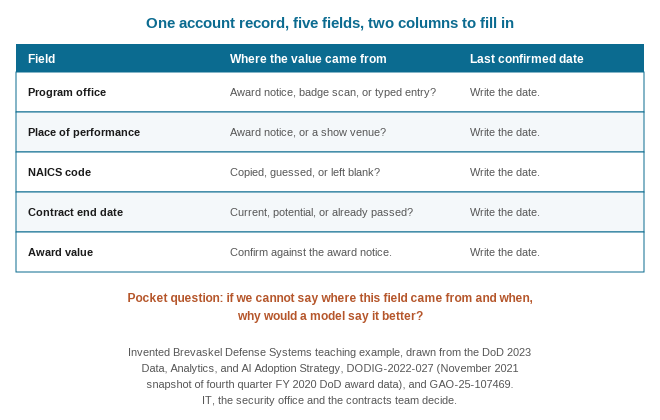
Walk one invented Brevaskel record and, for each field, write down where the value came from and the date someone last confirmed it:
- Program office, standing in for Funding Office Name. Is it the name from the award notice, a badge scan, or a spelling someone typed years ago? If the same office appears three ways, that is a consistency problem, not three accounts.
- Place of performance. Does the city in the CRM match the place on the award notice, or a show venue where someone met the buyer?
- NAICS code. Was it copied from the award record, guessed from a product line, or left blank?
- Contract end date. Is this the current end date, the potential end date, or a date that has already passed? The report listed both Current End Date and Potential End Date among those data elements.
- Award value. Marketing uses this to rank the list. Confirm it against the award notice before anyone quotes it, even though the audit’s high-error list above does not name a dollar field.
A field with no source and no date is a guess with formatting.
Is the 2021 snapshot still the whole story?
GAO-25-107469, published September 25, 2025, describes the Federal Procurement Data System as “the government’s principal repository for procurement information, some of which is displayed on USAspending.gov, the official source of federal spending data.” The same review found that selected agencies varied in the extent to which their verification and validation procedures and corrective actions help ensure procurement data quality, and that “DOD did not adequately include in its verification and validation procedures a requirement that its components certify that their procurement data were reported to FPDS on time” before the fiscal year 2025 procedures update already quoted above. GAO adds no new error rate here; it is the 2025 currency check. Our reading: the November 2021 audit is a snapshot, the DoD has changed procedures since, and the safe habit does not depend on today’s error rate. Confirm an imported award field against the award notice before it goes into outreach.
A checklist borrowed as a model
Appendix A of the 2023 strategy defines quality dimensions the Department uses for its own data. Four of them travel well to an account sheet, used here only as a model:
- Accuracy: “Data that correctly reflect proven, true values or the specified action, person, or entity.”
- Consistency: “The degree to which a value is uniformly represented within and across data sets.”
- Uniqueness: the strategy describes “a one-to-one alignment between each observed event and the record that describes such an event,” and it asks “Are there duplicate records in this data set?”
- Timeliness: “Measures the time between an event occurring and the data’s availability for use.”
Integrity, in the same appendix, covers a data set’s pedigree, provenance and lineage, which are known and aligned with relevant business rules. Our reading: provenance on a marketing sheet is the source column and the last-confirmed date from the applications above. For a method that finds duplicate and stale show leads, see find duplicate and stale show leads. For a method that names fields in an export, see turn a show lead export into an ontology. This article does not repeat either method.
What a company AI tool can and cannot do with this record
The 2023 strategy says “DoD customers with clean, high-quality data can seek commercially available analytics and AI capabilities while retaining appropriate data rights.” That sentence describes DoD customers, not a contractor CRM. Our reading: the order runs clean data first, tools second. A company AI tool that reads a messy export gives the mess back in tidier form, and it cannot know that an end date already passed, or that three spellings are one office, unless a person fixed the record first. No source in this article tests AI tools on CRM data; this is our reading, not a measured finding.
At a strict-policy prime, nobody pastes the CRM export into a public chatbot. The earlier post on prospect data in AI tools covers what may go into a tool at all. If IT allows a company tool, point it only at the cleaned, labeled export it is cleared to read, and keep the source column in that export. The model reads the record you have, not the record you meant.
Common mistakes
- Asking the approved tool to rank a list nobody has sourced. Clean and label first, then, if IT allows it, let the tool read the labeled export.
- Quoting an imported award end date in an email. Confirm the award notice before the date goes in the outreach, not after.
- Treating three spellings as three offices. Consistency is a person-level check, not a formatting trick.
- Pasting a CRM export into a public chatbot. Company policy at a strict-policy prime keeps that export off public tools.
Small contractors and startups. No data team? One person owns the account sheet. Add a source column and a last-checked date, check any award number against its award notice before it goes in a pitch, and merge duplicate accounts by hand. Write it down as company policy: if an AI tool is allowed at all, it gets the cleaned sheet only, never contract documents or anything a customer marked.
Further reading
See also the personal-accounts post, the duplicate-leads walkthrough, the field-naming walkthrough, and what may go into an AI tool.
Limits
These sources are one DoD strategy written for DoD components, one Inspector General audit of the DoD’s fourth quarter FY 2020 financial and award data, dated November 2021, and one GAO review published in September 2025. None measures how messy defense contractors’ CRMs are, and none measures how often a company AI tool repeats CRM errors, so this article makes no such claim. IT, the security office and the contracts team decide which records a company tool may read.
Sources
- Department of Defense, "Data, Analytics, and Artificial Intelligence Adoption Strategy: Accelerating Decision Advantage," cleared for open publication June 27, 2023
- DoD Office of Inspector General, "Audit of the DoD's Compliance With the Digital Accountability and Transparency Act of 2014 (DODIG-2022-027)," summary page
- DoD Office of Inspector General, "Audit of the DoD's Compliance With the Digital Accountability and Transparency Act of 2014 (DODIG-2022-027)," full report, dated November 8, 2021
- U.S. Government Accountability Office, "Federal Spending Transparency: Actions Needed to Help Ensure Procurement Data Quality," GAO-25-107469 (September 25, 2025)
- Adapted from AssociationAI, "AI Can't Fix Your Messy AMS (But This Sequence Can)"