

Tutorial
Before the Merge: Find Duplicate and Stale Show Leads, Then Decide Each One by Hand
A post-show routine for defense and space marketing teams: before you merge leads, enrich them with an AI tool or write AI follow-ups, list the likely duplicates and the stale records, and have a person decide each one.
Time needed: About 30 minutes
Before you start:
- A CSV copy of the post-show leads with an id, name, company, email, phone and last-touch date on every row
- A spreadsheet app your IT policy allows, on a work computer
Trade Shows Events Data Governance Personal Data Defense Space
Illustrative example: “Corvane Aerostructures,” the “Harborline Defense Expo” and all eight leads are invented.
Corvane’s team came home from Harborline with badge scans, booth-app leads and hand-typed business cards. Before any of it is merged into the CRM, enriched by an AI tool or handed to an AI-written follow-up sequence, one person should spend half an hour on two questions: which records are probably the same person, and which haven’t been touched in so long they shouldn’t be trusted?
The pocket question for every merge: who decided this was one person, and did they open both records?
Why bother
Duplicates distort counts. A Census Bureau overview of record linkage says: “The duplicates can have the effect of erroneously inflating estimates of the number of entities in different categories.” Its own example is a business list: “For instance, in a list of business, duplicates would inflate estimates in different industrial categories.” Our reading: a duplicated lead list overstates the pipeline you report.
Typos are why exact matching isn’t enough. An earlier Census paper notes that “many lists have typographical errors in more than 20% of first names and also in last names …” That describes the lists those researchers studied, not your CRM, but hand-typed business cards are not likely to do better.
The steps
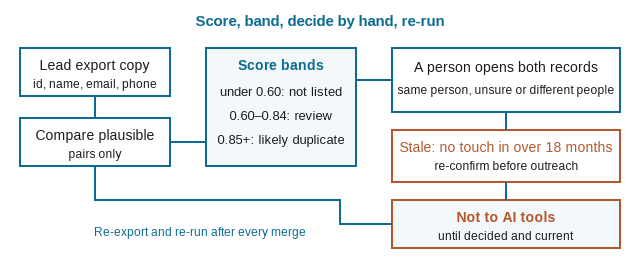
- Export a copy. Work from a CSV copy with an id, name, company, email, phone and last-touch date.
- Write down your cut points first. This walkthrough uses a score of 0.60 to list a pair for review, 0.85 to call it a likely duplicate, and more than 18 months since last touch to call a record stale. These are teaching choices; no source sets them. Pick yours before looking at results.
- Compare only plausible pairs. Compare two leads only if they share an email, a non-blank phone or the first three letters of a last name. The score used here weights name similarity 0.40, same email 0.35, same phone 0.15 and same company 0.10, also a teaching choice. Eight leads make 28 possible pairs; this rule compares 4.
- Sort each listed pair into a band. Winkler’s overview describes a three-way rule: clear matches, clear non-matches, and a middle band where you “designate pair as a possible match and hold for clerical review.”
- Open both records and record a verdict: same person, unsure, or different people. “A score is a lead, not a decision.”
Try it now: the lead record review loads eight invented show leads. Record a decision for each likely pair and mark which leads are queued for AI enrichment, and it marks every pair and lead STOP, FIX or PASS and writes a dated record. It merges and sends nothing.
- Merge by hand, and only “same person” pairs. Never merge on a shared role inbox. Priya and Sam Anand both list events@corriganlabs.example and the same phone, so their pair scores 0.92. They are two people. This walkthrough treats events, info, sales, marketing, contact and admin as role mailboxes, a teaching list, not a standard.
- Check staleness. People change addresses and jobs. USPS offers mailers move updates: “the NCOALink Product enables mailers to process mailing lists and update lists with new addresses prior to mailing.” Its licensees receive 18 or 48 months of change-of-address data depending on license type. Those are data windows for postal licensees, not a rule for when a lead goes stale. Your 18-month cutoff is your own choice.
- Keep unresolved and stale records away from AI tools. “Don’t send an unresolved or stale record to an AI tool.”
- Re-export and re-run after every merge.
Check your work
All six cases use an as-of date of 2026-10-30. L3 (31 months) and L7 (20 months) are stale. “Good decisions” means: merge Dana Whitcomb with Dana Whitcombe, keep the Anands separate as different people, merge Theo with Theodore Brandt, both records opened each time.
- A, nothing decided yet: 0 STOP · 5 FIX · 6 PASS. Three pairs held, two stale leads.
- B, decided by a person (good decisions): 0 STOP · 2 FIX · 9 PASS.
- C, merge everything on the score: 3 STOP · 2 FIX · 6 PASS. Every merge lacks a “same person” verdict.
- D, merged without opening both: good decisions, except the Anands are merged as “same person” without opening both records: 1 STOP · 2 FIX · 8 PASS.
- E, the shared inbox: same as D, but both records opened. Still 1 STOP · 2 FIX · 8 PASS, because a shared inbox isn’t proof of one person.
- F, AI enrichment queued on everything: good decisions, except the Anands held as “unsure,” and all eight leads queued: 4 STOP · 1 FIX · 6 PASS. L3, L5, L6 and L7 are stopped.
What the check misses
Marcus Ilves appears twice, at Fenwick Orbital and at Saltbrook Defense. Different email, different phone, different company: the pair scores 0.40 and isn’t listed. He probably changed jobs; the score can’t see that. An empty review list isn’t proof that a file has no duplicates. Scan for repeated names by hand.
Common mistakes
- Merging on the score alone.
- Trusting a shared inbox as one person.
- Moving the cut points after seeing the output.
- Handing a chatbot the whole export to dedupe. Before you do, read what to decide before prospect data reaches an AI tool. For the send itself, see check the send list before the invite.
Sources
- William E. Winkler, "Overview of Record Linkage and Current Research Directions," U.S. Census Bureau Research Report Series (Statistics #2006-2)
- Edward H. Porter and William E. Winkler, "Approximate String Comparison and its Effect on an Advanced Record Linkage System," U.S. Census Bureau RR97-02
- USPS PostalPro, "NCOALink"
- Adapted from AssociationAI.ai, 'Find Likely Duplicate and Stale Member Records Before Any AI Sees the List'