

Article
Who Owns AI-Made Marketing Work Depends on the Country
For brand, marketing, proposal graphics and events staff at large defense and space primes with teams in the UK and the United States: one AI-made backdrop can get an author under the UK's 1988 Act and a much weaker claim in the United States, and the UK has proposed dropping its rule. Before anyone promises exclusive rights in AI-made work, find out which country the promise rests on.
Policy Brand Ai Policy Copyright Agencies Defense Space
Who this is for: brand, marketing, proposal graphics and events staff at the largest defense and space primes, under strict AI and brand policies. You may use AI image and text tools only through the company accounts IT has approved, and you work with agencies, teaming partners and show organizers from a UK site and a US site at the same time. Readers at small contractors and startups have a labeled box after the six applications.
This article describes how two countries treat AI-made material and is not legal advice. Before you promise anyone rights in a specific asset, ask your company’s counsel.
Teaching example: Invented Halvercrest Defense and its backdrop are made up. No real company, show, agency, partner or artwork is described. The US half rests on a July 2025 CRS summary; the UK half on the 1988 Act and a March 2026 UK report.
One backdrop, two teams
Invented Halvercrest Defense has an events team at its UK site and a brand agency on contract in the United States. Ahead of a spring show in Europe, the UK team builds a booth backdrop with the company’s approved AI image tool: a night sky over a launch pad, generated from a prompt, with the company name set by a designer and a few product silhouettes placed by hand. It works, so the US team reuses it at a show near Washington that fall.
Then a teaming partner sees it and asks for exclusive use of the image on a co-branded panel. The agency contract says Halvercrest owns everything delivered. The partner’s draft asks Halvercrest to promise that nobody else will use the picture. Someone in brand forwards the request with one line: we own this, right?
Nobody in the thread can answer, and not because anyone was careless. The answer depends on which country you ask, and the UK’s own answer is under review. Below are both sides as the public sources describe them, then habits a brand team can keep.
The US side, as CRS summarizes it
For the United States, this post uses one summary: Congressional Research Service Legal Sidebar LSB10922, updated July 18, 2025 (CRS Legal Sidebar LSB10922, version 10). Everything in this section is as of that July 2025 update. Later court steps are covered in the FOUNDINT.AI post this article adapts, linked at the end.
CRS reports that in August 2023 a district court ruled for the Copyright Office and held that “human authorship is an essential part of a valid copyright claim” (CRS Legal Sidebar LSB10922). CRS then reports that the appeals court affirmed that decision in Thaler v. Perlmutter (CRS Legal Sidebar LSB10922).
That does not leave every AI-assisted asset without protection. CRS writes that “works containing AI-generated material may be copyrighted under some circumstances, such as “sufficiently creative” human arrangements or modifications of AI-generated material” (CRS Legal Sidebar LSB10922).
On registration, CRS describes the guidance the Copyright Office released in March 2023 this way: authors may claim protection only “for their own contributions” to such works, “and they must identify and disclaim AI-generated parts of the works when applying to register their copyright” (CRS Legal Sidebar LSB10922). Those are CRS’s words about the Office’s guidance. This post is not telling you what to file.
CRS adds a caution: “courts are not legally bound to adopt the office’s interpretations of the Copyright Act” (CRS Legal Sidebar LSB10922).
For the Halvercrest backdrop, our reading of that summary is roughly this. The parts people shaped, such as the designer’s type and the hand placement of the silhouettes, have the better claim in the United States. The sky the tool produced from a prompt has the weaker one. That is a way to sort the file, not a conclusion about any real asset.
The UK side: section 9(3) of the 1988 Act
The UK starts from a different place. Section 9 of the Copyright, Designs and Patents Act 1988, headed “Authorship of work.”, says in subsection (3): “In the case of a literary, dramatic, musical or artistic work which is computer-generated, the author shall be taken to be the person by whom the arrangements necessary for the creation of the work are undertaken.” (legislation.gov.uk, CDPA 1988 section 9).
Put simply, when a computer makes the work, the UK still names an author, and it is whoever set things up. When we fetched the page on November 16, 2026, legislation.gov.uk said: “There are currently no known outstanding effects for the Copyright, Designs and Patents Act 1988, Section 9.” (legislation.gov.uk). That line describes the page on the day we read it, nothing more.
The section does not say who the person making the arrangements is when someone uses a modern AI tool. The March 2026 UK report gives the government’s reading for a general purpose AI that answers a prompt: the author “will usually be the person who inputted the prompt” (UK report on copyright and AI, 18 March 2026). That is the report’s reading, not a court ruling.
The same report says this protection “lasts for 50 years from the date of creation” (UK report on copyright and AI). It is also frank that the section is hard to apply, saying that “it is unclear in the absence of case law how an “original” yet wholly machine-authored work would be defined” (UK report on copyright and AI). So even in the UK, a team cannot assume the AI-made sky is covered.
What the March 2026 UK report proposes
The report notes that the UK protection “has been in place since 1988” and says it “departs from the core rationale for copyright, which is to encourage and reward human creativity” (UK report on copyright and AI, 18 March 2026). It also says most jurisdictions give no specific protection of this kind, adding: “This includes the USA and China” (UK report on copyright and AI).
Then comes the proposal. The report says that “in the absence of evidence of its ongoing value, we propose that this specific type of protection should be removed, while copyright should continue to protect works created with AI assistance” (UK report on copyright and AI). In the same passage it says: “We propose to continue to monitor the use and impact of protection for wholly computer-generated works.” (UK report on copyright and AI).
Fewer than half of all consultation respondents answered the questions on computer-generated works, and of those who did, the report says the majority were not in favour of keeping the current protection, “78% of online survey respondents” (UK report on copyright and AI, 18 March 2026). That figure is a share of online survey respondents who answered those questions, not of all respondents and not of the public.
A proposal is not a change. As of the March 2026 report, section 9(3) is still in the Act, and the government has proposed removing it while it keeps monitoring. This post does not say whether or when that happens, and it makes no claim about where UK policy stands today.
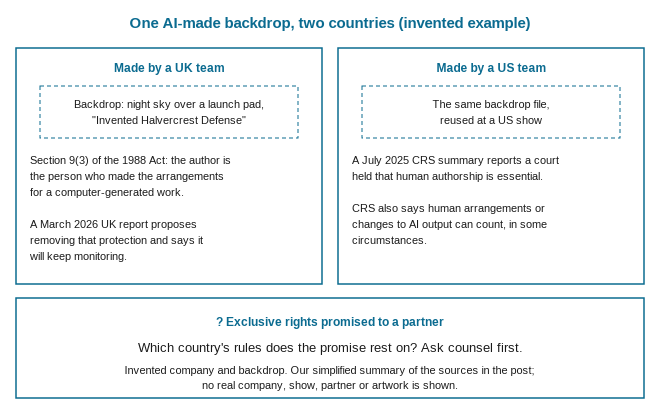
The figure is our own simplified summary of the sources above, drawn around an invented backdrop.
Where the two answers meet a contract
Back at Halvercrest, three promises now depend on the country question. The agency contract says the company owns what the agency delivers. The partner wants exclusive use of the image. And the show’s exhibitor terms may let the organizer use booth photos in its own marketing, which is a hypothetical clause here.
A contract can promise ownership, but our reading is that a promise does not by itself create a right a country does not recognize. If the UK team made the sky, the UK section may give someone an author for it, at least for now. If the same sky is used in the United States, the CRS summary suggests the claim rests on what people added. The file is the same at both shows. The answer about it changes at the border.
There is a second unknown that brand teams can control. If someone made part of the image on a personal account instead of the approved company account, nobody can say cleanly who made the arrangements, or under which terms.
Six applications for a strict-policy brand team
- Record where and how each AI-made asset was made. Note the team, the country, the approved company account and the date. (Our practice; no source above sets it.)
- Do not promise exclusive rights in AI-made material until counsel has looked at the country question. That covers partners, agencies and show organizers, and it covers co-branded panels as much as ads.
- Keep the layered files. Where a person arranged or changed AI output, the working files show what people did. CRS notes that “sufficiently creative” human arrangements or changes can count in the United States (CRS Legal Sidebar LSB10922).
- Treat the UK rule as current with a proposal against it. Do not plan next year’s campaigns on the assumption that section 9(3) will still cover AI-made parts, and do not assume it is gone.
- Ask agencies and UK partners two questions in writing. How does your contract treat AI-made deliverables, and in which country is the work made?
- Keep AI tool use on the company accounts your AI policy approves. (Our rule.) A personal account adds a question about who arranged the work on top of the country question.
Small contractors and startups. A small supplier that sells into a prime’s UK and US programs may use one freelancer or agency for every graphic it has. Ask that the contract say who owns AI-assisted deliverables and in which country the work is done. Keep the layered source files. And before you sign a prime’s exclusivity clause for an AI-made image, have someone check how both countries would treat it. (Our suggestion. None of the three sources speaks to small suppliers.)
Where this fits on ADINT
Permission for real people and real photos in defense marketing is in Real Faces, Real Permission. What an ad may claim, and which marks it may carry, is in Defense Ads That Read Clearly and Claim Only What You Can Back. The US court story in more depth, written for foundations, is in the FOUNDINT.AI post this article adapts.
Limits
The sources are one CRS summary dated July 18, 2025, one section of a UK Act as shown on legislation.gov.uk on November 16, 2026, and one UK government policy paper published 18 March 2026. The US half is CRS’s summary and not the court’s own text, and it stops at that July 2025 date. The UK report states proposals, not changes, and its reading of who counts as the author is not a court ruling. None of the sources discusses defense companies, trade shows or exclusivity clauses; applying them to a prime’s brand work is our reading. For any real asset or contract, your company’s counsel decides.
Sources
- Congressional Research Service, Legal Sidebar LSB10922, "Generative Artificial Intelligence and Copyright Law," updated July 18, 2025 (version 10)
- Copyright, Designs and Patents Act 1988, section 9, "Authorship of work." (legislation.gov.uk, fetched November 16, 2026)
- Department for Science, Innovation & Technology, Department for Culture, Media & Sport and Intellectual Property Office, "Report on Copyright and Artificial Intelligence," policy paper, published 18 March 2026
- Adapted from FOUNDINT.AI, "Who Owns What Your Foundation Makes With AI? The Human-Authorship Rule After Thaler"