

Article
Defense Ads That Read Clearly and Claim Only What You Can Back
For marketing, brand and events staff at large defense and space primes: five checks a trade press, show or digital ad should pass before public affairs sees it, covering readable text, live text, provable claims, DoD marks and which budget pays.
Policy Advertising Accessibility Wcag Trademarks Far Brand Defense Space
Who this is for: brand, marketing and events staff at big defense and space primes who place trade press, show and digital ads. At your company public affairs and legal read every ad, performance claims come only from released data, AI is banned or limited to a company account, and unreleased product pictures never go to an outside tool. Small contractors and startups have their own labeled box after the Tamsquay fix.
This is general information, not legal advice. Your legal, contracts and public affairs teams decide what an ad says, what marks it uses and how its cost is charged.
Teaching example: Invented Tamsquay Defense Systems and its ad are made up. No real company, program, weapon system, unit, agency or ad is described.
The ad that closes Friday
Invented Tamsquay Defense Systems makes shipboard sensor masts. The show issue of a trade magazine closes Friday, and the agency has sent a dark navy ad: thin gray type, a range figure lifted from an engineering slide, a program name in large letters, a service emblem in one corner and the booth number baked into the photo.
Public affairs bounces it for the emblem. Legal asks where the range came from. The contracts office asks which charge number the agency invoice will hit. Nobody has asked whether a reader with low vision can see the type, and the landing page version is one flat image a screen reader can’t read.
At a prime, the tool question is settled before anyone opens a file. The company has approved the design software, and AI image tools are either off limits or confined to the company account. What’s left is the ad itself and four readers who see it before any customer does: public affairs, legal, contracts, and the person with low vision. The question to carry: could a reader with low vision read this ad, and could our lawyer defend every word of it?
Our 11/14 piece covers photos, AI-made people and endorsement terms. This one covers the whole ad, in five checks.
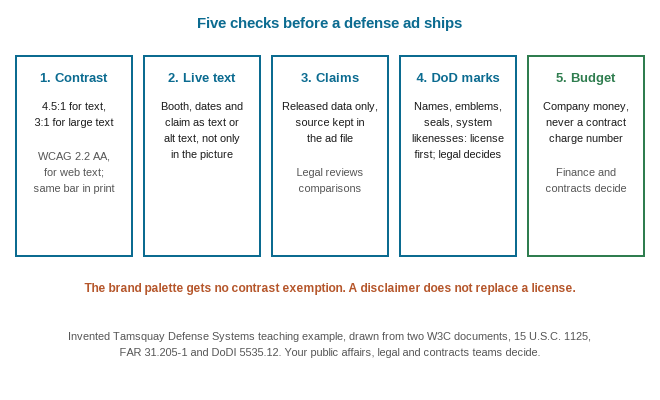
Check 1: readers can see the text
WCAG 2.2 success criterion 1.4.3, “Contrast (Minimum) (Level AA),” requires a “contrast ratio of at least 4.5:1” for text and images of text, and “Large-scale text and images of large-scale text have a contrast ratio of at least 3:1”. The W3C’s Understanding document explains that “18 point text or 14 point bold text is judged to be large enough to require a lower contrast ratio,” and that “the computed values should not be rounded (e.g., 4.499:1 would not meet the 4.5:1 threshold).”
Two lines matter to a brand team. “Text that is part of a logo or brand name has no contrast requirement.” But beyond logos, “text that has insufficient contrast due to corporate identity or brand guidelines is not exempted from the requirements of this criterion.” Incidental text in a photo, like a street sign, isn’t covered. The point of the requirement is text “read by people with moderately low vision or impaired contrast perception, without the use of contrast-enhancing assistive technology.”
Scope: these are WCAG 2.2 Level AA requirements for text on the web. Our reading: hold print and show graphics to the same bar. It costs nothing, and the brand guide keeps one standard. Thin gray on navy fails, and the brand palette doesn’t earn an exemption.
Check 2: the words exist as text
Success criterion 1.4.5, “Images of Text (Level AA),” asks that, where the technology allows, “text is used to convey information rather than images of text.” Logotypes are treated as essential. The aim is to serve people who need text in “a particular font size, foreground and background color, font family, line spacing or alignment.” And “Where images of text are used in addition to text to convey the same information, and where both are presented to the user, this success criterion is met.”
Scope: web content. Our reading: in a digital ad or landing page, the booth number, the dates and the claim go in live text or in alt text a person writes, not only inside the picture.
Check 3: every claim traces to released data
The Lanham Act’s false-advertising section, 15 U.S.C. 1125 in the unofficial copy (Cornell LII), says a person who, “in commercial advertising or promotion, misrepresents the nature, characteristics, qualities, or geographic origin” of goods or services “shall be liable in a civil action by any person who believes that he or she is or is likely to be damaged by such act.” The same section reaches statements likely to cause confusion “as to the affiliation, connection, or association” with another person, “or as to the origin, sponsorship, or approval” of goods or services by another person.
Who can sue and what a court would decide are questions for legal; this article only notes that the statute exists. Company-policy framing: at a prime, a range, speed or “proven” claim comes from released, cleared data, and its source stays in the ad file. A customer, program or agency mention needs that customer’s approval and public affairs’. Legal reviews any comparison. If the range figure can’t be traced to a released source, it stays out of the ad.
Check 4: no DoD marks without a license
DoD Instruction 5535.12, as amended by Change 2 (September 23, 2025), sets out DoD’s branding and trademark licensing program. For the latest version, look it up on the DoD issuances page before you rely on it. It describes DoD marks broadly, including “words, names, seals, emblems, symbols, slogans, designs, logos, heraldic images, military operation designations, medals, insignia, the names or likenesses of military weapon systems,” for marks a DoD Component owns or controls.
Under the program, “All authorizations for the use of a DoD mark shall be made in the form of a license, regardless of whether fees are received or not.” Marks “may not be licensed for use in a manner that creates a perception of DoD endorsement of any non-federal entity or its products and services.” Licensees display a non-endorsement disclaimer, and “Licensees may not state they are a partner, or imply any further association, with DoD or the DoD Component concerned as a result of the license agreement.” The DoD seal “is reserved for official use only.”
Scope: the instruction governs DoD’s own trademark licensing program. It doesn’t bind your company directly, and whether a particular name or image in your ad needs a license is for legal or trademark counsel. Our reading: a program name in large type, a weapon system likeness, a unit emblem or the seal is a legal question before it’s a design choice. A disclaimer doesn’t stand in for a license. The 11/14 piece linked above covers DVIDS terms.
Check 5: the ad isn’t billed to a contract
FAR 31.205-1, on Acquisition.gov, lists advertising media that include conventions, exhibits, magazines, trade papers, direct mail, outdoor advertising, radio and television. Paragraph (f)(1) makes unallowable all public relations and advertising costs, “other than those specified in paragraphs (d) and (e) of this subsection,” “whose primary purpose is to promote the sale of products or services by stimulating interest in a product or product line.” Paragraph (f)(5) adds “Costs of promotional material, motion pictures, videotapes, brochures, handouts, magazines, and other media that are designed to call favorable attention to the contractor and its activities.” Paragraph (f)(2) adds “All costs of trade shows and other special events which do not contain a significant effort to promote the export sales of products normally sold to the U.S. Government.”
Paragraph (d) is a closed list: “The only allowable advertising costs are those that are” of three kinds. The first is advertising specifically required by contract, or arising from requirements of Government contracts, and used exclusively to acquire scarce items or to dispose of scrap or surplus materials acquired for contract performance. The second is export promotion: “Costs of activities to promote sales of products normally sold to the U.S. Government, including trade shows, which contain a significant effort to promote exports from the United States.” Those exclude memorabilia, alcoholic beverages, entertainment and facilities used mainly for entertainment. The third is costs allowable under FAR 31.205-34, Recruitment costs. Scope: the cost principles apply to contracts that use them, and how a cost is charged is for finance and contracts. Our reading: treat the ad budget as company money and never code agency work to a contract charge number. For what you pay the agency itself, see our 10/23 piece on ad tech invoices.
How Tamsquay fixes it
The marketing lead sends the agency a five-line note. Darken the type to pass 4.5:1, put the booth number and dates in live text and alt text, replace the range figure with the released one and keep its source in the file, take out the emblem and program name unless legal clears them, and confirm the invoice goes to the marketing budget. Public affairs approves on the next pass.
This part is company-policy framing too. The agency works in the design software your company approves. Unreleased product photos, CAD renders and customer images never go to an outside design or AI service. If your company permits AI, use the company account and review its output like anything else; many primes keep AI-made images out of ads altogether.
Small contractors and startups. With no reviewer on staff, have the founder, or one named person, sign off on every ad against the same five checks. Test every text color for contrast, put dates and booth numbers in live text, keep a one-line source for each claim, leave out program names, emblems and seals unless counsel approves them, and ask your accountant how advertising is treated before anything is billed to a contract.
Common mistakes
- Exempting the brand palette. Only logos and brand names get a pass on contrast.
- Baking the details into the picture. A screen reader can’t find a booth number inside a photo.
- Lifting figures from engineering slides. Use released data and keep the source.
- Treating a disclaimer as permission. For DoD marks the license comes first.
Limits
These sources are two W3C explanatory documents, one statute, one cost principle and one DoD instruction. None measures how many defense ads fail contrast or how often ad claims are challenged, so this article makes no such claim. Public affairs, legal and contracts decide.
Sources
- W3C, "Understanding SC 1.4.3: Contrast (Minimum) (Level AA)," Understanding WCAG 2.2
- W3C, "Understanding SC 1.4.5: Images of Text (Level AA)," Understanding WCAG 2.2
- 15 U.S.C. 1125, "False designations of origin, false descriptions, and dilution forbidden," unofficial copy (Cornell LII)
- FAR 31.205-1, "Public relations and advertising costs," Acquisition.gov (FAC 2026-01, effective 03/13/2026)
- DoD Instruction 5535.12, "DoD Branding and Trademark Licensing Program Implementation," as amended by Change 2 (September 23, 2025); check the DoD issuances page for the latest version
- Adapted from AssociationAI, "Make Ads Your Members Can Read and Trust"