

Tutorial
Turn an NDAA Section Into a Decision Brief Without Calling It Law Too Early
For marketing, BD and capture staff at large defense and space primes: write an eight-line leadership brief on one defense bill section, record which version of the text every line comes from, keep authorized apart from funded, and check each line in a lab with invented data.
Time needed: About 45 minutes for an eight-line brief; legal and government relations review is separate
Before you start:
- The official text of the bill section leadership is asking about, with its version noted
- The name of your government relations or legal contact who reads briefs before leadership does
- Your company's rules for AI tools and for where capture information may be written
Policy Ndaa Appropriations Legislation Capture Government Relations Defense Space
Who this is for: marketing, business development and capture staff at a large defense or space prime who get asked what “the NDAA” means for a product line. Your company keeps capture plans out of personal chatbots and allows AI only through a company account, if at all, and government relations and legal own what a bill means. You write the brief they read first. A box for small contractors and startups, clearly labeled, comes after the common mistakes.
This is general information, not legal or policy advice. Your government relations and legal teams decide what a bill means for your company.
Teaching example: Invented Wystmoor Dynamics, its Sample decision brief on Section X of an invented defense bill (invented), and Section X itself are made up. No real bill, section, program, company, member of Congress or agency appears.
Why status beats wording
When a defense bill moves, trade newsletters and AI summaries get there first, and they blur versions. A House-passed provision, a Senate committee’s own bill and the conference text all get called “the NDAA.” The expensive mistakes are about status: a brief says a provision is law when it has passed one chamber, or says a program is funded because an authorization bill named an amount. Hiring and event spend can follow either one.
The question for every line: which version of the text is this from, and does it say law or money before either exists?
The three sources, and what they are
Two are Congressional Research Service primers. Each is a CRS explanation, not law: CRS In Focus IF10515, “Defense Primer: The NDAA Process,” updated December 4, 2025, and CRS In Focus IF10514, “Defense Primer: Defense Appropriations Process,” updated February 11, 2026. The third is the House’s own page, “The Legislative Process.” Anything binding comes from the bill or the law itself; these explain the path.
The steps
The eight lines, the step order and the lab’s rules are our teaching choices. Where your government relations team works differently, follow them.
-
Record the version before you read the words. CRS IF10515 says hearings “typically lead to the drafting and markup of separate bills in the House and the Senate,” and that the Senate Armed Services Committee’s proposal “is typically reported to the Senate as an original bill (i.e., its text has not been previously formally introduced).” Our reading: introduced text isn’t the only starting point and may not be the final wording, so every line of the brief names its version.
-
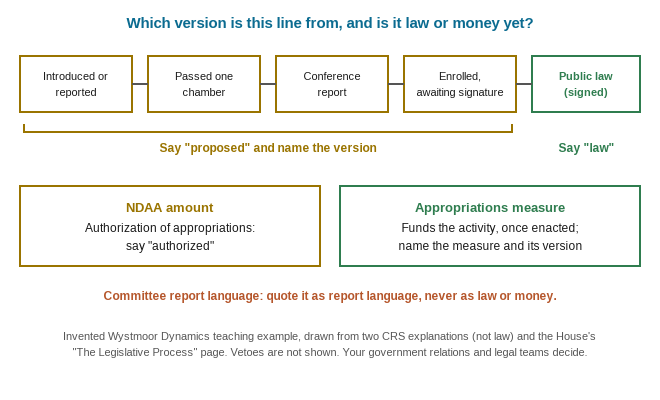
Say law only for the signed version. IF10515: “The Constitution requires that the House and Senate approve the same bill in precisely the same form before it is presented to the President.” A conference report “is subject to debate during floor consideration, but is not amendable,” and “If the House and Senate each agree to the conference report, the NDAA is enrolled for presentation to the President.” The House page describes a conference committee that “works out any differences between the House and Senate versions of the bill,” a result that “returns to the House and Senate for final approval,” printing “in a process called enrolling,” and then the President acting “to sign or veto the enrolled bill.” Until the signed version exists, the line says “proposed.” The lab treats “Public law (signed)” as the only enacted version and doesn’t model vetoes or veto overrides.
-
Keep authorized apart from funded. IF10515 says the NDAA “provides authorization of appropriations for the Department of Defense (DOD)” and sets defense policies and restrictions, but “Unlike an appropriations bill, the NDAA does not provide budget authority for government activities.” CRS adds that historically it has been “a fairly reliable indicator of congressional sentiment on subsequent appropriations for particular programs.” IF10514 quotes the Constitution: “No money shall be drawn from the Treasury, but in Consequence of Appropriations made by Law.” Of the appropriations measures, “These measures determine which department activities will be funded.” When those aren’t finished, Congress may provide temporary funding, and “These measures are known as continuing resolutions (or CRs).” Our reading: a money line names the appropriations measure and its version, or it says “authorized.”
-
Quote report language as report language. IF10514 says appropriations subcommittees “prepare reports, which include information required by House and Senate rules, explain committee actions, and provide guidance and directives to agencies,” and “Committee reports may not be amended directly during floor proceedings.” Our reading: cite the named report, and don’t call its language law or money. How much weight it carries for your program is for government relations.
-
Date every deadline to its version. IF10515: “Completion of the conference report is not on a specified timeline, but many of the authorities provided by the NDAA expire at the end of the fiscal year.” A deadline line says which version it comes from, and that conference can still change it.
-
Write it where company information belongs. This is company-policy framing. Draft in company-approved tools. If AI is allowed at all, use the company account, give it public bill text only, and treat each sentence it writes as unverified until it points to a line in the bill, the report or the appropriations measure. Capture plans, customer names and pricing never go into any chatbot.
Try it now: open the NDAA brief line check lab, choose Case B, and find the one line that trips four rules at once.
- Clear the lab, then hand it to government relations. Resolve every STOP and every VERIFY on your own lines, then have government relations or legal read the brief before leadership sees it.
The worked example
Invented Wystmoor Dynamics, a mid-size counter-drone sensor supplier, briefs leadership on Section X. Its clean brief, the lab’s Case A, has these eight lines, all drafted in company-approved tools:
| Line | About | Source | Version | Worded as |
|---|---|---|---|---|
| 1 | Where the bill stands | Bill text | Passed one chamber | Proposed |
| 2 | What Section X would require | Bill text | Passed one chamber | Proposed |
| 3 | Money for the program | Appropriations bill | Reported by committee | Proposed |
| 4 | Deadline in the section | Bill text | Passed one chamber | Proposed |
| 5 | Committee report language | Committee report | Reported by committee | Proposed |
| 6 | Who it affects | Bill text | Passed one chamber | Proposed |
| 7 | What we don’t know yet | Bill text | Passed one chamber | Flagged as open |
| 8 | Our recommended next step | Bill text | Passed one chamber | Recommends an action |
Check your work
Each lab verdict means one thing. STOP: the line can’t go to leadership as written. VERIFY: someone checks it again. PASS: none of the lab’s rules fired, which is not a review. Your counts should come out like this:
| Case | STOP | VERIFY | PASS |
|---|---|---|---|
| A, clean brief | 0 | 0 | 8 |
| B, newsletter-fed | 2 | 2 | 4 |
| C, personal account | 1 | 3 | 4 |
| D, law too early | 4 | 1 | 3 |
| E, as typed | 1 | 4 | 3 |
| F, signed text | 1 | 2 | 5 |
Eight lines in all match two or more rules. Whichever rule comes first decides the verdict.
Common mistakes
- “The NDAA says.” Which NDAA? Name the chamber and the version.
- Planning on an authorized amount. It’s an authorization. Check the appropriations measure.
- Promoting report language. It explains and directs; quote it with the report’s name.
- Letting an AI summary pick the version. It may describe text that never passed.
Small contractors and startups. No government relations team? Read the bill text and the CRS primers yourself, keep the same eight lines, and mark every one with its version. Don’t plan hires or event spend on an authorized amount alone, and keep company plans out of personal AI accounts, whatever your size.
Related
For the regulation side, after a bill becomes law and an agency writes rules, see our 11/12 tutorial on rule alerts. For a renewal decision you can make without Congress, read renew or drop a paid directory listing.
Limits
The two CRS primers are explanations for public understanding, not law. The House page is a short overview. None of them tells you what a specific section means for your company, and the lab doesn’t predict what Congress will do. The lab keeps its logic simple on purpose, and every rule in it is our own call. Your government relations and legal teams decide.
Sources
- Congressional Research Service, In Focus IF10515, "Defense Primer: The NDAA Process," updated December 4, 2025 (a CRS explanation, not law)
- Congressional Research Service, In Focus IF10514, "Defense Primer: Defense Appropriations Process," updated February 11, 2026 (a CRS explanation, not law)
- U.S. House of Representatives, "The Legislative Process," house.gov
- Adapted from FOUNDINT.AI, "Prepare a Policy Brief That Tells Education Staff What Is Still Unknown"