

Article
Renew or Drop That Paid Defense Directory Listing? Check the Free Records First
For marketing and BD staff at large defense and space primes: at renewal time, confirm the SAM record the government relies on and your small-business teaming partners' SBA search profiles, then keep paying only for a listing that produced contacts you can name.
Policy Directories Sam Small Business Teaming Government Contracting Defense Space
Who this is for: marketing and business development people at a large defense or space prime, or one of its business units, who approve or renew paid directory, buyers-guide and “featured supplier” listings. Your company quarantines unknown email, forbids clicking unknown links, and allows AI only through a company account or not at all. You don’t own the SAM registration, but you can make sure someone checks it. A labeled box after the worked example is for small contractors and startups.
This is general information, not legal or contracting advice. Your contracts, BD and legal teams decide what your company registers, renews and pays for.
Teaching example: Invented Ostrevane Systems and its three listings are made up. No real directory, vendor, association, company, program or person is described.
The renewal notice
A year ago, the team decided whether to buy the listing at all; our 11/02 piece covered that first decision. Now the second-year notice is in the inbox. It says the listing “drove visibility,” attaches a chart of impressions, and wants an answer before a deadline. Nobody tracked where last year’s real contacts came from, so the easy move is to renew.
The question that settles it: if we dropped this listing tomorrow, which confirmed contact would we lose?
First, the records the government relies on
Before any paid listing, there are records your company already has to keep right, and they cost nothing.
SAM. Under FAR 4.1102 (FAC Number 2026-01, Effective Date 03/13/2026), “Offerors and quoters are required to be registered in SAM at the time an offer or quotation is submitted in order to comply with the annual representations and certifications requirements except for” a short list of cases. One of them covers classified contracts “when registration in SAM, or use of SAM data, could compromise the safeguarding of classified information or national security”. If you work in a classified line of business, check with your contracts office.
The SAM maintenance clause, FAR 52.204-13, defines SAM as “the primary Government repository for prospective Federal awardee and Federal awardee information.” It says “The Contractor shall maintain registration in SAM during contract performance and through final payment of any contract,” and “The Contractor is responsible for the currency, accuracy and completeness of the data within SAM, and for any liability resulting from the Government’s reliance on inaccurate or incomplete data.” The clause also points contractors to where they can “obtain additional information on registration and annual confirmation requirements”; how that confirmation works is for SAM.gov and your contracts office, not this post.
SBA’s Small Business Search. On its page for contracting officials, SBA tells federal buyers they are required to use the Small Business Search (SBS, formerly the Dynamic Small Business Search) in market research, and that they can use it “to help determine set-aside or sole-source allocation, or search for contractors for open or upcoming awards.” SBA’s how to win contracts page calls SBS a database “that government agencies use to find small business contractors for upcoming contracts,” says “SBA maintains the SBS database,” and explains that SAM registration information “is used to populate SBS, so you should create a comprehensive business profile.” Program participation “will be displayed on the firm’s Small Business Search profile.”
What that means at a large prime
A large prime is not a small business and doesn’t appear in SBS as one. So at a prime, the free-record check has two parts, and both are our reading of the sources above:
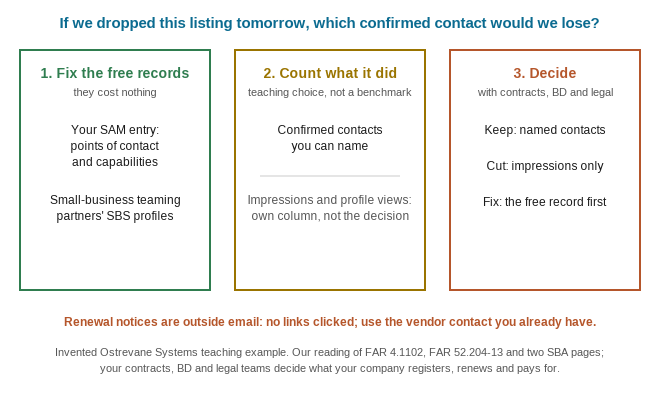
- Keep your own SAM entry accurate. The clause puts that responsibility on the contractor. Marketing doesn’t edit SAM, but at renewal it can ask contracts whether the points of contact and capabilities there still match what the paid listing says. If they don’t, fix the record the government reads before paying to polish one it may not.
- Look at your small-business teaming partners’ SBS profiles. Their profiles are built from their SAM data and are what buyers search when a set-aside is in play. If a partner’s profile is thin, that’s a conversation for BD and the partner, not a reason to buy your company a bigger directory tier.
The record a contracting officer is told to search is built from data your company already has to keep accurate.
Second, count what the listing actually did
Buyers have more than one way in. SBA tells contracting officials that “In addition to using SBS, you can try to find contractors through outreach, by hosting events and industry days,” and its how-to page notes that “there are multiple databases that government agencies use to find contractors.” Our reading: a paid listing is one channel among the government’s own search, its outreach and its industry days. Measure it against them; don’t assume it.
The counting rule here is a teaching choice, not a finding. No source in this post measures whether any paid directory produces contracts, and we don’t cite a benchmark because none of these sources gives one.
- Confirmed contacts only. Count a contact only when you can name it and it came from the listing: an inbound message that cites it, a tracked form, or a code the sales team logged.
- Impressions in their own column. Count the contacts you can name. Put impressions and “profile views” in a separate column and leave them out of the decision.
- Compare channels where you can tell. Next to the listing, note contacts that came through SAM or SBS lookups, outreach events and industry days.
- Decide keep, cut or fix. Keep a listing that produced named contacts. Cut one that produced only impressions. Fix the free record first when the listing is doing work SAM should be doing.
Handle the notice like any outside email
This part is company-policy framing. A renewal notice is still an email from outside. Don’t click a “confirm your listing” link in it; if it looks suspicious, report it the way your company says to. Reach the vendor through the contact you already have on file. SAM-themed scams target contractors directly, and our 11/12 piece on payment change requests covers that pattern.
If your company allows AI at all, use the company account. Don’t paste contracts, invoices or lead lists into a personal chatbot to “summarize whether it’s worth it,” and never upload customer contact data to any AI tool.
Worked example: Ostrevane’s three renewals
Invented Ostrevane Systems, a mid-size sensor supplier, reviews three paid listings at renewal. The marketing lead, the BD lead and the contracts office meet for half an hour.
| Listing (invented) | Confirmed contacts last term | Impressions only | Decision |
|---|---|---|---|
| Sample buyers’ guide listing | Two named inbound contacts that cited it | Yes | Keep for one more term, with a tracked form |
| Sample “featured supplier” upgrade | None | Yes | Cut |
| Sample capability directory profile | None, but it lists a point of contact SAM no longer shows | Yes | Fix SAM first; drop the profile unless it produces a named contact |
Before any of that, contracts confirms the SAM points of contact, and BD checks the SBS profiles of the two small-business partners Ostrevane teams with most.
Small contractors and startups. Before you pay for any listing, finish your SAM registration and make your SBS profile comprehensive, since SBA says your SAM data populates it. Then put time into the outreach events and industry days that agencies use to find contractors. If a paid listing still looks useful, try it for one term with a way to count confirmed contacts, and decide at renewal with those contacts in front of you.
Common mistakes
- Renewing on impressions. A chart of views is not a contact you can name.
- Fixing the listing instead of the record. The paid profile can’t correct a stale SAM entry.
- Assuming a prime shows up in SBS. It’s a small-business search. Check your partners’ profiles instead.
- Clicking through the notice. Use the vendor contact you already have.
Limits
FAR 4.1102 and FAR 52.204-13 say what the rules require of offerors and contractors; SBA’s pages describe how SBA presents its search to buyers and businesses. None of the four sources measures whether a paid directory produces contacts or contracts. Whether your company registers, renews or pays for anything is for contracts, BD and legal. The habit to keep: fix the free record, then pay only for contacts you can name.
Sources
- FAR 4.1102, Policy (System for Award Management), Acquisition.gov (FAC Number 2026-01, Effective Date 03/13/2026)
- FAR 52.204-13, System for Award Management Maintenance, Acquisition.gov
- U.S. Small Business Administration, "Contracting officials"
- U.S. Small Business Administration, "How to win contracts"
- Adapted from AssociationAI, "Does an Online Directory Get Used, and Does Use Become Revenue?"