

Tutorial
Train Your First Gaussian Splat on Public Data First
For marketing, events and web staff at large defense and space primes: learn Gaussian splats on a public CC0 practice dataset on an approved company computer, show a sample splat from your own site, then check each real capture plan for place, photos, release and sharing before anyone picks up a camera.
Time needed: An afternoon for the practice run on an approved company computer; approvals for anything real take as long as they take
Before you start:
- A company computer that IT has approved for the training software
- The names of your security office, trade compliance and public affairs contacts
- Your company's rules for AI tools, cloud storage and personal devices
Events Gaussian Splatting 3d Public Release Itar Security Web Defense Space
Who this is for: marketing, events and web teams at big defense and space primes that are curious about Gaussian splats for product or event pages. At your company IT approves every install, the security office owns any photo of a building or customer site, trade compliance decides what a picture of hardware may show, public affairs clears every public asset, and AI is either banned or allowed only through a company account. Smaller firms will find a separate, labeled box toward the bottom; for big primes, the rest applies as written.
This is general information, not legal, security or export-control advice. Your trade compliance team, security office and public affairs decide what your company photographs, trains and shows.
Teaching example: Invented Duskfirth Sensors and its “Sample splat capture plan (invented)” are made up. Nothing here depicts a real customer, program, plant, hangar, range, base or agency. The apple below is real public CC0 practice data.
The walk-around everyone wants
Someone saw a walk-around splat of a competitor’s booth and now wants one of the new sensor, the lobby and maybe the customer hangar where the demo ran. The quickest route on offer is a free phone app that uploads the photos to its own servers, trains them and hands back a public link. One tap sends company imagery to an outside service, may show a place nobody cleared, and publishes it before public affairs or trade compliance has seen it. And the team still doesn’t know whether it can train a splat at all.
A splat is a photograph you can walk around. So it needs every approval a photograph needs, and the security office’s too. The question for every capture: who said yes to this photo, and where did the photos go?
A sample splat, on this page
Here is the end state of the practice run: a Gaussian splat of an apple, served from this site with a viewer this site hosts. It loads only when you ask it to, because the file is about 9 MB (measured on 11/12).
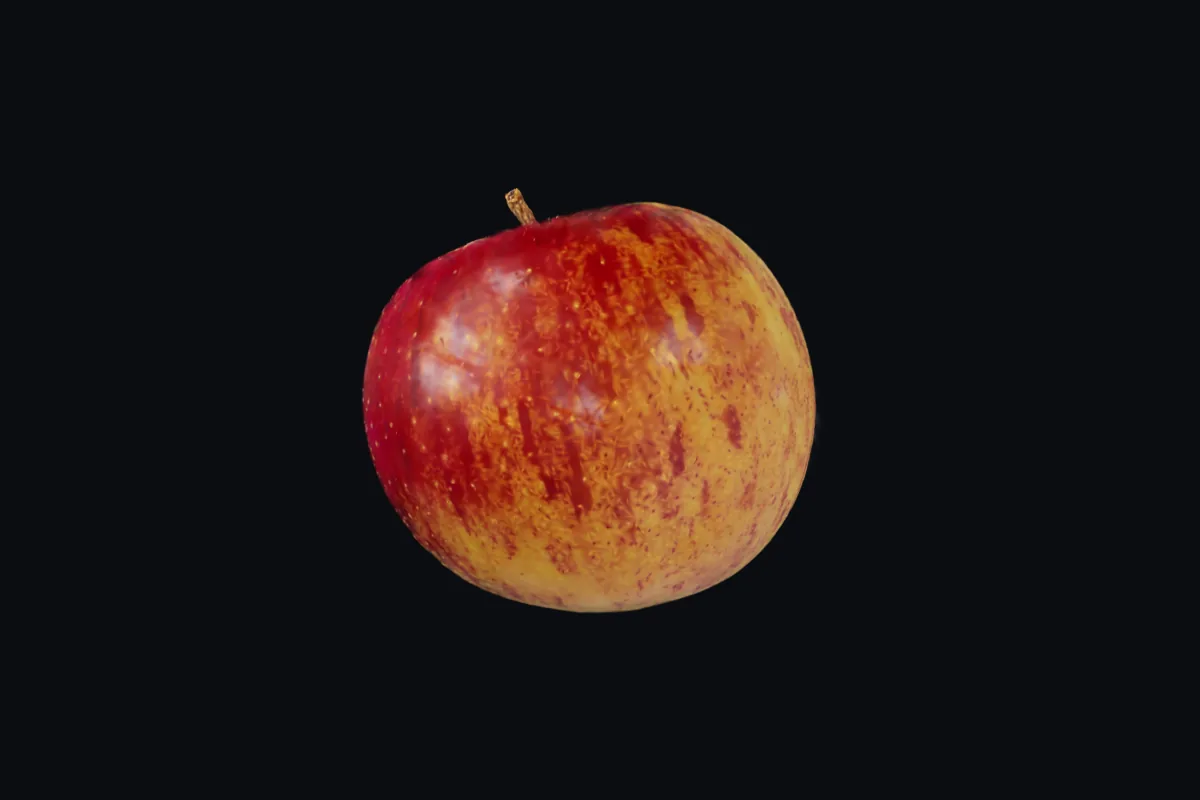
Sample splat: “Apple” from the DX.GL multi-view datasets (CC0), trained from Poly Haven’s CC0 “Food Apple 01” model. Credit to DX.GL and Poly Haven. Viewer: GaussianSplats3D (MIT) and three.js (MIT), served from this site.
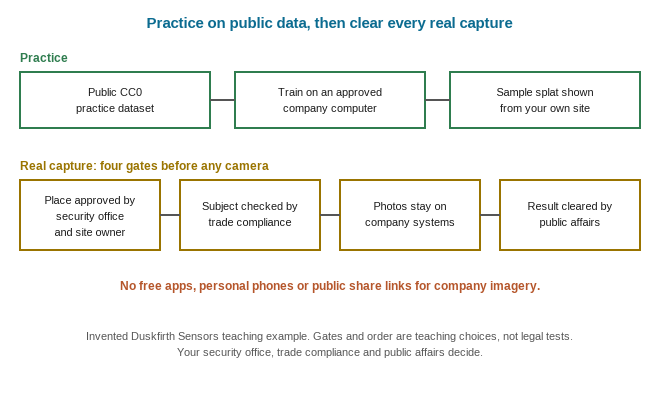
The steps
The step order and the lab’s rules are our teaching choices. Where your security office, trade compliance or public affairs team works differently, follow them.
-
Practice on public data first. The DX.GL multi-view datasets are “rendered from CC0 3D models.” Per the dataset card, there are 10 objects, each with 196 views at 1024×1024. “Each dataset includes calibrated camera poses, depth maps, normal maps, binary masks, and point clouds,” so the camera positions come already solved and the practice run skips that stage. The card shows the training command, starting
ns-train splatfacto --data ./apple, and includes pre-trained splats (“nerfstudio splatfacto, 20k iterations, SH degree 3”). Installing the training software and downloading the dataset are IT decisions. Use a company computer IT has approved. Learn the software on a public apple before you point a camera at anything with a part number. -
Read the sample’s terms, and credit both sources anyway. The card says “All source 3D models are CC0 (public domain) from Polyhaven,” that “The rendered datasets inherit this license,” and that you can “use them for anything, no attribution required.” Poly Haven says “Our assets are all licensed as CC0,” “which is effectively Public Domain even in jurisdictions that do not support the Public Domain,” and “You can use our assets for any purpose,” “including commercial work.” Credit is optional there too. One caution: “All content on this website, excluding the CC0 assets themselves, is protected by intellectual property laws,” and that includes Poly Haven’s example renders. The CC0 status of DX.GL’s renders and splats rests on DX.GL’s own statement. Our reading: credit DX.GL and Poly Haven anyway. It costs one line and shows where the file came from.
-
Show the sample with a viewer your site hosts. The page above uses GaussianSplats3D on three.js, both under the MIT license (“Copyright (c) 2023 Mark Kellogg”; “Copyright © 2010-2026 three.js authors”). MIT allows anyone “to use, copy, modify, merge, publish, distribute, sublicense, and/or sell copies of the Software,” on the condition that “The above copyright notice and this permission notice shall be included in all copies or substantial portions of the Software.” Our reading: build the viewer into the site’s own bundle, ship both notices with it, load nothing from a third-party server, and keep the large file behind a click.
-
Places are the security office’s call. 18 U.S.C. 797, in the unofficial copy (Cornell LII), applies starting 30 days after the President defines a vital military or naval installation or equipment as within the category in section 795. It then covers “whoever reproduces, publishes, sells, or gives away any photograph,” drawing or other graphical representation of it without permission from the commanding officer of the post, camp or station concerned, or higher authority, unless the image is marked as censored by the proper military or naval authority. The section reaches only installations and equipment the President has defined, and your security office and legal say whether a given place qualifies. Our reading, and company-policy framing: a splat is a graphical representation you can walk around, so photos of any company building, plant, range or customer site wait for a written yes from the security office and from whoever runs the place. That includes the lobby. For publishing finished 3D models, see our 11/16 tutorial.
-
Hardware is trade compliance’s call. Under the ITAR, “Public domain means information which is published and which is generally accessible or available to the public:” through listed routes. Those include unlimited distribution at a trade show or exhibition in the United States, and “Through public release” in any form “after approval by the cognizant U.S. Government department or agency.” (Quoted from eCFR text current to 11/10/2026.) That is a definition, not a verdict on any splat. Our reading: a public splat of a prototype or test article puts whatever it shows in front of anyone, and trade compliance decides whether and how that’s allowed. For the ITAR release idea, see our 11/13 piece.
-
Photos stay on company systems. This is company-policy framing. Train on a company computer. No free phone apps or outside AI services for company imagery, no personal phones or laptops, and the company cloud account only after the security office says the subject may be stored there. If the photos left the building to be trained, the question is no longer how good the splat looks.
-
Leave public share links off. Also company-policy framing. If the training tool offers a public link, use it for the practice data at most. Show a finished splat only on an internal machine or, once cleared, from your own site.
Try it now: open the splat capture release check lab, choose Case F, and find the capture that trips three rules at once.
- Clear the lab, then pick up a camera. Resolve every STOP and every VERIFY with the office that owns it. For photo-set quality before training, see our 11/03 tutorial.
The worked example
Invented Duskfirth Sensors, a mid-size maker of airborne sensor pods, writes a plan for eight captures. Its clean plan, the lab’s Case A:
| Capture | What it is | Photos trained on | Shown |
|---|---|---|---|
| 1 | Practice run, public apple dataset | Company computer | Own site |
| 2 | Released product, outer shell | Company computer | Own site |
| 3 | Prototype, team review only | Company computer | Internal |
| 4 | Front lobby, visitors page | Company computer | Own site |
| 5 | Customer hangar, for the customer | Company computer | Internal |
| 6 | Released product | Company cloud account | Own site |
| 7 | Second practice run | Free phone app | Internal |
| 8 | Prototype for the show page | Company computer | Own site |
The lobby and hangar have security office and site owner approval. Captures 2, 6 and 8 are cleared by public affairs and trade compliance, Captures 1 and 4 by public affairs, and nothing internal is set for release.
Check your work
A STOP verdict means the capture can’t go ahead as planned. VERIFY asks for a second check. PASS only says no rule in the lab fired; it isn’t a security, release or export-control approval. Compare your tallies:
| Case | STOP | VERIFY | PASS |
|---|---|---|---|
| A, clean plan | 0 | 0 | 8 |
| B, quick wins | 2 | 2 | 4 |
| C, wrong devices | 3 | 1 | 4 |
| D, almost there | 0 | 4 | 4 |
| E, typed by hand | 2 | 2 | 4 |
| F, links on | 2 | 2 | 4 |
Nine captures across the cases trip more than one rule, and only the earliest rule in the order sets the verdict.
Common mistakes
- Starting with the hangar. Start with the apple.
- Trusting the app’s privacy page. Company imagery doesn’t go to outside services.
- Forgetting the lobby. It’s a company building; the security office decides.
- Leaving the share link on. A link anyone can open is a release.
Small contractors and startups. If your firm has neither a security office nor a trade compliance team, pick one person to say yes to photos of any place (your facility security officer if you have one, or the founder with the owner’s written OK) and one to field export questions, such as an empowered official or a lawyer you retain. Until then, practice only on public CC0 data like the apple dataset, train on a company machine, keep share links off, and don’t photograph anyone else’s site.
Limits
The dataset card and Poly Haven’s page set the sample’s terms, and the MIT licenses set the viewer’s. The U.S. Code and ITAR text are quoted from an unofficial copy (Cornell LII) and eCFR text, not official editions. None of these sources says whether a particular capture is allowed, and a PASS in the lab is not a clearance. Your security office, trade compliance and public affairs decide.
Sources
- DX.GL, "DX.GL Multi-View Datasets for NeRF & 3D Gaussian Splatting," Hugging Face dataset card (CC0-1.0), revision 60fe6e9
- Poly Haven, "License"
- GaussianSplats3D LICENSE (MIT)
- three.js LICENSE (MIT)
- 18 U.S.C. 797, "Publication and sale of photographs of defense installations," unofficial copy (Cornell LII)
- 22 CFR 120.34, "Public domain" (ITAR), eCFR text, up to date as of 11/10/2026
- Adapted from AssociationAI, "Make Your First Gaussian Splat From Your Own Photos"