

Article
Phone Signals, Not Ad Data: What the Record From Ukraine Supports
For staff at large defense primes with strict AI, email and device rules: two West Point commentary pieces describe phones in Ukraine being found by their emissions, not by ad data. Here's how to keep those risks apart when staff ask.
ADSEC Opsec Mobile Personal Data Defense Space
Who this is for: people at big defense and space primes whose companies lock down AI tools, email and devices, and in particular anyone in security, marketing or business development who briefs travelers. If a colleague has ever told you “the phone gave them away,” this article is about what that sentence can and can’t mean.
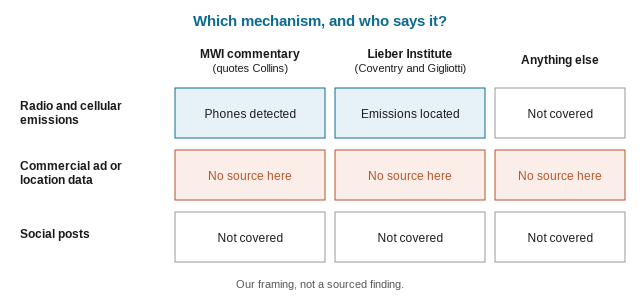
Three things people mean by “the phone”
Our framing, not a sourced finding. Stories about phones on the battlefield reach a prime secondhand, usually at a coffee station or in a hallway before a trip. By then they tend to blur three different mechanisms into one warning.
- Radio and cellular emissions. A phone that’s switched on sends signals. Someone with the right equipment can detect them.
- Commercial ad or location data. Apps and ad networks collect location, and some of that data is bought and sold.
- Social posts. People share photos and updates that say where they are.
Each has a different fix. Ad settings don’t silence a radio. Switching off a radio doesn’t recall data that was already sold. A post can’t be unposted from someone else’s screenshot. If staff mix the three up, they’ll pick the wrong fix and feel safe anyway.
Only the first mechanism appears in the two sources we use below. That’s the point of this article.
The pocket question: when someone says “the phone gave them away,” which mechanism do they mean, and who is saying it?
What a Modern War Institute commentary says
The Modern War Institute at West Point published a commentary by Lucas Scarasso in April 2020. It isn’t research and it isn’t an official position. MWI says so itself: “The articles and other content which appear on the Modern War Institute website are unofficial expressions of opinion.”
Scarasso’s piece cites an earlier account. In his words: “In July 2018, Col. Liam Collins wrote an assessment of Russian electronic warfare in Ukraine.” Scarasso writes that “he detailed how Russian forces targeted the cell phones of Ukrainian soldiers”.
The commentary then quotes Collins directly. As quoted by MWI, Collins’s account includes this passage: “followed by an artillery strike to the location where a large group of [cell phones] was detected”. The bracket is MWI’s. In MWI’s quote, the strike comes at the end of a sequence: “In one tactic, soldiers receive texts telling them they are” surrounded, and texts to their families “often prompts a call or text to the soldiers.”
Read that carefully. We have the Collins account only as MWI quotes it. We don’t have a date, a place or a count, and we aren’t citing the original assessment. The step that leads to the strike is detection of phones, which is the emission mechanism. Nothing in it mentions buying data.
Scarasso also makes a historical point that’s easy to lose: “Militaries targeted combatants through the signals they generated long before the invention of the cell phone.” Targeting by signals isn’t new. The phone is a new thing that emits.
What the Lieber Institute at West Point says
The second source comes from the Lieber Institute at West Point, a separate institute from MWI at the same academy. In a June 24, 2024, post on its Articles of War site, Charles Coventry and Luke Gigliotti write about the electromagnetic spectrum and the law of armed conflict. Like MWI, the institute marks the piece as the writers’ own: “The views expressed are those of the authors”.
Coventry and Gigliotti open their point on Ukraine broadly: “The conflict in Ukraine demonstrates that high-quality EM detection can significantly enable combat operations.” They also describe the general capability: “Modern EM detection technologies can passively identify, locate, and distinguish different EMEs, producing valuable military intelligence.”
Then they give the example that gets repeated most. According to Coventry and Gigliotti, “Ukraine has been able to locate and target Russian generals by geolocating emissions from their personal cellular devices with significant strategic effect.”
That finding is theirs, stated in a commentary post. We don’t add names, events or numbers to it. Note what it describes: emissions from personal phones, located by detection. It’s the same mechanism as the Collins account, on the other side of the war.
What our sources don’t say
Our sources don’t show either side using commercial ad data. Neither the MWI commentary nor the Lieber Institute post says that Russia or Ukraine bought ad data, bidstream data or app location data to find a target. Both describe phones found through what they emit.
That doesn’t mean commercial data carries no risk. It means these two sources aren’t evidence for that risk, and a briefing that cites them for it is overstating. If you want to talk to staff about the data market, use a source about the data market. Keep the two conversations separate, so that a traveler who hears one warning doesn’t assume it covers the other. When a colleague forwards a phone story for the next briefing, ask for the original source before it goes on a slide, and note who is making the claim.
What a prime’s people can do
Our framing, not a sourced finding. None of the steps below come from either source. They’re teaching choices for staff who brief others or travel themselves. Your security team’s guidance comes first.
Illustrative: Invented Prime Co. is a made-up company; no real firm or person is described.
At Invented Prime Co., the security lead and the business development lead agreed on three habits for travel briefings.
- Sort before you repeat. When a phone story comes up, the briefer asks two questions: which mechanism, and who says so? A party to the conflict, a journalist and a service-school writer are different kinds of speaker. If nobody can answer, the story stays out of the briefing.
- Keep the risks and the fixes apart. Emissions, ad data and posts each get their own line in the briefing, with their own fix. Nobody is told that an ad setting protects them from detection, because no source here says so.
- Do the part you control. Before a show, each traveler runs a short check of app location settings, photo location and radios. Our staff phone location check walks through one way to do that and records the result.
We’re deliberately not offering anything about detection methods or countermeasures. That’s a job for your security team, not a marketing article.
Why strict policy can blur this
Our framing, not a sourced finding. At a prime with strict device rules, people learn that phones are risky in general. That’s good instinct, but it can turn into one big worry that covers everything. When the worry is general, the fix tends to be general too, and general fixes rarely match a specific risk.
Sorting by mechanism gives the instinct a shape. It also protects your credibility. A briefing that overstates once gets discounted the next time, even when the next warning is right.
Limits
Both sources are commentary from West Point institutes, and both say they state the authors’ views. The Collins account is secondhand: we have it only as MWI quotes it. Neither source is about defense contractors or trade shows, and a battlefield isn’t an exhibit hall. Nothing here shows any risk to a specific prime’s staff. The three-mechanism split and the three habits are our framing and teaching choices, not findings.
Sources
- Lucas Scarasso, Text Messages From Hell: Restraint and Information Warfare, Modern War Institute at West Point (commentary, April 21, 2020)
- Charles Coventry and Luke Gigliotti, Distinction and the Rule of Perfidy within the Electromagnetic Spectrum, Articles of War, Lieber Institute at West Point (June 24, 2024)