

Article
Your Firewall Doesn't Cover the Data Market: Service Members in Broker Data
For staff at large defense primes with strict AI, email and device rules: what a Duke University Sanford School research team paid for identified records on service members in its own purchases, why a NATO center of excellence treats broker data as a security risk, and what a prime can do about the part it controls.
ADSEC Opsec Personal Data Data Brokers Defense Space
Who this is for: staff at large defense and space primes that already run strict AI, email and device rules, especially security, marketing and business development teams. If your company has those rules in place, this article is about what they don’t reach.
The part your policy doesn’t touch
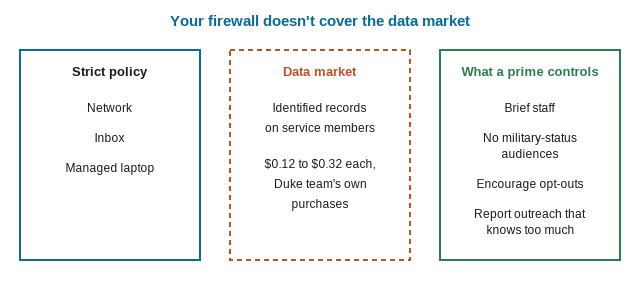
This framing is ours, not a finding from either source below. A large prime does a lot right. Personal AI accounts are blocked. Phishing lands in quarantine. Program detail stays out of chatbots, and staff hear it every year in training. Those controls all protect company systems: the network, the inbox, the managed laptop.
The commercial data market sits outside every one of them. Records about your people can be bought and sold without anyone ever touching your network. No filter sees the sale, no gateway logs it, and no policy written for company systems applies to it. Primes employ veterans, reservists and staff with military family members, and their marketing teams buy audiences. That puts a prime on both sides of this market.
The pocket question: what could someone buy about our people without ever touching our network, and what are we doing about the part we control?
What the Duke research report is
In November 2023, a team at Duke University’s Sanford School of Public Policy published a research report on the sale of data about U.S. military personnel. It is a university research report. It isn’t peer-reviewed work, and we describe it here only as what it is.
The team didn’t just read broker marketing. It bought data and reported what arrived. That is the part we rely on.
What the Duke team paid in its own purchases
Among other purchases, the team set out to buy “individually identified contact data on 5,000 active-duty military personnel.” Its reported cost: “The purchased data cost us between $0.12 to $0.32 per U.S. military servicemember when buying between 4,951 and 15,000 identifiable records at a time.”
Read those figures carefully. They are what this one team paid in its own purchases, at that time and in those batch sizes. They aren’t market prices, and we aren’t claiming any broker charges them today.
Across the datasets the team bought, the report describes contact data such as names, home addresses, email addresses and phone numbers. Some of the purchased sets added further fields, including health-condition checkboxes, net worth, credit rating, religion and political affiliation. Not every set had every field. Some purchases were focused on areas with major military installations.
The data wasn’t stripped of identity. In the report’s words: “None of these datasets were anonymized nor aggregated”. These were records about named people.
Buyer checks were uneven, not absent
The report is clear that controls on the selling side were inconsistent rather than missing. It concludes: “Data broker methods of determining the identity of customers are inconsistent and evidence a lack of industry best-practices.” Some brokers sold to the team without asking much about who it was.
Others did say no. The report notes: “Two brokers refused to sell to us based on our lack of a website and the fact that we were not a “verified” company.” Both halves matter. Some sellers ran no meaningful checks; two turned the buyer away.
Why a security center treats this as a security problem
The NATO Strategic Communications Centre of Excellence in Riga has looked at the same market from a defense angle in its paper “Data Brokers and Security.” It’s the center’s own assessment and doesn’t speak for NATO as an alliance.
Its central worry is cost. The paper argues that “purchasing this information from a data broker is more cost effective than traditional spycraft”. It also warns about what personal records can do in the wrong hands: “Sensitive data, such as financial information or private internet habits, can be used to blackmail or extort decision-makers.”
Neither source is about defense contractors. The Duke team bought data on service members, families and veterans; the NATO paper looks at militaries in general. Nothing here shows that anyone has bought data on a prime’s staff or used it against them. The connection to a prime is our framing: your company employs many of the kinds of people these sources describe.
What a prime can do about the part it controls
You can’t change what was sold before. You can control what your company adds to the market and how well your people understand it. The steps below are our teaching choices, not requirements from either source. Check them with your security and legal teams first.
Illustrative: the firm below, Invented Prime Co., is made up and stands for no real business or employee.
At Invented Prime Co., the security team and the marketing lead agreed on four habits.
- Brief staff on what the report found, and only that. Veterans, reservists and staff who travel for business development get a short session. It covers the figures above, framed as what one team paid in its own purchases, plus the point that the data was identified, not anonymized. No speculation beyond the report.
- Don’t buy or build audiences keyed on military status. Marketing doesn’t purchase segments that target people by service or veteran status, and doesn’t create them from its own lists. Before registrant or staff data goes to any event or list vendor, the team checks the vendor’s data terms for resale. Our vendor resale terms check walks through one way to do that.
- Encourage personal opt-outs. Staff get time and a simple guide to request removal from people-search and marketing lists, without the company naming or recommending any particular service.
- Report outreach that seems to know too much. A message from a stranger that knows your home address, your family or your service history goes to company security, not to a reply.
The NATO paper makes the point that matters most for step one: “Awareness is only useful if it leads to meaningful change in behaviour.” A briefing that changes nothing is a slide deck. Ask each team what it will stop doing.
Why strict policy makes this easy to miss
Again, this is our framing. Strict rules can create a quiet confidence. When every email is filtered and every AI tool is approved, it’s natural to assume the people are covered too. But a rule that governs company systems can only see company systems. A record sold about an engineer’s home address never passes through any of them.
That’s why this belongs with security, not only with the data team. The question isn’t whether your controls work. It’s whether anyone at the company owns the risk that sits outside them, and whether marketing knows its own purchases are part of the same market.
Limits
The Duke research report, published in November 2023, covers one U.S. team’s purchases from three brokers. Its figures are what that team paid in its own purchases, not market prices. The NATO center’s paper is its own assessment, about militaries generally, and the center doesn’t speak for NATO. Neither source is about defense contractors, and nothing here shows a specific attack on any company’s staff. The four habits are teaching choices. Your security and legal teams’ guidance comes first.
Sources
- Sherman, Barton, Klein, Kruse and Srinivasan, Data Brokers and the Sale of Data on U.S. Military Personnel: Risks to Privacy, Safety, and National Security, Duke University Sanford School of Public Policy research report (November 2023)
- Twetman and Bergmanis-Korats, Data Brokers and Security: Risks and vulnerabilities related to commercially available data, NATO Strategic Communications Centre of Excellence