

Tutorial
Plan Next Year's Show From a Year of Venue Crowd Counts, Not Device Paths
An exhibit manager can read a convention center the way a traffic engineer reads a highway: zone-by-hour counts across every event the venue hosted last year. A five-step check for six offered data extracts, and the one line you never cross, individual device paths.
Time needed: About 30 minutes
Before you start:
- The data extracts your venue or its partners have offered, with a description of what each contains
- The written license or consent basis for each extract, or a note that none was provided
- The name of your legal or contracts reviewer
Events Trade Shows Conferences Location Data Data Governance Defense Space
Illustrative example: Corwin Abernathy-Lisle, “Invented Convention Center” and Invented Extract A through Invented Extract F are invented. No real venue, show, data provider or person is described.
Corwin Abernathy-Lisle is the exhibit manager for a defense supplier that will return to Invented Convention Center next year. He wants to know where crowds jammed, which entrances sat idle and when the halls emptied, across every event the venue hosted from September 1, 2025 to August 31, 2026. He has been offered six data extracts. Some are counts of people. Some may be lists of people.
The pocket question for each extract: is this counts of people, or a list of people?
Read the hall like a highway
Traffic engineers find road bottlenecks without following any one driver. The Federal Highway Administration’s guide to recurring bottlenecks explains how road probe data reaches analysts. Of the data sources, it says “they aggregate and summarize the speed data based upon their multiple-source probes.” It also describes a national dataset that “provides travel-time data in 5-minute time aggregations (throughout the year) for both trucks and passenger cars.”
FHWA is describing roads, not venues. The analogy is ours: a hall planner can work the same way, from zone-by-hour counts over a full year, and never needs to know where any single attendee walked.
Why device paths are off limits
A 2013 study in Scientific Reports looked at fifteen months of phone-carrier records for 1.5 million people, at hourly and antenna-level resolution. The authors found that “four spatio-temporal points are enough to uniquely identify 95% of the individuals.” Making the data coarser didn’t rescue it: “Hence, even coarse datasets provide little anonymity.”
That study used carrier data, not venue Wi-Fi, but the lesson carries over. A trace of one device through a hall over several days is a trace of one person. Counts with small cells suppressed are lower risk; they are not a guarantee of anonymity, and this tutorial doesn’t claim they are.
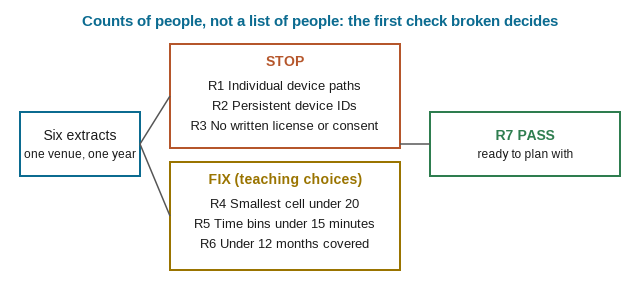
The steps
- Ask for zone counts, never device paths or persistent IDs. The extract should say how many people were in Hall A, Hall B, the lobby or an entrance during each time bin. If it follows single devices or carries a device ID that stays the same across days, send it back.
- Confirm the written license or consent basis. Get the document that says the venue or provider may share this data with you for planning. No document, no use. Ask counsel to read it.
- Suppress small cells. Any zone-and-time cell with fewer than 20 people gets merged with a neighbor or removed. The 20 is our teaching choice, not a legal standard.
- Use time bins of 15 minutes or more. Finer bins add detail that aisle and desk planning rarely needs. The 15-minute floor is our teaching choice.
- Cover a full year of events. Ask for 12 months, so every show the venue hosted is in the counts, not just one busy week. The 12-month floor is also a teaching choice.
Try it now: open the venue crowd flow review, load Case E, then work out why Invented Extract A stops on R1 even though it also lacks a license.
Reading the result
With clean extracts, Corwin looks for the busiest zone-hours, entrances that idle through the morning and halls where people linger. Those answers move registration desks, widen aisles near the jam points and put signage where the counts say people actually arrive.
Check your work
Each extract meets the checks top to bottom; whichever it fails first decides. The baseline is zone counts, no IDs, license on file, smallest cell 50, 60-minute bins and 12 months.
- A, clean set: 0 STOP, 0 FIX, 6 PASS.
- B, hard stops: device paths on B, persistent IDs on D, no license on F: 3 STOP, 0 FIX, 3 PASS.
- C, cells and bins: a smallest cell of 8 on A and 5-minute bins on C: 0 STOP, 2 FIX, 4 PASS.
- D, coverage: six months on E; on F, a smallest cell of 12 with 1-minute bins, where the cell rule wins: 0 STOP, 2 FIX, 4 PASS.
- E, stacked problems: A has paths, IDs and no license and stops on paths first; C stops on IDs; D stops on the license; E’s small cell sets its FIX: 3 STOP, 1 FIX, 2 PASS.
- F, edges: a cell of 20, a 15-minute bin and 12 months each pass; 19, 14 and 11 are each FIX: 0 STOP, 3 FIX, 3 PASS.
Common mistakes
- Accepting a “heat map” without asking whether it was built from single-device traces.
- Treating a hashed device ID as if it were no ID at all.
- Assuming the venue’s license covers your use without reading it.
- Planning from one busy show week instead of the full year.
Limits
Counts describe past events, not next year’s crowd. Venue layouts and show schedules change. The lab’s thresholds are teaching choices, not law or a standard, and neither source sets rules for venue data. Ask counsel about the license before any extract is loaded.