

Tutorial
Human-Gated Outbound to Teaming Partners and Show Prospects, Inside CAN-SPAM
A practical way for defense and space marketing teams to reach teaming partners and trade-show prospects by email: a short list built from sources you can name, one drafted message per contact, a named person who approves each one, and the CAN-SPAM basics checked before anything goes out.
Time needed: About three hours to set up, then half an hour a week
Before you start:
- A spreadsheet of past teaming partners, exhibitors or show contacts your company legitimately holds
- One named person who reads and approves every outgoing message
- Your company's valid physical postal address for the email footer
- Your current suppression list (everyone who has asked not to be emailed)
Sponsorship Trade Shows Opt Out Compliance Ftc Defense Space
By the end of this guide you’ll have a small outbound routine for teaming partners and show prospects. It runs on a hand-built list, one drafted email per contact, a named reviewer who approves each message, and a footer that covers the CAN-SPAM basics.
Most defense and space marketing teams have no sales development desk, so outreach happens in bursts. A repeatable routine keeps it steady and keeps your name off a complaint.
Illustrative example: “Kestrel Ridge Avionics,” its reviewer and every prospect named here are invented. No real company or person is described.
Step 1: Describe the partner who already says yes
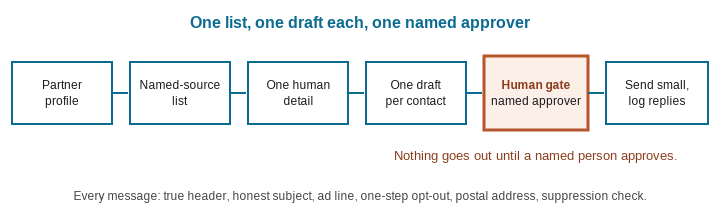
Look at recent teaming agreements or show meetings that went somewhere, and write one paragraph about that company: segment, size, and what it wanted from you. Kestrel Ridge’s version reads: “Small-sat primes and subsystem suppliers with 50 to 500 staff who need avionics test capacity and have met us at a show or on a past bid.”
Get your business development lead to sign off.
Step 2: Build the list from sources you can name
- Make one row per prospect: company, contact, title, email, source and one human detail.
- Fill it from sources you can name: your past teaming and exhibitor lists, business cards exchanged at shows, and public company pages, typed by hand.
- Write the source on every row.
Don’t buy a list or scrape addresses. Section 7704(b) makes a violation worse if the message went to addresses scraped by automated means from a website that promised not to share them, or to addresses made by combining names, letters or numbers. A bought list may well contain addresses like these. Separately, 18 U.S.C. § 1037 is a criminal statute covering email fraud.
Step 3: Add one detail a person noticed
For each row, add one sentence a person actually noticed, such as “Posted a teaming call for an RF subsystem” or “Spoke on small-sat supply chains at our user day.” If you have none, leave it blank; the gate will catch it.
Step 4: Draft one message per contact
Use an AI drafting tool your IT policy allows. Give it the profile, the human detail and one specific ask, such as a 15-minute call. Ask for a few sentences per prospect, never one blast for the whole list. The email’s job is to start a conversation.
Write the footer once and reuse it. It holds your postal address and an opt-out line that takes one step, for example “reply REMOVE to this address.”
Step 5: Put a named person at the gate
Every message gets read before it goes. The reviewer checks three things:
- Is the human detail right?
- Is there one specific ask?
- Would we be comfortable if this was forwarded to our CEO?
Fix the draft or drop the row. Then the reviewer puts their name and the date on the row. If anyone edits the message after that, it needs approval again.
Try it now: the outreach gate opens with five invented prospect rows for an invented avionics company. Edit a draft and it checks the header, subject, ad line, opt-out and postal address against CAN-SPAM, checks the contact against a suppression list, and marks nothing ready until a named person approves. It doesn’t send any email and is not legal advice.
Step 6: Send small and log replies
Send ten to fifteen a week from a real person’s work address. Add columns for date sent, reply, reply date and next step. Screening a whole list at once is a different job. For that, use the send-list checker.
Step 7: Check the CAN-SPAM basics on every message
The statute is 15 U.S.C. chapter 103, with the FTC’s rule at 16 CFR part 316. Violations carry civil penalties, and the FTC adjusts its maximum amounts for inflation. For a commercial message, confirm:
- The From and Reply-To lines name who is really sending, and the subject says what’s inside. No “RE:” on a first message.
- The message says clearly that it’s an advertisement or solicitation.
- It gives a working way to opt out. Under 16 CFR 316.5, opting out can’t require a fee, extra information or more than a reply or a single web page.
- It includes a valid physical postal address. The rule defines that as a current street address or a properly registered PO Box or private mailbox.
- Opt-outs are honored promptly. Section 7704(a)(4) bars sending “more than 10 business days after the receipt of such request.” A stricter house rule, stopping at once, is simpler.
- Opt-out addresses are never sold or passed on.
Messages that only complete a deal the recipient already agreed to count as transactional under section 7702. The rule against misleading headers still applies to them.
Verify the routine after a month
- Did every message carry a reviewer’s name?
- Was every opt-out honored and added to the suppression list?
- Did every row have a named source?
- Do the reply rates suggest the Step 1 profile needs adjusting?
If any compliance answer is no, pause sending and fix that first.
Mistakes that end programs
- Buying a list. You get volume fast, along with bounces, complaints and possible harvested addresses.
- Automating the send. One wrong detail, repeated fifty times, tells every recipient how the email was made.
- Asking for the contract in email one. Ask for a conversation first.
A how-to built from the CAN-SPAM statute, the FTC’s rule and one AssociationAI guide, using an invented avionics firm. It isn’t legal advice. Run your footer and opt-out process past counsel before the first send.
Sources
- 15 U.S.C. chapter 103, CAN-SPAM Act of 2003 (Cornell LII)
- 18 U.S.C. § 1037, Fraud and related activity in connection with electronic mail (Cornell LII)
- Federal Trade Commission, "FTC Publishes Inflation-Adjusted Civil Penalty Amounts for 2025" (February 2025)
- 16 CFR part 316, CAN-SPAM Rule (eCFR)
- 15 U.S.C. 7704, Other protection for users of commercial electronic mail (govinfo, U.S. Code 2023 edition)
- 15 U.S.C. 7702, Definitions (govinfo, U.S. Code 2023 edition)
- Adapted from AssociationAI.ai, "Automate Outbound Sponsor Outreach Without Becoming Spam"